
A missing flash of light revealed a molecular secret
Liquids and solutions may seem simple, but at the molecular level they are constantly in motion. When sugar dissolves
Liquids and solutions may seem simple, but at the molecular level they are constantly in motion. When sugar dissolves in water, for example, each sugar molecule is quickly surrounded by shifting clusters of water molecules. Inside living cells, the situation becomes even more intricate. Tiny liquid droplets ferry proteins or RNA and help organize many of the cell’s chemical reactions.
Despite their central role in biology and chemistry, liquids have long resisted close inspection. Unlike solids, they have no fixed structure, and the most important interactions between dissolved molecules and their surroundings happen at extreme speeds. These ultrafast events, where chemistry truly unfolds, have largely remained out of reach for scientists.
A New Way to See Ultrafast Chemistry in Liquids
Researchers from Ohio State University and Louisiana State University have now demonstrated that high-harmonic spectroscopy (HHS) can expose hidden molecular structures inside liquids. This nonlinear optical technique is capable of tracking electron motion on attosecond timescales. The work, published in PNAS, shows that HHS can directly probe solute-solvent interactions in liquid solutions, something that had not been possible before.
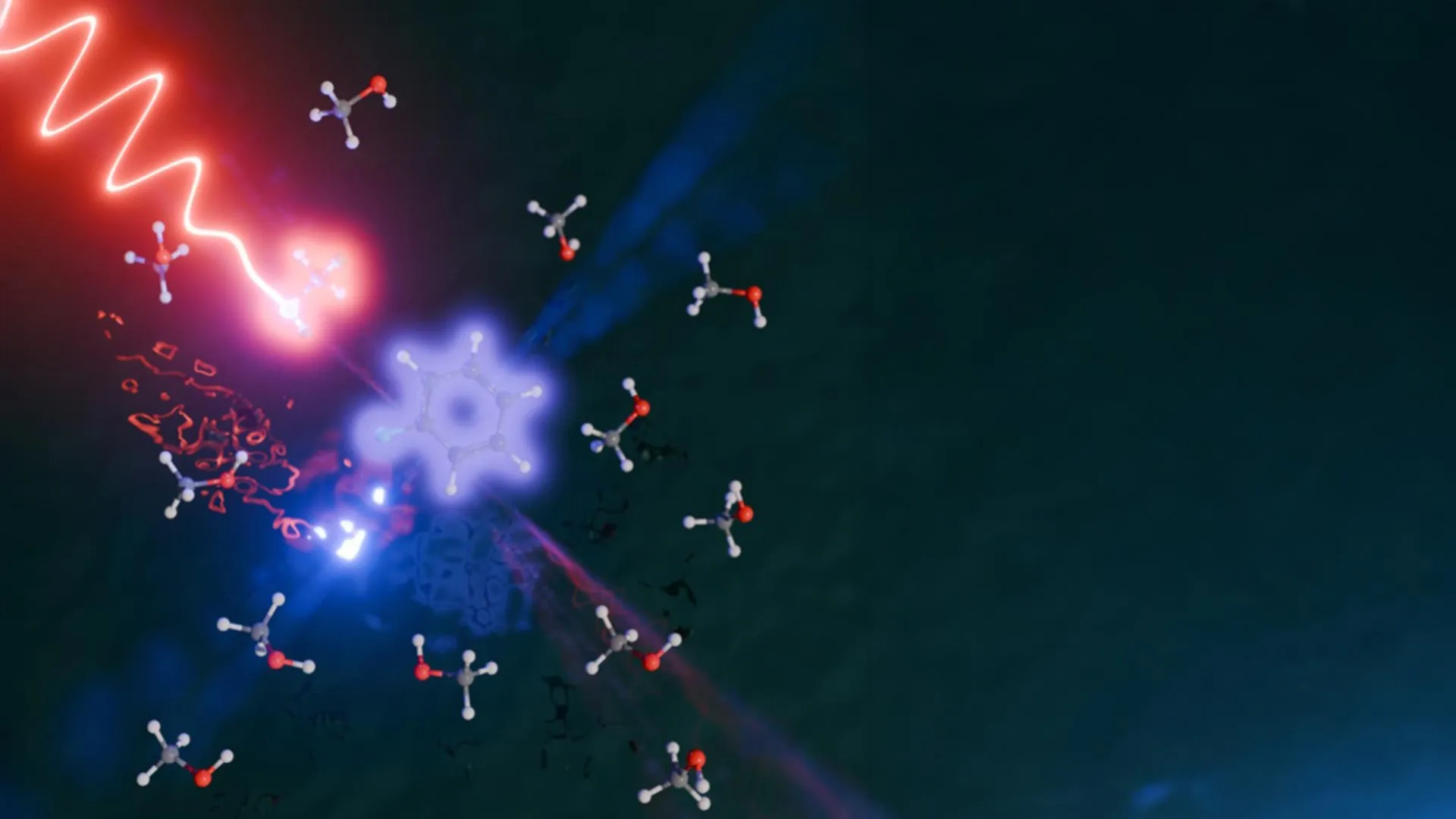
HHS uses extremely short laser pulses to momentarily pull electrons away from molecules. When those electrons snap back, they emit light that carries detailed information about how electrons and even atomic nuclei move. These snapshots occur on timescales far faster than conventional methods can resolve. Traditional optical spectroscopy has been widely used to study liquids because it is gentle and easy to interpret, but it operates much more slowly. HHS, on the other hand, reaches into the extreme-ultraviolet range and can resolve events lasting just an attosecond, a billionth of a billionth of a second.
Overcoming the Challenges of Studying Liquids
Until now, HHS experiments were mostly limited to gases and solids, where conditions are easier to control. Liquids present two major obstacles. They absorb much of the harmonic light that is produced, and their constantly moving molecules make the resulting signals difficult to analyze.
To address these issues, the OSU-LSU team developed an ultrathin liquid “sheet” that allows more of the emitted light to escape. Using this approach, they showed for the first time that HHS can capture rapid molecular dynamics and subtle structural changes in liquids.
A Surprising Result from Simple Liquid Mixtures
With this new setup, the researchers tested how HHS behaves in straightforward liquid mixtures. They shined intense mid-infrared laser light on methanol combined with small amounts of halobenzenes. These molecules are nearly identical, differing only by a single atom: fluorine, chlorine, bromine, or iodine. Halobenzenes produce strong harmonic signals that stand out clearly, while methanol provides a relatively clean background. The expectation was that even when present in low concentrations, the halobenzene signal would dominate.
In most cases, that is exactly what happened. The harmonic emission looked like a simple blend of the two liquids. Fluorobenzene (PhF), however, stood out immediately. “We were really surprised to see that the PhF-methanol solution gave completely different results from the other solutions,” said Lou DiMauro, Edward E. and Sylvia Hagenlocker Professor of Physics at OSU. “Not only was the mixture-yield much lower than for each liquid on its own, we also found that one harmonic was completely suppressed.” He added that “such a deep suppression was a clear sign of destructive interference, and it had to be caused by something near the emitters.”
In practical terms, the PhF-methanol mixture produced less light than either liquid by itself, and one specific harmonic disappeared entirely. It was as if a single note in the light spectrum had been silenced. This kind of selective loss is extremely rare and pointed to a very specific molecular interaction interfering with the electrons’ motion.
Simulations Reveal a Molecular Handshake
To understand what was happening, the OSU theory team carried out large-scale molecular dynamics simulations. John Herbert, professor of chemistry and leader of the theory effort, explained: “We found that the PhF-methanol mixture is subtly different from the others. The electronegativity of the F atom promotes a ‘molecular handshake’ (or hydrogen bond) with the O-H end of methanol, whereas in other mixtures the distribution of the PhX molecules is more random.” In short, fluorobenzene forms a more organized solvation structure than the other halobenzenes.
The LSU theory group then investigated whether this arrangement could explain the experimental results. Mette Gaarde, Boyd Professor of Physics, said: “We speculated that the electron density around the F atoms was providing an extra barrier for the accelerating electrons to scatter on, and that this would disturb the harmonic generation process.” Using a model based on the time-dependent Schrödinger equation, the researchers confirmed that such a scattering barrier could account for both the missing harmonic and the reduced overall light output. “We also learned that the suppression was very sensitive to the location of the barrier — this means that the detail of the harmonic suppression carries information about the local structure that was formed during the solvation process,” added Sucharita Giri, postdoctoral researcher at LSU.
“We were excited to be able to combine results from experiment and theory, across physics, chemistry, and optics, to learn something new about electron dynamics in the complex liquid environment.”
Mette Gaarde, LSU Boyd Professor of Physics
Why This Discovery Matters
Although more work is needed to fully explore what HHS can reveal in liquids, the early results are encouraging. Many of the most important chemical and biological processes take place in liquid environments. The energies of the electrons involved are also similar to those responsible for radiation damage. Gaining a clearer picture of how electrons scatter in dense liquids could therefore have broad implications for chemistry, biology, and materials science.
As DiMauro noted, “Our results demonstrate that solution-phase high-harmonic generation can be sensitive to the particular solute-solvent interactions and therefore to the local liquid environment. We are excited for the future of this field.” Researchers expect that continued advances in experiments and simulations will expand the use of this technique and provide increasingly detailed views of how liquids respond to ultrafast laser pulses.
Key contributors to this work include Eric Moore, Andreas Koutsogiannis, Tahereh Alavi, and Greg McCracken from OSU; and Kenneth Lopata from LSU. This study was funded by the DOE Office of Science, Basic Energy Sciences, and by the National Science Foundation.