


World is entering an era of ‘water bankruptcy’
Drought in Iran has left little water in the Latyan Dam near Tehran BAHRAM/Middle East Images/AFP via Getty Images
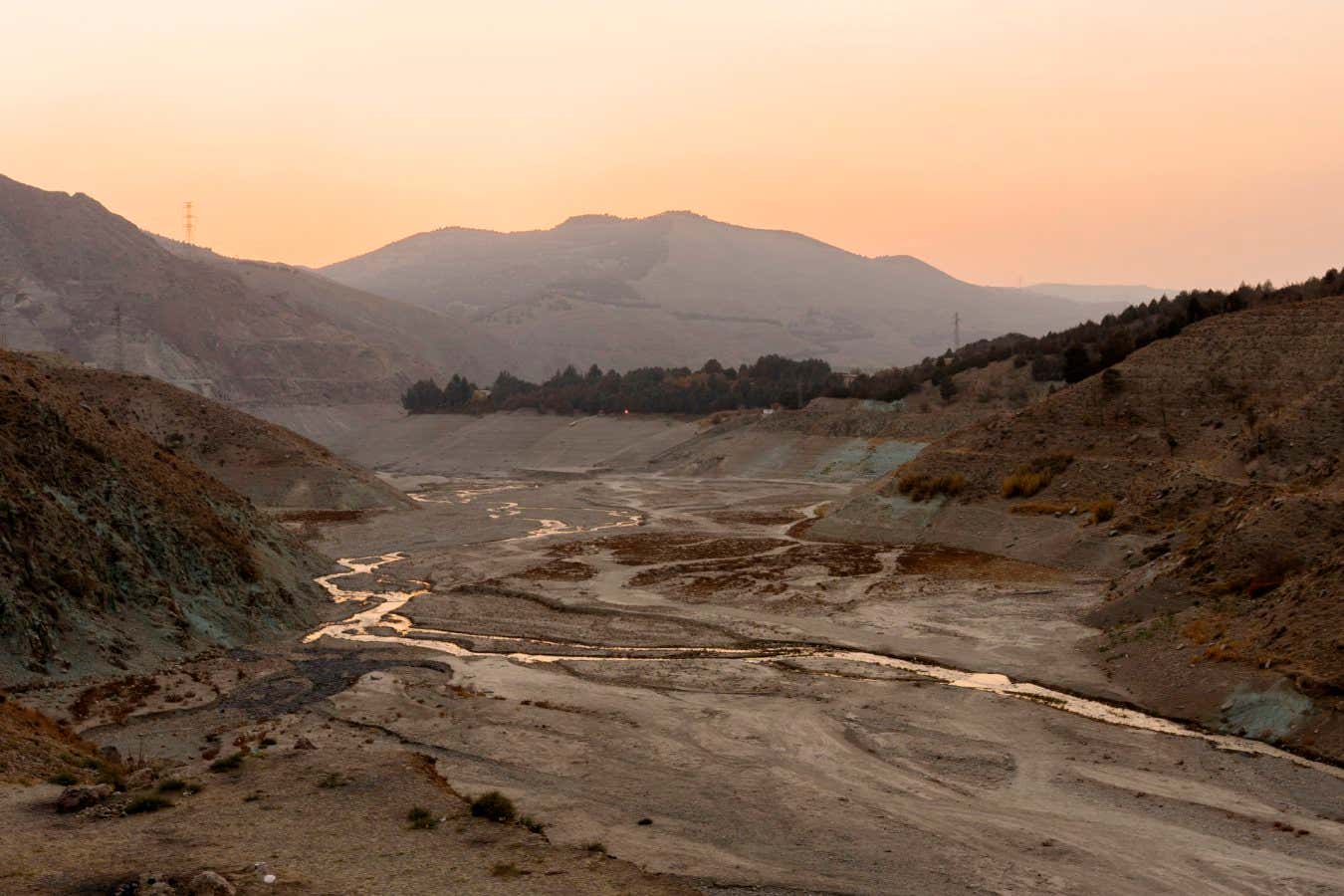
Drought in Iran has left little water in the Latyan Dam near Tehran
BAHRAM/Middle East Images/AFP via Getty Images
Earth has entered an “era of water bankruptcy” due to over-consumption and global warming, with 3 in 4 people living in countries that face water shortages, water contamination or drought.
That’s the conclusion of a United Nations report that has found most regions are overdrawing their annual income of rainwater and snowmelt and dipping into their savings of groundwater, which can take thousands of years to replenish. Seventy per cent of major aquifers are declining. Many of these changes are irreversible.
Two key drivers are agriculture and cities expanding into arid areas, which are getting even drier due to climate change. Almost 700 sinkholes have appeared in Turkey due to groundwater pumping, while dust storms from desertification have killed hundreds in Beijing.
“Our checking account, the surface water… is now empty,” says the report’s author, Kaveh Madani at the UN University Institute for Water, Environment and Health. “The savings account that we inherited from our ancestors, the groundwater, glaciers and so on … they’re also drained now. We are seeing symptoms around the world … of water bankruptcy.”
About 4 billion people experience water scarcity at least one month a year, fuelling migration, conflicts and unrest. Madani, who was formerly deputy head of Iran’s Department of Environment, says water shortages contributed to the recent bloody protests there, although a currency collapse was the immediate trigger.
Iran had its driest autumn in 50 years, while a rash of dams and wells for farming have almost completely dried up Lake Urmia – once the largest lake in the Middle East – and depleted most of the country’s groundwater. The government has mooted evacuating Tehran and is trying to induce rainfall through cloud seeding.
In the US, the flow of the Colorado river, which provides water to much of the West, has decreased by an estimated 20 per cent over 20 years, due largely to lower precipitation and increased evaporation. But it is also being overly diverted to grow feed for beef and dairy cattle, all while cities like Los Angeles rely on it for drinking water. As with a rising number of rivers, it no longer reaches the sea.
The river’s two major reservoirs are at about 30 per cent capacity and could reach “dead pool” levels at 10 to 15 per cent of capacity as soon as 2027, according to Bradley Udall at Colorado State University. Talks over how much each state would reduce consumption broke down last year.
Increasing agricultural water efficiency has been shown to only increase water use, since drip or sprinkler irrigation allows water to be gradually absorbed by plants, whereas the flooding of fields results in more water running back into the river. So it needs to be coupled with cuts in water consumption, according to Udall.
“The solution is going to have to come from agriculture primarily because they use 70 per cent of the water,” he says. “Ag cutbacks, that’s what we’re talking about, and that’s true worldwide.”
Half of all food production is in areas with declining water storage. But reducing agriculture’s water use will also require economic diversification, since it is the livelihood of more than 1 billion people. Most of them are in lower-income countries, which often export food to the service economies of higher-income nations.
“Water plays a major role in economies… because it puts people [in] jobs,” says Madani. “If they lose their jobs, what happens is what you see in Iran today.”
Even in rainy places, more water is being sucked up by data centres or polluted by industry, sewage, fertilisers or manure. Wetlands covering an area the size of the European Union have been lost, mostly due to conversion to agriculture, costing the world an estimated $5.1 trillion in ecosystem services like flood buffering, food production and carbon storage.
In Bangladesh, about half the country has well water that is contaminated by arsenic due to sea level rise and saltwater intrusion. Meanwhile, the tap water and the “dead river” in the capital Dhaka have been poisoned by chemicals from the production of fast fashion for sale in Europe and North America.
“Every person knows that the rivers are being polluted because of the garment industry,” says Sonia Hoque at the University of Oxford. “But they know that stringent regulation, if applied, would… scare away the buyers.”
In many cases, rivers, lakes, wetlands and aquifers will never return to their previous state. Moreover, many glaciers have melted, shrinking water supplies to hundreds of millions of people.
Humanity will have to learn to live with less water, according to Madani. With better water management, that’s possible. First, however, most countries need to simply start accounting for their water sources and consumption, starting with water meters in homes, wells and diversion canals.
“You’re thinking about launching a [cloud-seeding] rocket to get water, but you don’t even know how much water you have in your system,” says Madani. “We cannot manage what we do not measure.”
Topics: