

US shipyard HII expands in UK to service growing Europe UUV business
PARIS – Huntington Ingalls Industries has doubled the footprint of its site on the south coast of England as
PARIS – Huntington Ingalls Industries has doubled the footprint of its site on the south coast of England as the American shipbuilder seeks to service its growing business of unmanned underwater vehicles for the United Kingdom’s Royal Navy and other navies in western and northern Europe.
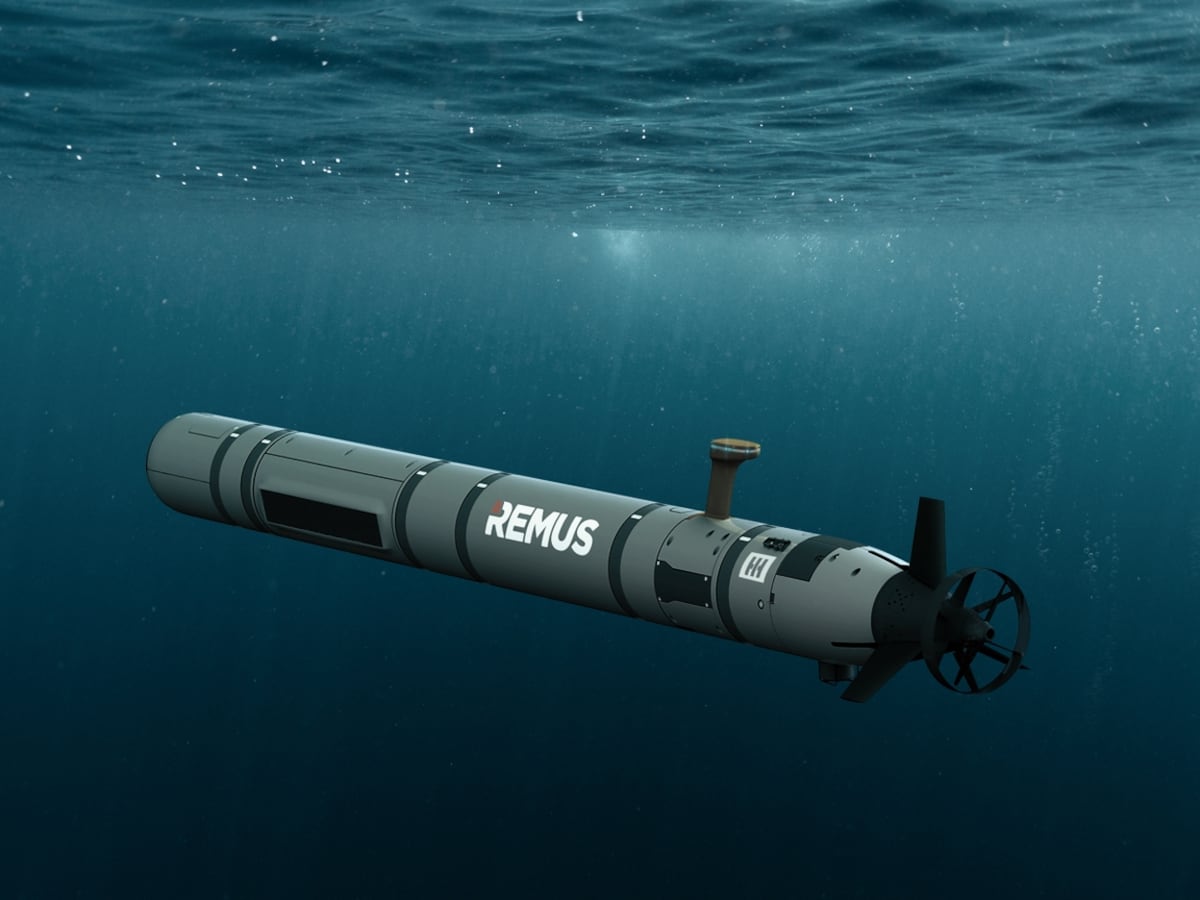
The enlarged HII site in Portchester, England, will now be able to assemble the company’s Remus 620 medium-class modular UUV, and allow the company to increase the pace of training for allied navies, Nick Green, the manager in charge of the facility, said in a Jan. 12 briefing with reporters.
Growing technological maturity means navies are now comfortable placing bigger UUV orders of 10 or 15 systems, compared to orders for one or two units in the past, according to Green. European NATO members including the U.K., the Netherlands and Belgium, are replacing traditional crewed minehunter vessels with a range of unmanned vehicles to detect and neutralize sea mines.
“The demand is there, the requirements are there as the technology is improving, the sensors are improving and the capabilities are improving, and ultimately that will see an increase in the market space,” Green said.
The Royal Navy acquired its first two Remus vehicles in 2001 for mine warfare, and now operates a mixed fleet of models in that role, and Green said the new facility will help HII fulfill its maintenance contract for the Royal Navy.
The company says its Remus systems are in use with 30 countries, including 14 NATO members. Beyond the U.K., European users include Germany, the Netherlands, Belgium, Norway, Sweden, Lithuania and Estonia.
HII continues to see “robust interest” in the area of mine countermeasures, while increased defense budgets and a focus on investing in unmanned systems will drive unit sales more broadly, said Duane Fotheringham, president of the Unmanned Systems group in HII’s Mission Technologies division, in the briefing.
While competition has increased in UUVs, “it’s something we’re well prepared for,” according to Fotheringham. He said the open architecture of the Remus drones and their modularity allows software and hardware to be updated, with partners providing the sensors or payloads. “We’ve been building vehicles for a long time, and those vehicles have stood the test of time.”
While countering mines is the main use case for U.K. and European clients, the ability for long-range patrol will be relevant for changing seabed-warfare requirements such as protection of critical infrastructure, according to Green. “The payloads that we are developing and putting onto these vehicles at this time allow sort of a future capability coverage,” Green said.
The plan is for some level of U.K. production “where possible,” including on launch and recovery systems for the Remus 620 as well as basic-level assembly of the vehicles themselves, according to Green.
“The intent is to try and put more emphasis onto what we can do within the U.K., as we believe that U.K. content for U.K. contracts is more and more important, and a big part of what we can offer as a mature UUV-USV supplier,” Green said.
The company has been testing torpedo-tube launch and recovery of the Remus 620, and in the U.K. is working with Babcock on that capability, with the British partner’s launch and recovery technology used on the Royal Navy’s submarines.
Almost all repair and maintenance work for U.K. customers as well as many European customers is done on Portchester, and the company seeks to avoid moving equipment between the U.S. and Europe, accordinng to Fortheringham.
HII has delivered more than 750 UUVs in the Remus family, including a “significant number” across Europe, according to Fotheringham. The company says the two-man portable Remus 100 is its most popular model with more than 400 units sold worldwide.
Portchester will also provide a European support base for the planned Romulus family of unmanned surface vehicles, according to Fotheringham.
HII has been testing an intelligence, surveillance and reconnaissance version of a Romulus platform as well as a man-portable Romulus in the United States, Fotheringham said. The company is building a 190-feet Romulus that it intends to have on the water and ready for delivery by the end of 2026, according to the executive.
The intent is to bring Romulus systems over to this side of the Atlantic to demonstrate them to the Royal Navy and HII’s other European naval customers, according to Green.
Rudy Ruitenberg is a Europe correspondent for Defense News. He started his career at Bloomberg News and has experience reporting on technology, commodity markets and politics.