


US Air Force needs 500 next-gen fighters, bombers to beat China, think tank says
The U.S. Air Force must buy at least 500 sixth-generation fighters and bombers — more than it already plans
The U.S. Air Force must buy at least 500 sixth-generation fighters and bombers — more than it already plans — to be able to prevail in a war against China, the Mitchell Institute for Aerospace Studies said Monday.
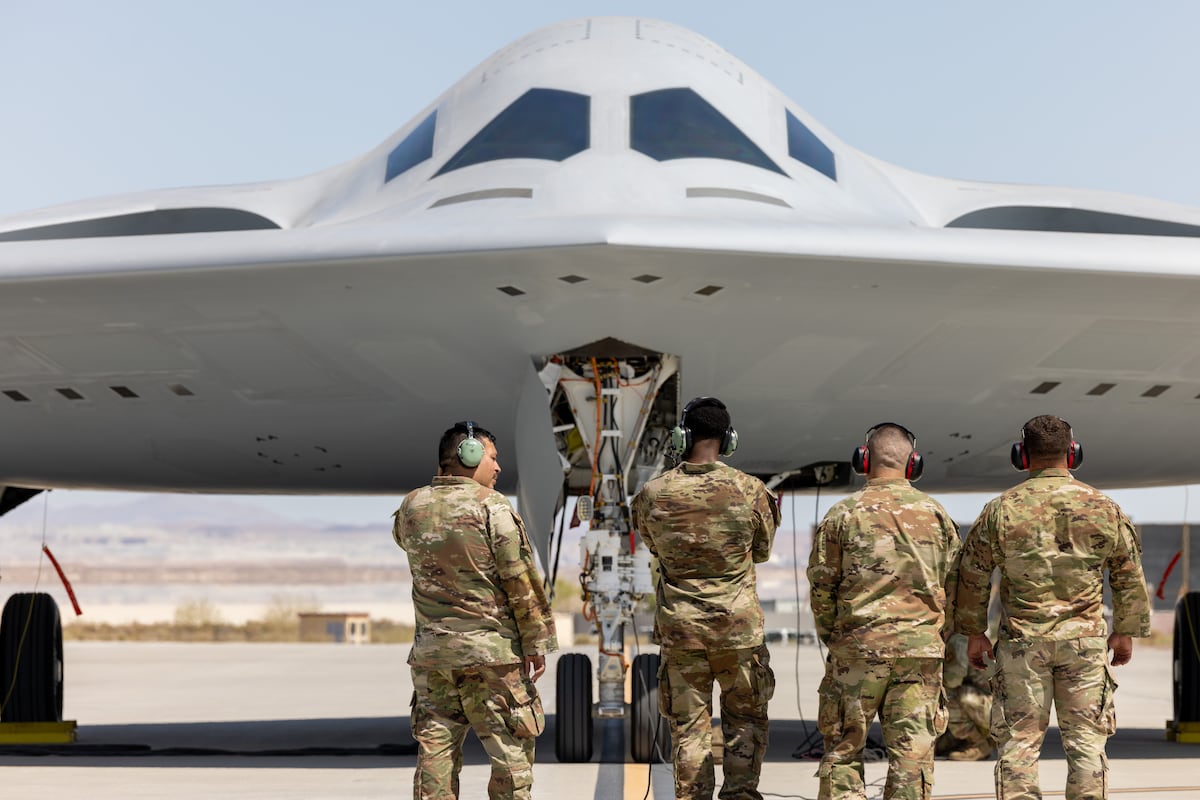
In its policy paper, “Strategic Attack: Maintaining the Air Force’s Capacity to Deny Enemy Sanctuaries,” experts from the Mitchell Institute argue that the Air Force needs at least 300 next-generation F-47 fighters and at least 200 B-21 Raider stealth bombers to counter China. The Air Force has previously signaled it plans to buy at least 185 F-47s from Boeing and at least 100 Northrop Grumman-made B-21s.
In an online discussion about the paper, former F-16 pilot and Mitchell Institute director of research Heather Penney warned that past U.S. wars such as Korea and Vietnam, and Ukraine’s current war against Russia’s invasion, have showed that militaries who can’t or won’t hit enemy bases and other sanctuaries from the air risk falling into grueling wars of attrition, akin to trench warfare.
And without a significantly boosted combat fleet able to project long-range air power in force, Penney said, the United States could find itself in a similar danger against China.
“China is deliberately building the capabilities and the posture to effectively make the entire western Pacific their sanctuary,” Penney said. “But we know from history that allowing an adversary that kind of sanctuary allows them to win, and it’s a recipe for our own defeat.”
The Air Force has carried out recent strike operations such as Midnight Hammer, which bombed Iran’s nuclear sites, exceptionally well.
But Midnight Hammer employed the service’s entire fleet of available B-2 Spirit stealth bombers, Penney said, some in the strike portion of the operation and some as decoys. And if Iran shot down any of those B-2s, Penney said, the Air Force couldn’t replace them — nor could the Air Force carry out a similar mission the next day if a second strike was needed.
And if the U.S. found itself in a conflict with China or other major regional power, Penney said, the Air Force would have to deal with a threat far more dangerous than Iran, with significantly better air defenses. Without a great enough combat aircraft reserve, Penney said, the Air Force might have to stay outside China’s air defenses and refrain from more daring strikes to avoid losing irreplaceable planes — but a conservative strategy like that might not be enough to win, or deter China from a first strike against Taiwan.
“The inability to hold [Chinese] targets at risk really provides a singular reward to a first mover, to an aggressor,” Penney said. “So if China doesn’t see any risk to their homeland, to their population, to their infrastructure, they can afford to lose some of those assets on the edge, because they know that they can hold us at bay. So it really erodes our ability to keep them from taking that kind of aggressive action.”
Penney and the Mitchell Institute argued that the Air Force also must take interim steps to maintain its combat airpower until the B-21 and F-47 come online in significant numbers.
That means refraining from retiring any legacy B-1 Lancer or B-2 bombers until the Air Force has at least 100 B-21s on hand, the Mitchell Institute report said. And the institute called for Congress and the Pentagon to provide the Air Force enough funding to speed up the acquisition of the B-21.
And the Air Force needs to boost its procurement of the fifth-generation F-35A Joint Strike Fighter, the F-15EX Eagle II and autonomous drone wingmen the service calls collaborative combat aircraft, Penney said.
This means buying 74 F-35As and 24 F-15EXs each year to start to turn around decades of cuts to the force, she said.
“The Air Force must reverse its fighter crisis and procure F-35s and F-15EXs at maximum rates: No more ‘divest to invest,’” Penney said, referring to an Air Force strategy of retiring older air frames to free up funds to develop new aircraft. “The Air Force must recapitalize its fighters with at least a one-for-one rate [replacing each retired jet with a newly procured tail], while also augmenting its force with collaborative combat aircraft.”
The Mitchell Institute also argues that the Air Force should have a bomber force of at least 300 aircraft. With 76 Cold War-era B-52 Stratofortresses in the Air Force’s fleet and slated for massive upgrades, that would mean the Air Force would have to buy at least 224 B-21s to meet Mitchell’s goal. The Air Force is planning to retire all B-1s and B-2s in the next decade and fly a two-bomber fleet.
Stephen Losey is the air warfare reporter for Defense News. He previously covered leadership and personnel issues at Air Force Times, and the Pentagon, special operations and air warfare at Military.com. He has traveled to the Middle East to cover U.S. Air Force operations.