

Trump’s Moves on Greenland – The New York Times
‘A place called Greenland’ Greenland has loomed large this week at the World Economic Forum in Davos. Long before
‘A place called Greenland’
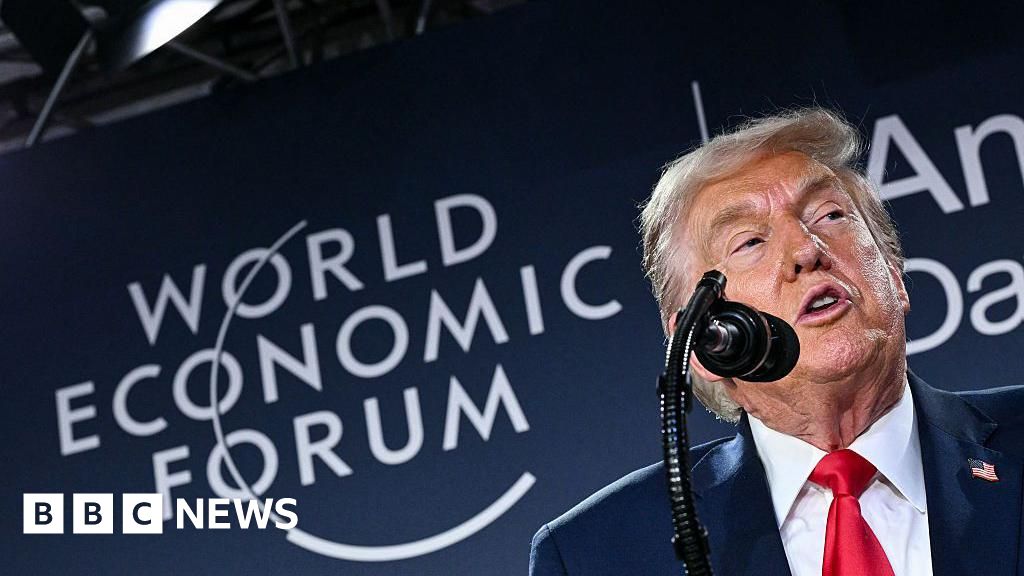
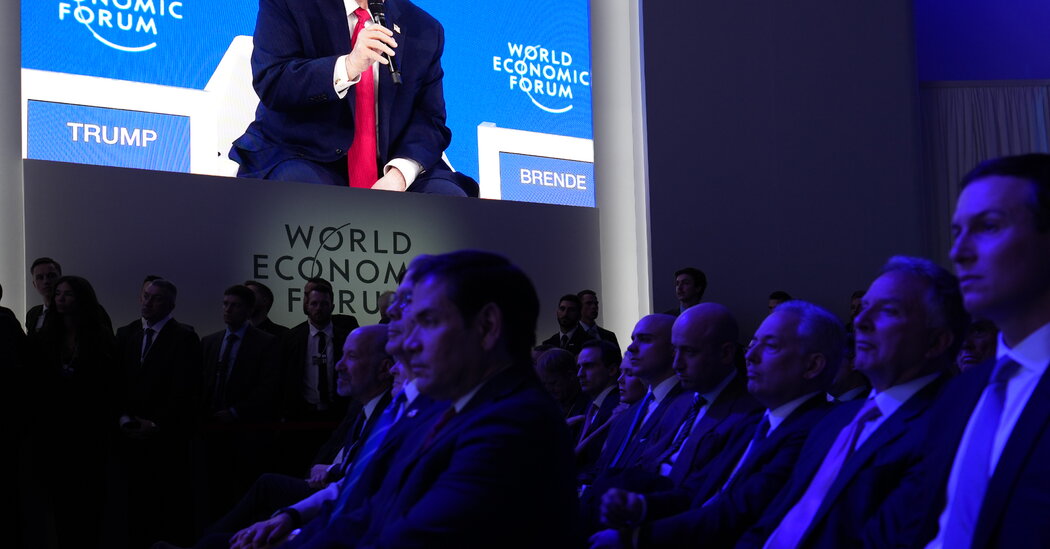
Greenland has loomed large this week at the World Economic Forum in Davos. Long before Trump arrived, it was all anyone wanted to talk about. While waiting in line for the many security checks. In the corridors of the sprawling conference center. At the bar after hours.
In the ladies’ room, I stumbled across a group of French diplomats touching up their makeup while listing ways Europeans could retaliate. A session titled “Can Europe Defend Itself?” was wildly oversubscribed.
When Trump finally took the main stage yesterday, looking out over an auditorium packed with hundreds of elected and business leaders, he knew exactly what everyone was there to hear.
“Would you like me to say a few words about Greenland?” he asked. There were a few scattered chuckles. But as my colleague Zolan Kanno-Youngs reported, they quickly turned into an anxious silence, punctuated by audible gasps, as Trump lashed out at NATO allies and threatened economic warfare if the United States did not obtain the Arctic territory.
‘We will remember’
Trump said he was seeking “immediate negotiations” to take over Greenland. But despite growing fears of U.S. military action, he ruled out seizing the island by force.
“We probably won’t get anything unless I decide to use excessive strength and force where we would be, frankly, unstoppable,” he said. “But I won’t do that. That’s probably the biggest statement, because people thought I would use force. I don’t have to use force. I don’t want to use force. I won’t use force.”
He added: “All the United States is asking for is a place called Greenland.”
The speech was cautiously welcomed by some European leaders.
“I think we’ve heard a lot worse,” Rasmus Jarlov, the chairman of the defense committee in Denmark’s Parliament, told my colleague Michael Schwirtz. “I’m glad he’s ruling out military force.”
But the speech still came with a strong undercurrent of “or else.”
Europeans “have a choice,” Trump said. “You can say yes, and we will be very appreciative, or you can say no. We will remember.”
A plot twist
Even as Trump seemed to take military action off the table, his threat of economic warfare seemed clear.
Over the weekend, he had announced plans for steep new tariffs on a bloc of European countries to coerce them to the negotiating table to discuss Greenland.
In his speech, he reinforced that message. But several hours later, there was yet another twist.
In a Truth Social post, Trump said that he had met with Mark Rutte, the secretary general of NATO, who has a history of flattering the U.S. president. (Last year, Rutte joked that Trump acted as a “daddy” to misbehaving Middle Eastern nations.)
After the “very productive” meeting with Rutte, Trump said, “we have formed the framework of a future deal with respect to Greenland and, in fact, the entire Arctic Region.”
“Based upon this understanding, I will not be imposing the Tariffs that were scheduled to go into effect on February 1st,” he added. Further details were not available.
So where does that leave things? The status of negotiations over Greenland is still uncertain.
A day earlier, Prime Minister Mark Carney of Canada received a standing ovation when he declared that the world order had undergone “a rupture.”
Carney’s view is widely shared here. Whatever happens with Greenland, the world feels like it’s in uncharted territory.
More on Trump and Greenland
MORE TOP NEWS
U.S. starts moving ISIS detainees out of Syria
The U.S. announced yesterday that it had moved 150 Islamic State fighters from a detention facility in northeastern Syria to Iraq and that it might eventually move up to 7,000 more.
The transfer followed concerns that thousands of former ISIS fighters and their family members could escape from detention as the Syrian government and Kurdish-led forces vie for control of the area. The 150 fighters were taken to an unspecified “secure location in Iraq,” the U.S. Central Command said.
The Kurdish-led militia known as the Syrian Democratic Forces, or S.D.F., agreed on Sunday to hand over control of the prisons to the Syrian government. The transition has been rocky. In recent days, detainees escaped from at least one prison amid skirmishes. Chaos appeared to break out after S.D.F. forces abruptly withdrew from the Al Hol detention camp, which houses tens of thousands of family members of ISIS fighters.
The S.D.F. was the U.S.’s closest ally in Syria for more than a decade. That alliance is now disintegrating as the U.S. throws its weight behind the new Syrian government.
OTHER NEWS
— When Veronika, a 13-year-old cow in Austria, has an itch, she scratches it by expertly wielding a stick. Researchers say it’s the first scientifically documented case of tool use by cattle.
The Ocean Flower Island real estate project in Hainan Province, China, was supposed to rival Palm Island Jumeirah in Dubai. Instead, it’s a $12 billion “dead zone,” as one visitor put it.
The artificial island has a gigantic shopping mall without shops, a theme park without visitors, high-rise housing blocks without residents and beaches too dangerous for swimming. My colleagues paid a visit to the project, a symbol of China’s never-ending real estate crisis.
What’s curdling business … in Vermont
It was the cheese that drew Canadian customers across the U.S. border to Willey’s Store in Greensboro, Vermont. Alongside Americans, they shopped for Withersbrook Blue, a recent winner at the World Cheese Awards, and creamy Harbison, which has woodsy notes derived from its spruce-bark wrapping.
But recently, Trump’s threats and tariffs have driven many Canadians away. Willey’s Store sales declined by 33 percent last year, and the entire town is struggling. Read more.
RECOMMENDATIONS
Train: If lifting weights intimidates you, get strong with a medicine ball.
Read: In the novel “Tangerinn,” an Italian Moroccan woman examines her family’s legacy of immigration.
Watch: Here are seven under-the-radar movies streaming right now.
In Switzerland, rosti (pronounced roosh-ti) is considered a national dish, and it’s most popular in the country’s German-speaking regions. Traditionally, rosti is made from grated potatoes and fried in a skillet. Our dressed-up version is served with smoked salmon, sour cream and a poached egg. It’s perfect for a weekend breakfast.