Trump drops threats of tariffs on Nato allies over Greenland
Bernd Debusmann JrWhite House reporter Watch: The BBC’s Faisal Islam on how Trump’s Davos speech received President Donald Trump
Bernd Debusmann JrWhite House reporter
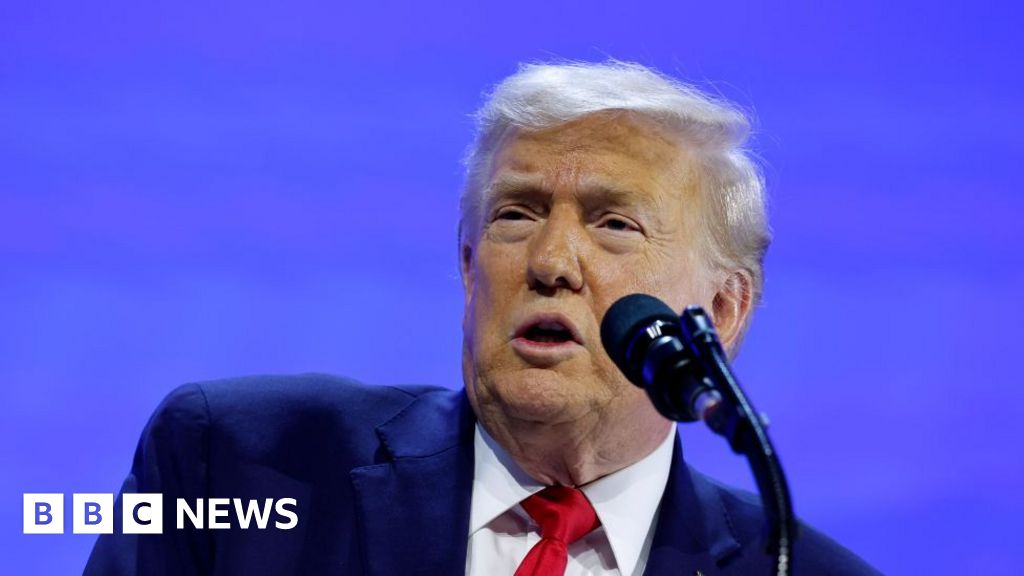
President Donald Trump has said he no longer plans to impose tariffs on European countries that had opposed his ambitions for the US to acquire Greenland.
In a social media post, Trump said his decision followed a “very productive meeting” with Nato Secretary General Mark Rutte.
“This solution, if consummated, will be a great one for the United States of America, and all Nato Nations,” he wrote.
Trump told CNBC that the deal, which he said would last “forever”, could involve mineral rights and the planned Golden Dome missile defence system.
Announcing his decision on Truth Social, Trump said more information would be made available “as discussions progress”.
He added that Secretary of State Marco Rubio and Special Envoy Steve Witkoff would “report directly” to him as negotiations proceed. No further details were provided.
Trump had previously dismissed the idea of a lease agreement, saying that “you defend ownership. You don’t defend leases.”
It also remains unclear what role rare earth minerals could play. Greenland has vast – and largely untapped – reserves of rare earth minerals, many of which are crucial for technologies including mobile phones and electric vehicles.
Globally, the Arctic territory ranks eighth for earth minerals, according to a recent analysis from the Washington-based Center for Strategic and International Studies.
Trump had said he was planning to place a 10% tariff “on any and all goods” sent from the UK to the US from 1 February, increasing to 25% from 1 June, until a deal is reached for Washington to purchase Greenland from Denmark.
The same would apply to goods from Denmark, Norway, Sweden, France, Germany, the Netherlands and Finland – all of which are members of Nato, the defence alliance founded in 1949.
In an earlier address at the World Economic Forum in Davos, Switzerland, Trump said he was “seeking immediate negotiations” to acquire Greenland, but insisted he “won’t use force” to take over the territory.
“We probably won’t get anything unless I decide to use excessive force. We’d be unstoppable, but we won’t do that,” Trump said on Wednesday. “I don’t have to use force. I don’t want to use force. I won’t use force.”
He also urged world leaders to allow the US to take control of Greenland from Denmark, saying: “You can say yes and we will be very appreciative. Or you can say no and we will remember.”
Under existing agreements with Denmark, the US has the power to bring as many troops as it wants to Greenland. It already has more than 100 military personnel permanently stationed at its Pituffik base in the north-western tip of the territory.
But during his speech, Trump suggested he would not be receptive to any agreements on the US use of Greenland that fall short of full ownership.
“Psychologically, who the hell wants to defend a license agreement or a lease?” he said.
“[Greenland] is a large piece of ice in the middle of the ocean, where if there is a war, much of the action will take place on that piece of ice.”
In his own speech at Davos, French President Emmanuel Macron criticised Trump’s previous threat of tariffs, saying an “endless accumulation of new tariffs” from the US was “fundamentally unacceptable”.
Macron was among those urging the EU to consider retaliatory options against US tariffs.
Trump used his speech to take aim at Macron. He said he had warned him about the need to raise drug prices, which he said the French president had refused to do until he threatened “a 100% tariff” on wines and champagnes.
He added that France had been “screwing” the US for decades.
Trump also appeared to brush aside remarks from Canadian Prime Minister Mark Carney. On Tuesday, Carney urged “middle powers” to come together, adding: “If we’re not at the table, we’re on the menu.”
Middle powers, such as Canada, Australia, Argentina, South Korea and Brazil, are nations that still exert large influence in global politics, even though their economies are smaller.
He also said “Canada was amongst the first to hear the wake-up call” that geography and historic alliances no longer guaranteed security or prosperity.
In response, the US president accused Carney of being ungrateful to the US.
“Canada lives because of the United States,” Trump said. “Remember that, Mark, the next time you make your statements.”