


This spider’s “pearl necklace” was living parasites
Researchers examining spiders and scorpions at the Zoological Collections Laboratory of the Butantan Institute in São Paulo, Brazil, noticed
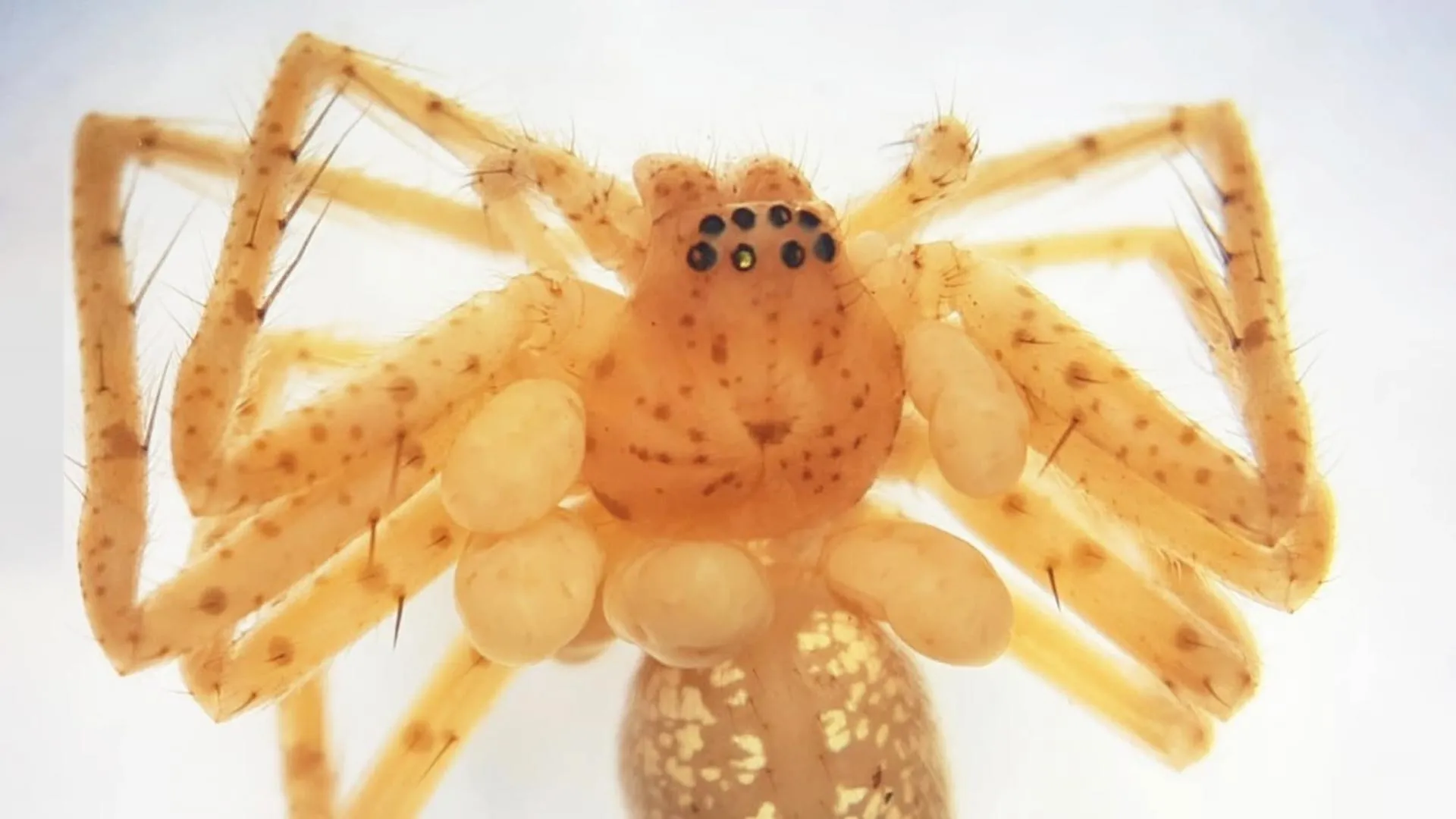
Researchers examining spiders and scorpions at the Zoological Collections Laboratory of the Butantan Institute in São Paulo, Brazil, noticed something unusual on a spider only a few millimeters long. The animal appeared to be wearing a delicate pearl necklace. Unsure of what they were seeing, the team turned to a colleague who specializes in mites for answers.
Ricardo Bassini-Silva, a researcher and curator of the laboratory’s Acarological Collection, quickly recognized that the bead-like structures were actually mite larvae. Until now, Brazil had only one documented case of mites that parasitize spiders, and that species belonged to a completely different family.
A New Parasitic Mite Identified
Detailed analysis of the spider and its tiny passengers followed. Using light microscopy, scanning techniques, and other morphological examinations, the researchers confirmed they were looking at a new species. The finding represents the second spider-parasitic mite ever described in Brazil and the first from its family recorded in the country.
The research was supported by FAPESP and published in the International Journal of Acarology. It brought together two FAPESP-funded projects. One is led by Bassini-Silva, while the other is coordinated by Fernando de Castro Jacinavicius, a co-author of the study and a professor at the Institute of Biology at the University of São Paulo (IB-USP).
Expanding the Map of a Rare Genus
The newly identified species, named Araneothrombium brasiliensis, belongs to a genus first described in Costa Rica in 2017. Finding it in Brazil suggests the group may be more widespread than previously thought and could exist in other neotropical regions.
Each mite larva measures about 500 micrometers, or half a millimeter. The spiders they parasitize are only a few millimeters long. So far, scientists have identified only the larval stage of the mite. These larvae were found attached to juvenile spiders from three different families. All collected specimens were engorged, showing they had fed enough to significantly increase their size.
“For this group of mites, it isn’t uncommon to know many parasitic species only through their larvae, since in adulthood they become free-living predators, living in the soil and feeding on small insects and even other mites, which makes them very difficult to find,” says Bassini-Silva.
Where the Parasitized Spiders Were Found
The spiders carrying the newly described mites were collected in Pinheiral, a municipality in the state of Rio de Janeiro. The area is located near caves and grottos, an environment similar to where Brazil’s first known spider-parasitic mite species, Charletonia rocciai, was discovered.
In a separate study published in 2022, researchers revisited that earlier species, which was originally described in 1979. The updated work added new details about its physical traits, biology, geographic distribution, and host organisms, including spiders.
Why the Mites Target a Spider’s Weak Spot
Spider-parasitic mites feed on lymph, a fluid that circulates through the bodies of certain arthropods. They draw out this fluid through the pedicel, the narrow region connecting the cephalothorax (where the spider’s eyes and mouth are located) to the abdomen.
“This is the spider’s most vulnerable region since other parts have a lot of chitin, which forms an exoskeleton difficult for the mites’ fangs to penetrate,” the researcher explains.
The mites’ tendency to latch onto juvenile spiders suggests opportunistic behavior, since younger spiders are more exposed to parasites and predators. Researchers also note that the species may not be limited to spiders. It could potentially parasitize other arthropods, including insects. This broader behavior has already been observed in Charletonia rocciai, which feeds on at least two different insect orders.
Hidden Biodiversity in Museum Collections
“With more than 3,000 species of spiders alone, Brazil has immense potential for discovering new parasitic mites,” says Bassini-Silva.
The discovery also underscores the value of zoological collections for biodiversity research. The spiders examined in this study had been stored for years, and the mites went unnoticed until now. According to Bassini-Silva, collaborations with field researchers and environmental consulting companies may soon lead to more samples. He hopes these efforts will result in the identification and description of additional mite species associated with a wide range of animals.