



This ancient animal was one of the first to eat plants on land
Life began in the sea. Around 475 million years ago, plants started spreading from water onto dry ground. Roughly
Life began in the sea. Around 475 million years ago, plants started spreading from water onto dry ground. Roughly 100 million years later, vertebrate animals followed. Yet even after animals established themselves on land, they remained meat eaters for tens of millions of years, feeding on other animals rather than plants.
Research published in Nature Ecology and Evolution now highlights a major shift in that pattern. Scientists have described a 307 million year old fossil belonging to one of the earliest known land vertebrates to develop the ability to eat plants.
“This is one of the oldest known four-legged animals to eat its veggies,” says Arjan Mann, assistant curator of fossil fishes and early tetrapods at the Field Museum in Chicago and co-lead author of the study. “It shows that experimentation with herbivory goes all the way back to the earliest terrestrial tetrapods — the ancient relatives of all land vertebrates, including us.”
“The specimen is the first of its group to receive a detailed 3D reconstruction, which allowed us to look inside its skull and reveal its specialized teeth, helping us to trace the origin of terrestrial herbivory,” says Zifang Xiong, a PhD student at the University of Toronto and co-lead author of the paper.
Tyrannoroter heberti and Its Surprising Diet
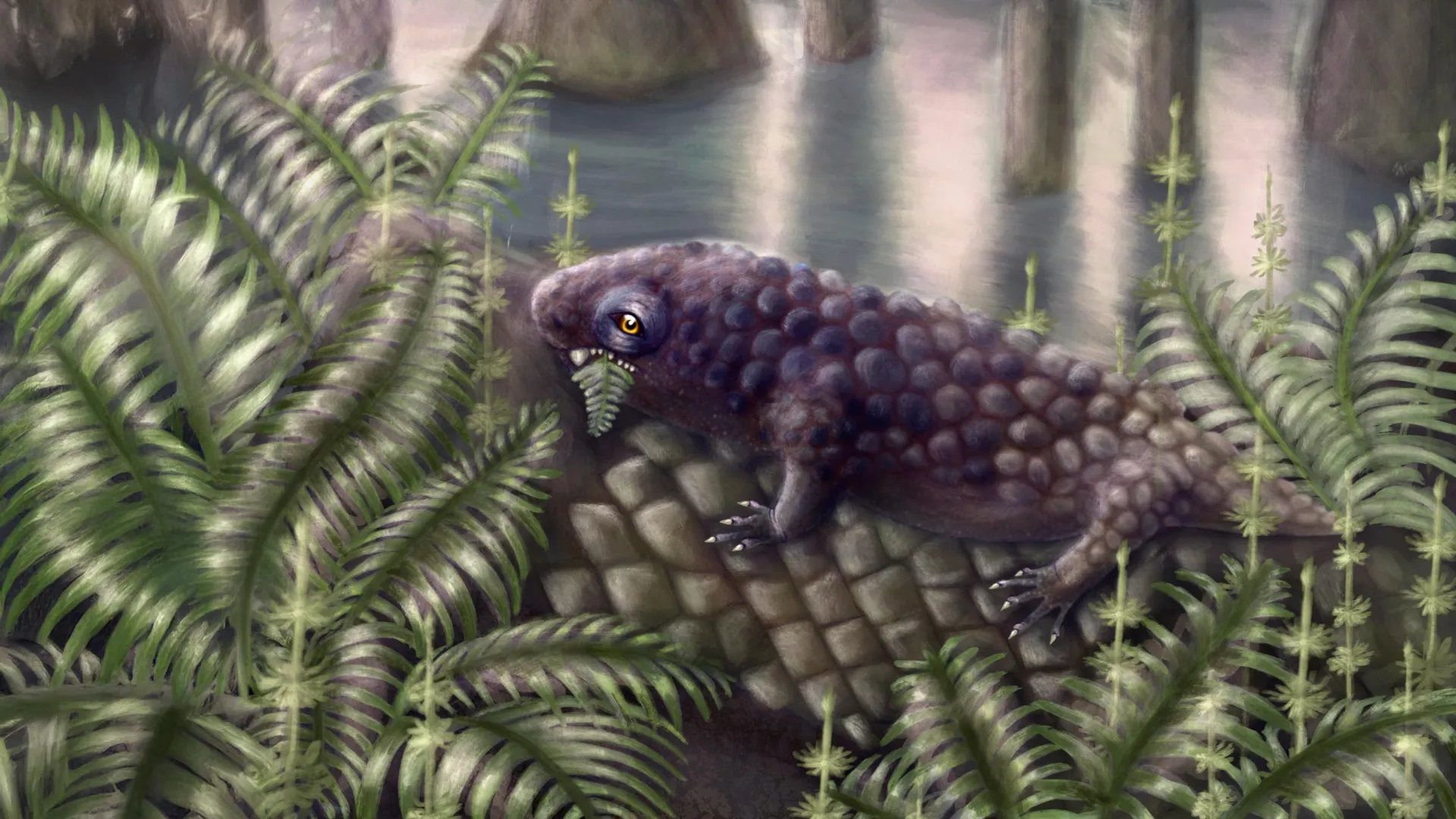
The newly identified species has been named Tyrannoroter heberti, which means Hebert’s tyrant digger, in recognition of its discoverer, Brian Hebert. So far, only the skull has been recovered. Based on the skull’s size and comparisons with related fossils, researchers estimate the animal was a sturdy four legged creature about a foot long.
“It was roughly the size and shape of an American football,” says Mann. Although modest in size by today’s standards, it ranked among the largest land animals of its era. It may have resembled a lizard, but it lived before reptiles and mammals branched into separate evolutionary paths, so it was not technically a reptile.
Fossil Discovery in Nova Scotia
The fossil was found on Cape Breton Island in Nova Scotia, a location known for difficult and sometimes dangerous fieldwork.
“Nova Scotia has the highest tides in the world — when we’re working there, we’re racing against the tide, when the ocean comes back in,” says Mann. “It’s very rocky, and the fossils are in cliffs on the shore. Paleontologists hate excavating in cliffs, because the cliff could come down on you.”
Brian Hebert, an avocational paleontologist from Nova Scotia, located the small skull inside a fossilized tree stump during a field season led by Hillary Maddin, a professor of paleontology at Carleton University.
“The skull was wide and heart-shaped, really narrow at the snout but really wide at the back,” says Mann. “Within five seconds of looking at it, I was like, ‘Oh, that’s a pantylid microsaur.'”
Pantylids and Early Land Vertebrates
Pantylids represent an early stage in the evolution of vertebrates on land. The first lobe finned fish that developed limbs capable of supporting movement on land still relied heavily on aquatic environments.
“The pantylids are from the second phase of terrestriality, when animals became permanently adapted to life on dry land,” says Mann. They are considered stem amniotes, meaning they are closely related to the group of tetrapods that later evolved eggs capable of surviving outside water. Over time, stem amniotes gave rise to reptiles and the early ancestors of mammals.
CT Scans Reveal Plant Crushing Teeth
To study the fossil, Mann carefully removed the surrounding rock. However, the skull had fossilized with the mouth closed, hiding internal structures such as the brain case. To examine those features, the team used CT scanning technology, assembling a stack of X ray images into a detailed three dimensional model.
“We were most excited to see what was hidden inside the mouth of this animal once it was scanned — a mouth jam-packed with a whole additional set of teeth for crushing and grinding food, like plants,” says Maddin, the study’s senior author.
Some of those teeth were located on the roof of the mouth, an arrangement that strongly suggests the animal could process vegetation. The findings indicate that stem amniote relatives were experimenting with plant eating earlier than previously believed.
“Tyrannoroter heberti is of great interest because it was long thought that herbivory was restricted to amniotes. It is a stem amniote but has a specialized dentition that could be used for processing plant fodder,” says Hans Sues, senior research geologist and curator of vertebrate paleontology at the Smithsonian National Museum of Natural History and co-author of the study.
A Mixed Diet and Evolutionary Transition
Even so, Tyrannoroter was unlikely to have been a strict herbivore.
“When Hans Sues was my advisor during my post-doctoral fellowship at the Smithsonian, he would always say that just about all herbivores alive today consume at least some animal protein, and that herbivory is best seen as a gradient,” says Mann.
The animal likely consumed insects and other small prey in addition to plants. Crushing insect exoskeletons may have helped early tetrapods develop the ability to handle tougher plant material. Eating plant fed insects could also have introduced beneficial gut microbes that later supported digestion of vegetation.
Climate Change at the End of the Carboniferous
Beyond clarifying the origins of herbivory, the discovery may also help scientists understand how plant eating animals respond to environmental upheaval. Tyrannoroter lived near the end of the Carboniferous Period, a time of major climate change and the last icehouse to greenhouse transition before the one occurring today.
“At the end of the Carboniferous, the rainforest ecosystems collapsed, and we had a period of global warming,” says Mann. “The lineage of animals that Tyrannoroter belongs to didn’t do very well. This could be a data point in the bigger picture of what happens to plant-eating animals when climate change rapidly alters their ecosystems and the plants that can grow there.”
The fossil offers a glimpse into both the early evolution of plant eating and the vulnerability of those diets during times of rapid environmental change.