
The painful questions for Nato and the EU if Trump takes Greenland
Katya AdlerEurope editor BBC Earlier today, the so-called Coalition of the Willing, largely made up of European leaders, met

Katya AdlerEurope editor

 BBC
BBCEarlier today, the so-called Coalition of the Willing, largely made up of European leaders, met in Paris with envoys of US President Donald Trump, to try to make further progress on a sustainable peace deal for Ukraine.
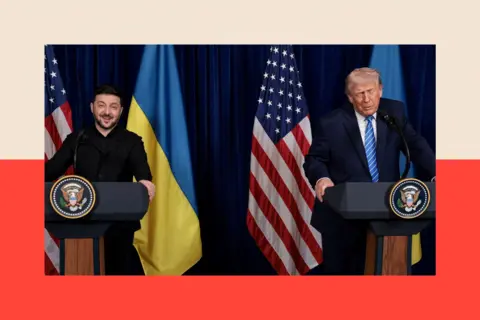
With Ukraine’s President Volodymyr Zelensky insisting a plan to end the war with Russia is “90% of the way there”, no-one in that room wanted to jeopardise keeping the Americans onboard.
But there was an immense elephant in that grand and glittering Paris meeting and the underlying atmosphere was extremely tense.
Bear in mind the events of the last few days: the Trump administration’s controversial intervention in Venezuela and the US president’s insistence soon after, that “we need Greenland from the standpoint of national security”.
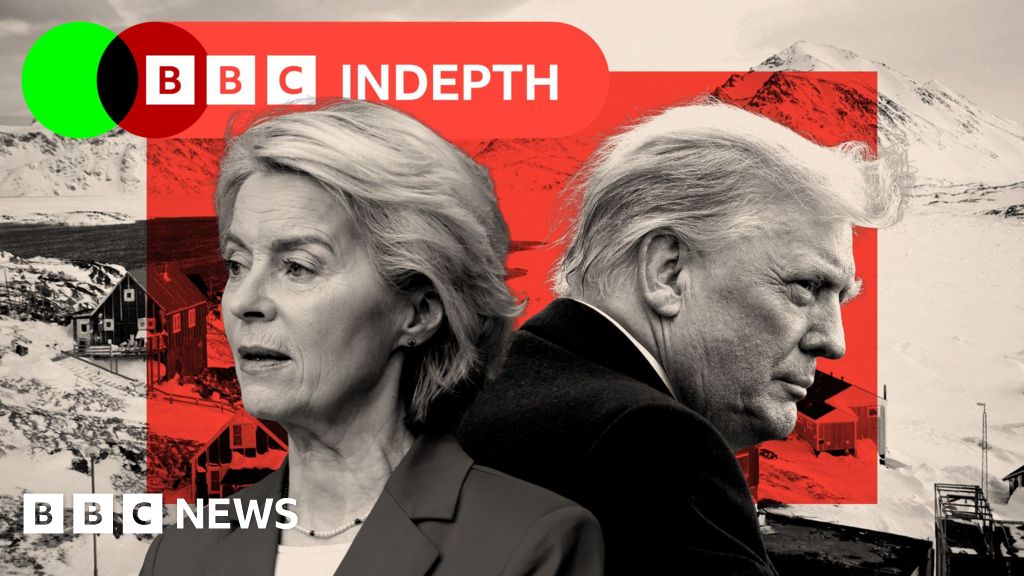
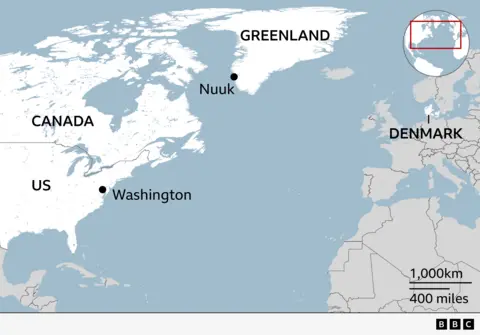
Greenland is the world’s largest island – it’s six times the size of Germany. It lies in the Arctic but is an autonomous territory of Denmark’s.
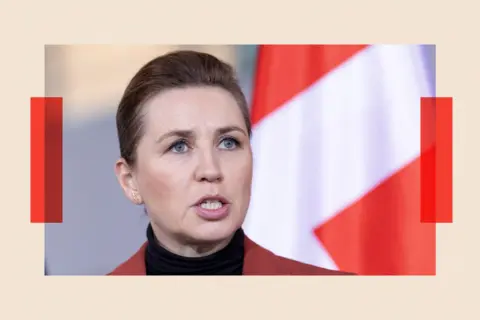
At the Paris meeting, Mette Frederiksen, Denmark’s Prime Minister, was sitting opposite two powerful figures representing Trump: special envoy Steve Witkoff and Trump’s son-in-law Jared Kushner.
She was under pressure from European colleagues not to antagonise the US over Greenland, in case that impacts US support for Ukraine.
Europe’s leaders would have far preferred to keep Greenland and the debate on Ukraine separate. But with the political temperature mounting from Washington and Copenhagen, leaders of big European nations at the Paris meeting issued a statement saying: “Greenland is part of Nato. Security in the Arctic must therefore be achieved collectively, in conjunction with Nato allies including the United States”.
 Getty Images
“It is for Denmark and Greenland, and them only, to decide on matters concerning Denmark and Greenland,” the statement added.
The communique was welcomed by Greenland’s prime minister, Jens Frederik Nielsen, but critics say it was slow to be put together and, because of the limited number of signatories to the statement, it failed to show a Europe united in purpose.
“Had there been a common statement from all 27 EU partners, plus Nato ally the UK, in support of Danish sovereignty, that would have sent a powerful message to Washington,” Camille Grande of the European Council on Foreign Relations (ECFR) think tank told me. He was the Assistant Secretary General for Defence Investment at Nato from 2016-22.
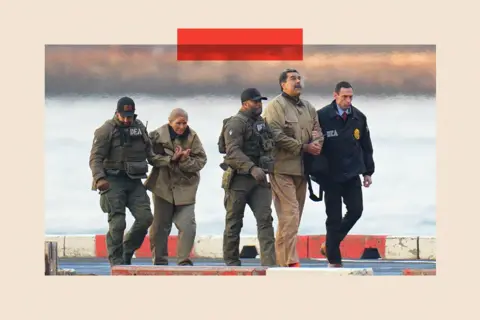
Consider the irony at play at the France meeting. Multiple European national and other leaders, including of Nato and the EU, are trying to engage the Trump administration in safeguarding the future sovereignty of a European country (Ukraine) against the aggressive territorial ambitions of an outside force (Russia), just after the US has swooped into sovereign Venezuela militarily, taking its president into custody, while also continuing to actively threaten the sovereignty of another European nation (Denmark).
 XNY/Star Max/GC Images
To make matters even more stark – Denmark and the US are both members of the transatlantic alliance Nato. They are, according to Copenhagen, extremely close allies. Or were.
The question is, were Trump to make good on his ambition to bring Greenland under US control, would it mark not just an existential threat to Nato but also a major crisis for the EU?
Europe risks being trampled underfoot
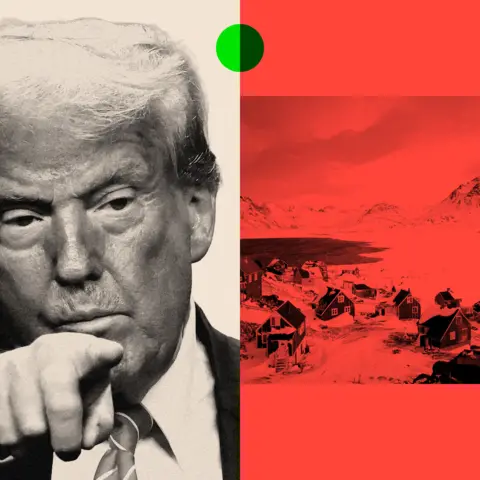
This is not the first time Trump has spoken of his determination to control Greenland. He’s suggested buying it in the past. He’s also refused to rule out taking it by force.
On Sunday he insisted that the island is “so strategic right now, Greenland is covered with Russian and Chinese ships all over the place. We need Greenland from the standpoint of national security and Denmark is not going to be able to do it.”
Denmark refutes that last statement. It recently pledged to invest $4bn in Greenland defence including boats, drones and aircraft.
Under a bilateral agreement, the US has a military base already on Greenland – established at the beginning of the Cold War. It has reduced the number of personnel there from around 10,000 during peak Cold War operations to around 200 and the US has long been accused of taking its eye off Arctic Security, until now.
Denmark has indicated it is open to discussion about a bigger US presence on the island and more but faced with the US President’s threat of unilateral action, Friederikson said on Monday that Trump’s ambition to take Greenland should be taken seriously.
After the US administration’s actions in Venezuela this weekend, her colleagues across Europe are doing just that.
Speaking to me on condition of anonymity one EU official said: “This whole situation has just underlined – once again – Europe’s fundamental weakness vis a via Trump.”
While Denmark’s nordic neighbours immediately rushed verbally to its defence after Trump’s weekend comments on Greenland, initially there was deafening silence from Europe’s so-called Big Three – London, Paris and Berlin.
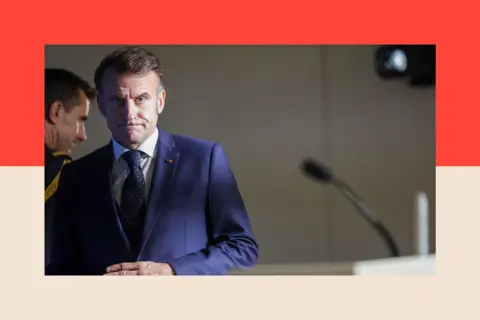
Eventually, UK Prime Minister Sir Keir Starmer said on Monday that Denmark and Greenland alone could decide the island’s future. Germany’s Chancellor, Friedrich Merz has said similar in the past. French President Emmanuel Macron visited Greenland in June in a gesture of solidarity with Copenhagen.
 EPA Shutterstock
But direct criticism of the US has been notably absent.
And this is the crux of the matter. Trump’s forthright manner, some call them his bullying tactics, have made European allies extremely nervous.
They’ve generally chosen to try to manage the US president, often in an attempt to safeguard bilateral relations, rather than stand up individually or together, and risk confronting the US president and facing potential consequences.
In the new world of Big Power Politics we now inhabit, where the US and China, along with others like Russia and India, dominate, Europe at best looks like it’s standing on the sidelines, and risks being trampled underfoot.
How the EU deferred to Trump
Every year I have covered EU politics, the bloc pledges to play a greater role on the global stage, but when it comes to Trump, it has looked decidedly weak.
At the end of last year, the EU failed to fulfil a pledge to financially support Ukraine using Russian state assets frozen in the EU. They found the money by other means, but critics say the bloc very publicly missed sending a potentially strong message both to Moscow and to the Trump administration, that has repeatedly dismissed the bloc as feeble.
And in the one area where the EU has long strutted internationally – as a huge trading power, it has chosen once again to defer to Trump.
When he slapped 15% tariffs on EU goods last year, the bloc swallowed its pride and promised not to retaliate, insiders say because it feared losing US support this continent relies on for its security and defence.
 Reuters
And now there’s Greenland and Denmark – where EU countries are deeply divided in their attitudes towards the Trump administration and therefore to what extent they might stick their neck out for Copenhagen.
As a result, Juliane Smith, the US ambassador to Nato until Trump’s re-election as president, told me this situation “risks breaking the EU” as well as being an existential dilemma for Nato.
Denmark’s prime minister warned on Monday that US unilateral action over Greenland could break the NATO alliance altogether.
Some might note that Donald Trump has never been a big fan of the transatlantic alliance.
“Europe should take President Trump and his team seriously when they talk about “getting” Greenland,” Julianne Smith told me.
“That means doing more than urging restraint. The leading powers in Europe may want to begin contingency planning; consider how they can make best use [of international meetings, such as] the upcoming Munich Security Conference and Davos where US senior officials will be present; and also consider bold and innovative ideas like new defence pacts.”
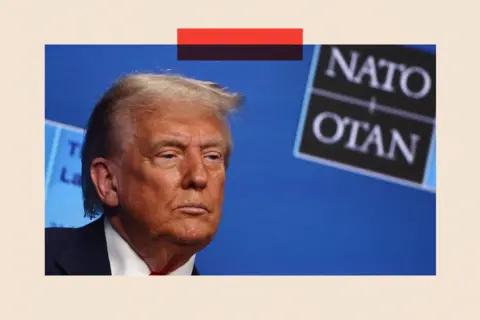
Nato treaties do not make a distinction between an attack on an ally from outside countries or from another Nato ally but there is an understanding that the alliance’s Article 5 – nicknamed its all for one and one for all clause – isn’t applicable to one Nato country attacking another.
Take, for example, strife between member states Turkey and Greece over Cyprus. The worst violence was in 1974 when Turkey invaded. Nato did not intervene but its most powerful member the US was able to help mediate.
 NurPhoto via Getty Images
If we come back to geography, Denmark is one of Nato’s smaller allies, though a very active one. The US is Nato’s biggest, most powerful member. By far.
The deep-seated nervousness in Europe right now is palpable.
Big European powers may have issued their joint statement underlining Nato as a forum to discuss Arctic security and insisting that only Denmark and Greenland can decide the islands future, but how far would the UK , France, Germany and others actually go to guarantee that sovereignty?
“Nobody’s going to fight the United States militarily over the future of Greenland,” said the confident sounding White House deputy chief of staff in an interview with CNN on Monday.
ECFR’s Camille Grande told me tensions over Greenland point – once again, he says – “at the need for the Europeans to reduce security dependencies on the US and to speak with one voice.”
Trump got all Nato allies – bar Spain – last summer to commit to massively increase spending on their own defence.
But Europe is still heavily reliant on the US in many areas including intelligence gathering, command and control and air capabilities. Washington is well aware of this.
Nato insiders say, right now, even in meeting behind closed doors European member states of the alliance can hardly bring themselves to contemplate what could happen if Washington were to move in on Greenland militarily.
They may have to.
Top picture credit: NurPhoto/Getty Images

BBC InDepth is the home on the website and app for the best analysis, with fresh perspectives that challenge assumptions and deep reporting on the biggest issues of the day. You can now sign up for notifications that will alert you whenever an InDepth story is published – click here to find out how.