


The hunt for where the last Neanderthals lived
Neanderthals often found refuge in caves GREGOIRE CIRADE/SCIENCE PHOTO LIBRARY This is an extract from Our Human Story, our
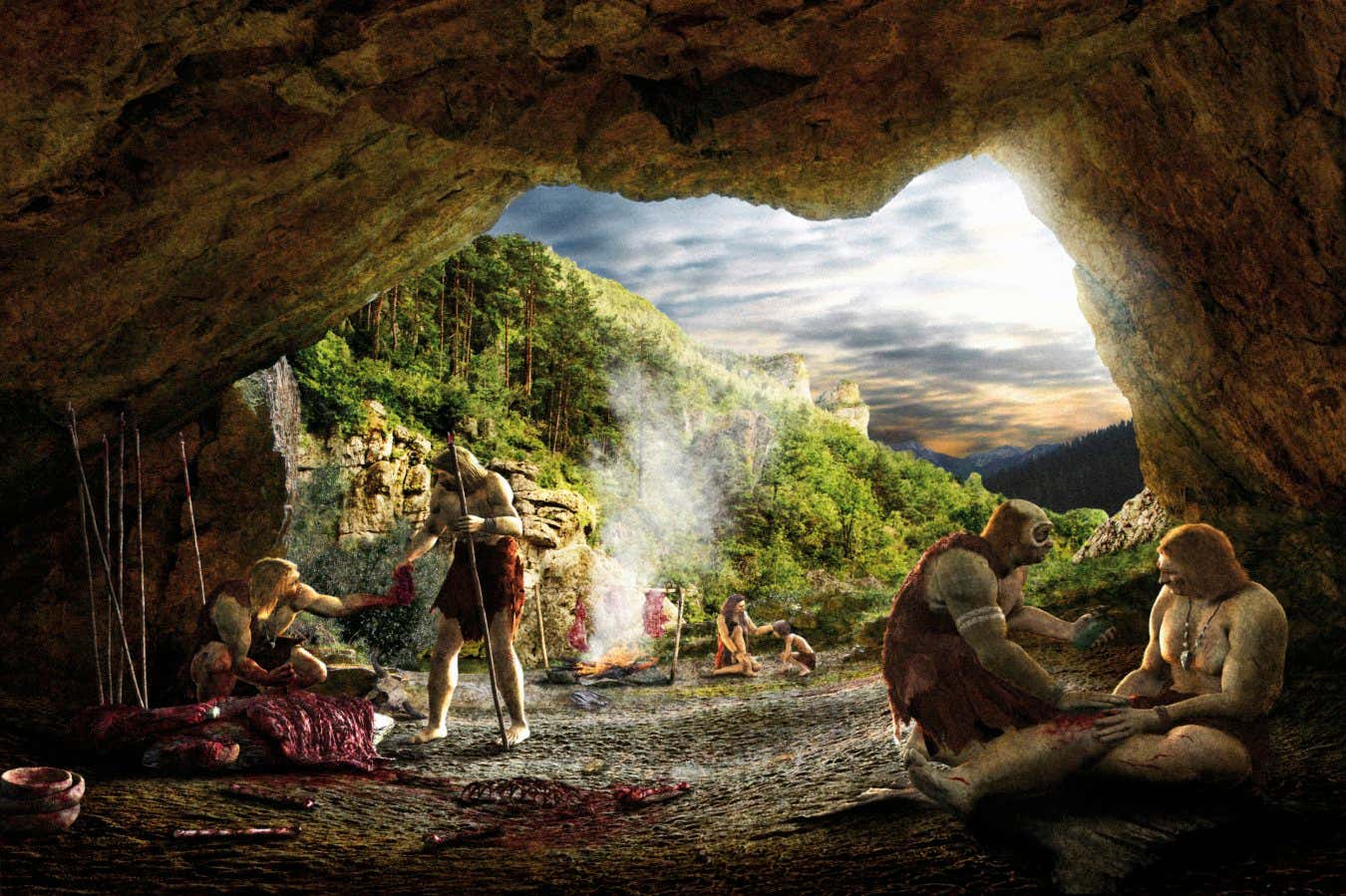
Neanderthals often found refuge in caves
GREGOIRE CIRADE/SCIENCE PHOTO LIBRARY
This is an extract from Our Human Story, our newsletter about the revolution in archaeology. Sign up to receive it in your inbox every month.
It’s early January and south-west Britain is painfully cold. Not that cold, obviously: my friends in Canada and Scandinavia are laughing at my pitiful attempts to deal with near-freezing conditions. But it’s cold enough that I need to wrap up warmly or the chill seeps into my bones.
Which brings me to the Neanderthals, our long-extinct cousins, who we have tended to imagine living in frigid environments. A lot of our imagery of the Neanderthals is decidedly Siberian: frozen tundra, driving winds, woolly mammoths plodding through the snow. They have often been described as cold-adapted hominins.
Now, if you’ve been paying close attention to New Scientist over the past couple of months, you might remember a hint that that isn’t quite right. In November, we published a story called “Neanderthals’ hefty noses weren’t well adapted to cold climates”.
In it, Chris Simms reported on the first study of a well-preserved nasal cavity, which belonged to a Neanderthal dubbed Altamura Man who lived in what is now Italy. It had previously been reported that Neanderthal nasal cavities contained specialised bony structures that helped them to warm up the air they had just breathed in. But these were not present in this spectacular specimen, suggesting they weren’t a standard Neanderthal feature. Researcher Todd Rae said the idea of Neanderthals being cold-adapted was “complete nonsense” and that “they were probably struggling with the cold” just like we would.
Likewise, in December we learned of the oldest evidence of ancient humans starting fires, by striking flint against pyrite. This was from southern England 400,000 years ago. Given that timeline, the Neanderthals may have been the fire-starters. Which would make sense: their bodies weren’t adapted to the cold British climate, so they devised a new behaviour instead. (By the way, ancient humans probably had control over fire long before this: the new evidence is specifically of people deliberately starting fires.)
Anyway, if Neanderthals weren’t specifically adapted for cold climates, what kinds of environments were they living in? That’s the question tackled by a new set of studies in the Journal of Archaeological Science: Reports. This research reveals a rich story of Neanderthal life.
Southern refuges
Of all the extinct hominins we know about, the Neanderthals are our closest relatives. They lived in Europe and western Asia for hundreds of thousands of years, before vanishing around 40,000 years ago – about when our species arrived in Europe in a big way.
Neanderthals’ long history meant they lived through a lot. They went through several glacial periods, when the climate cooled and ice sheets crept south, and warmer interglacial periods in which the ice sheets retreated. They also lived through periods when Earth’s magnetic field wobbled significantly, which could have exposed them to more harmful ultraviolet radiation. There is growing evidence that Neanderthals produced art, and had cultural practices around death such as burial.
Nevertheless, as time went on, their habitat shrank. For whatever reason, the Neanderthals retreated from Asia and northern Europe, until they were confined to southern Europe – especially the Iberian peninsula, which today makes up Spain and Portugal. The new studies focus on southern Europe, because it’s the place Neanderthals survived the longest.
The papers look at a lot of different things. I’m going to try to draw a straight line through them; just be aware that this is necessarily a selective reading of a large body of work.
Let’s start with a study by Loïc Lebreton at the Catalan Institute of Human Paleoecology and Social Evolution in Spain and his colleagues. They looked at small mammals (adorably called “micromammals”), which they used as an indicator of the climate: warmer and wetter climates attract different mammals than colder and drier ones. This revealed that north-eastern Spain had a pretty stable climate between 215,000 and 10,000 years ago, thanks to a strong influence from the Mediterranean. It was warm and wet. In contrast, southern France and northern Italy had more variable climates. This may help explain why the Neanderthals in Spain survived so long.
Many areas where they lived seem to have been wooded. A study led by Sarah Barakat at the University of Aberdeen in the UK focused on Lazaret cave in France, which was inhabited by Neanderthals between 190,000 and 130,000 years ago. The remains of aurochs, red deer, ibex and grey wolves have been found in the cave. Analyses of their teeth indicates that the herbivores were eating a lot of woody plants. The authors suggest the area was woodland, perhaps opening out into grasslands in places. The climate was a little cooler than it is today, but hardly frigid. The Neanderthals may have camped in the cave at certain times of the year.
We can get a glimpse of the animals Neanderthals lived alongside from Cova del Gegant, a cave on the coast near Barcelona, Spain. It contains materials laid down between 145,000 and 24,700 years ago. This includes 1225 bird bones, from at least 319 individuals. They include common quails, red-legged partridges and corn buntings: species “typical of forest and shrub areas”, the authors say.
There were also some birds that today are only found much further north, like snowy owls and snow buntings. These may have migrated south to escape harsh Arctic winters during the cold glacial periods.
There’s no direct evidence of the Neanderthals hunting or eating the birds, and the authors say Neanderthals probably couldn’t have hunted them. However, there may be two exceptions: red-billed and yellow-billed choughs. Both hide in the darkest regions of caves, camouflaged by their dark feathers. This might make them easy to capture: “no sophisticated weapons are needed, just a mere stick.” Since they’re small, the Neanderthals could just cook them and pull them apart – so we wouldn’t find any telltale butchery marks. To find out if the Neanderthals did this, the bones will have to be examined for human toothmarks.
The last days
Even when the Neanderthals’ time drew to a close, they continued to adapt. Rosa Albert at the Catalan Institution for Research and Advanced Studies and her colleagues studied the Riparo l’Oscurusciuto site in the Ginosa Ravine, southern Italy, where Neanderthal activity is recorded between 55,000 and 42,800 years ago. The site has clearly preserved layers, showing how conditions changed over that period. At first, the area was a forest or semi-open woodland, but over time it shifted to a more open woodland and steppe. Preserved hearths reveal that the Neanderthals started burning more grass in their fires, neatly adapting to the decline in wood.
As late as 41,000 years ago, some Neanderthal groups were still doing well – even as their fellows had vanished from much of Eurasia. At Cova Eirós in north-west Spain, Hugo Bal-García at the University of Santiago de Compostela, Spain, and his colleagues reconstructed the animals the Neanderthals who camped there ate. The researchers found 3353 specimens, 787 of which they were able to identify. This enabled them to spot 31 species that lived in the area, including large numbers of red deer and cave bears.
The team found that 5.5 per cent of the bones had traces of Neanderthal use, such as cut marks and evidence of heating. Most of these bones couldn’t be identified, but they did find such traces on 15 red deer bones – indicating the Neanderthals were eating them – and on two cave bear bones. Cave bears were intimidating opponents, but it’s previously been suggested that Neanderthals ambushed them when they awoke from hibernation.
Alicia Sanz-Royo at the University of Aberdeen and her colleagues found a similar pattern at Covalejos, another cave in northern Spain. There, red deer, horse and bovids (cow-like animals) were being eaten by hominins, including Neanderthals and the modern humans that arrived later.
What about the very last Neanderthals? A study by Liz Charton at the Institute of Human Palaeontology in France and her colleagues suggests they faced some environmental challenges. Charton’s team studied a core from the western Mediterranean seabed, which contains pollen from between 41,000 and 34,000 years ago. Around 39,000 years ago, steppe and semi-desert vegetation became much more widespread. This is in line with previous evidence suggesting that the climate became significantly drier at this time.
The team mapped known hominin sites for the entire period and found that after the drying, there were fewer sites with Neanderthal-type tools and a growing preponderance of sites with tools linked to modern humans. The Neanderthals may have clung on in the most southern parts of Europe, like the south of Spain – but even there, modern humans were also becoming widespread.
This isn’t to say that the drying killed off the Neanderthals: they had faced many similar climatic challenges before and survived. But perhaps it was one factor among many.
Finally, let’s try to get a glimpse into the Neanderthals’ culture. Nohemi Sala at the National Research Center on Human Evolution in Spain and her colleagues compiled data from 46 sites on the Iberian peninsula, to see how the Iberian Neanderthals treated their dead. In other places, like Shanidar in Iraq and La Ferrassie in France, there is evidence of deliberate burial. But there are no such cases in Spain and Portugal.
Does this mean the Iberian Neanderthals didn’t perform mortuary practices or otherwise honour their dead? Not necessarily. They may simply have had different ideas about the best way to mourn.
At Sima de las Palomas in south-east Spain, there are several Neanderthals in vertical cave shafts. One, an adult female, was found lying on her right side, with her arms bent and her hands near her face. She may have been intentionally placed there, along with the others. Perhaps those shafts served as a natural cemetery. The team says some other Spanish sites look similar.
Elsewhere, Neanderthals may have performed funerary cannibalism: that is, eating parts of the dead person. Cannibalism is taboo in many modern societies, but as I wrote in a feature in 2024, some cultures regard it as a sign of respect or even love, a way of keeping the dead person alive inside you.
Curiously, the Iberian Neanderthals’ mortuary practices seem to have become more varied in their final 10,000 years. Sala suggests this might be due to a wave of migration, with Neanderthals moving in from elsewhere and bringing in new practices.
If that’s true, it’s a melancholy thought: the Neanderthals were innovating and changing, but their time on Earth was almost up. However, there’s another way to look at it. Neanderthals interbred with modern humans, so their genetic legacy lives on in many of us today – and it may be that our ancestors picked up a few ideas from them as well.
Topics: