



Test your brain on these mind-bending scientific riddles
(1) You have been invited to sit at the periodic table. Among those mythological figures, and the elements named
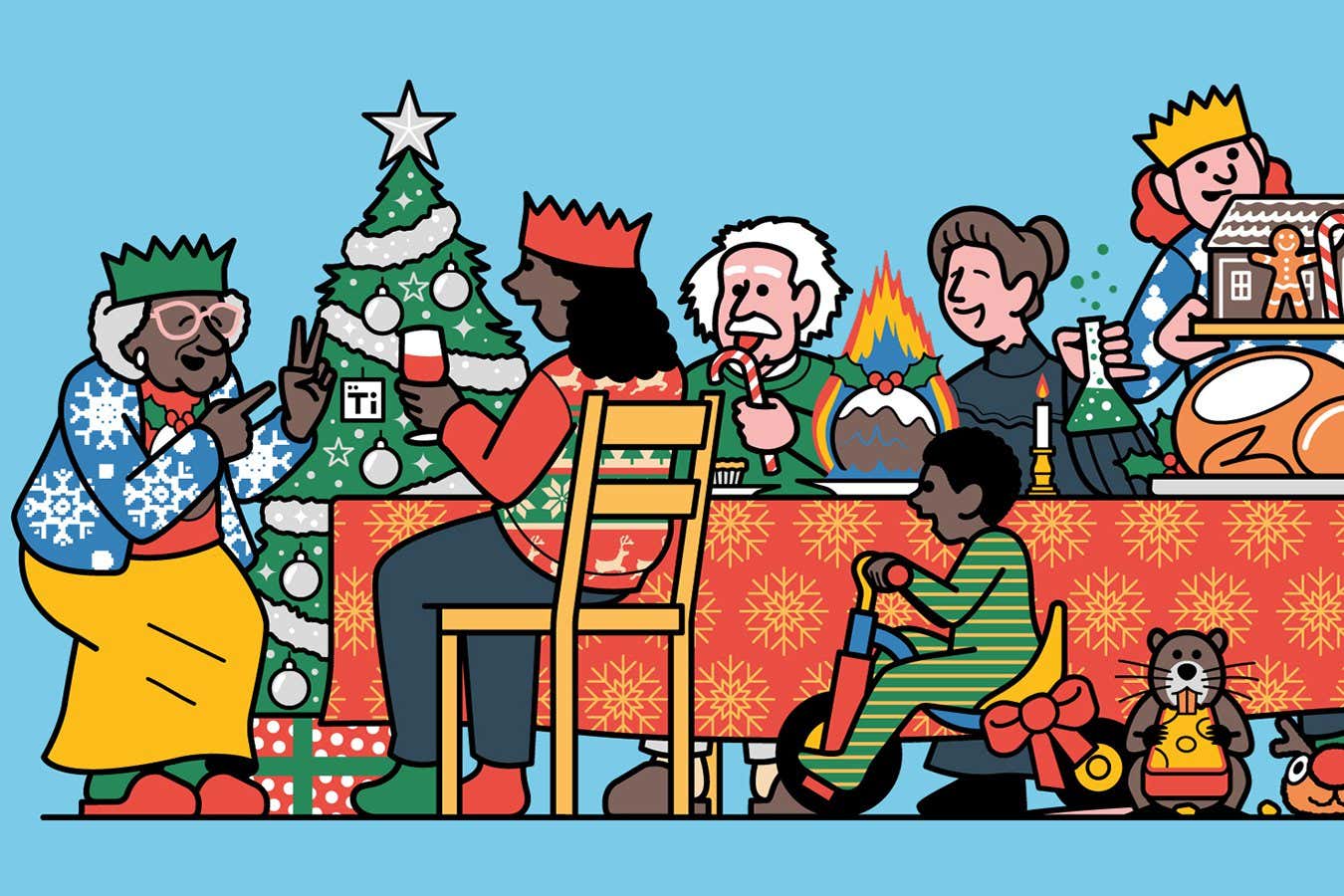
(1) You have been invited to sit at the periodic table. Among those mythological figures, and the elements named after them, are the 12 titans (titanium), Prometheus (promethium) and Thor (thorium). The Nobel prizewinners and their element namesakes include Ernest Rutherford (rutherfordium), Marie Skłodowska-Curie and Pierre Curie (curium) and Albert Einstein (einsteinium). The “noble types” are the noble gases, which sit on the far-right-hand side of the periodic table.
(2) The word on the card is Noel (or, more accurately, NOeL). N is the symbol for newtons, O is the most common blood type, e is a mathematical constant and L. on specimen labels indicates that Carl Linnaeus named a species.
(3) Element 47 has been used through the ages. It creates images in a few ways: silver salts are used in photography, and silver itself is used in mirrors. Silver ions or compounds are included in wound dressings due to their antimicrobial properties. Silverware delivers calories in the form of knives, forks and spoons, and if you have shiny, glass baubles on your Christmas tree, that lustre may be due to a thin layer of silver inside.
(4) Why, it is the Carol of the Bells. In order, these describe astronomer Jocelyn Bell Burnell, physicist John Stewart Bell and inventor Alexander Graham Bell.
(5) Gingerbread would be an acceptable answer. Our dishes share their first two letters with the most commonly used metric prefixes (words that make a number bigger or smaller by powers of 10) stepping up regularly from the tiny (nano) to the massive (giga). In order, they are: nano (10-9), micro (10-6), milli (10-3), a break for 100 (which equals 1), kilo (103), mega (106) and giga (109).
(6) These describe Ada Lovelace, Mary Anning, Hannah Fry and mitochondrial Eve. Mary Anning is the only one without a palindromic first name, i.e. one that reads the same forwards and backwards (or on the return), so she is the one who won’t be coming back next year.
(7) Add the symbol for energy, E, and a symbol for a unit of energy, eV (the electronvolt), to Mendel to get Mendeleev. Gregor Mendel demonstrated how traits are inherited in a series of breeding experiments on pea plants in the 1850s and 1860s, while Dmitri Mendeleev created the first periodic table by putting the chemical elements in order of atomic weight.
(8) The three clues describe Makemake, murmur and meme. Each of these words is made of a repeated unit that gets one letter shorter each time, so the year MM (2000 in Roman numerals) could logically follow.
(9) The Christmas pudding has been set alight! The brandy must be warmed before being poured over it, so that the ethanol vapour from the alcohol burns, and not the pud.
(10) The theme of Grandma’s charades was music. The clues refer to classical, rock, pop and, finally, punk and emo.
(11) It is cheese. Humans have been making cheese in one form or another for more than 7000 years. It gets its flavour and texture from the many varieties of bacteria, moulds and yeasts that live within.
(12) The answer is nuts. Each clue describes a word that contains the word “nut”: sternutation, nutria, minute, nutrition. You might find these in your stocking, or perhaps on the table after dinner.