
Saildrone, Lockheed to place missile launchers on naval drones
MILAN— Saildrone will equip its unmanned surface vessels with strike missiles made by Lockheed Martin, the drone company announced
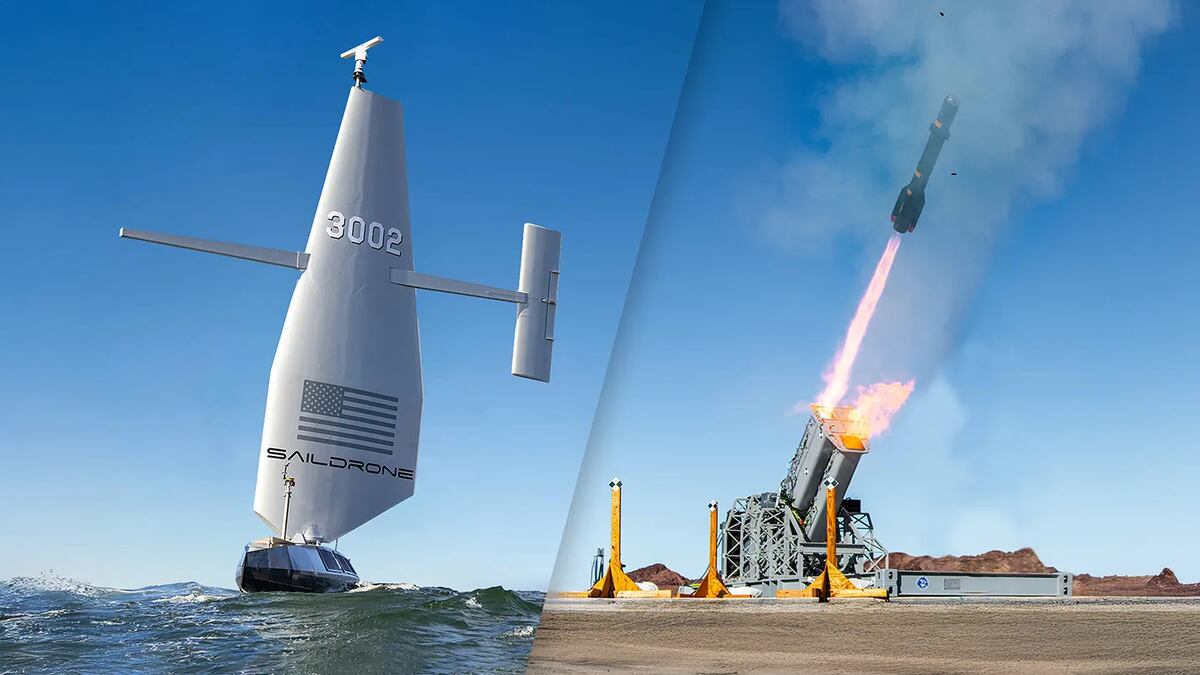
MILAN— Saildrone will equip its unmanned surface vessels with strike missiles made by Lockheed Martin, the drone company announced this week.
The collaboration comes in response to a call by global navies for more armed naval drones, according to Saildrone.
The 20-meter Saildrone Surveyor vessel will boast the Joint Air-to-Ground Missile (JAGM) launcher manufactured by the U.S. defense giant.
“We expect this work to attract interest from customers who already depend upon Saildrone and are now thinking about layered maritime defense – for some navies, awareness alone is no longer sufficient, and they’re asking how unmanned systems can also contribute to deterrence and if necessary a response,” ret. Vice-Adm. John Mustin, Saildrone’s president, told Defense News.
Larger Saildrone USVs are also under consideration to carry Lockheed Martin weaponry, such as the Mk 70 Vertical Launching System, a containerized missile launcher, per a company press release.
The new partnership will entail enhanced naval capabilities, including the use of artificial intelligence, which is part of Lockheed Martin’s $50 million investment in Saildrone.
According to Mustin, while the company strives to integrate greater autonomy across its USVs to increase sensing and data processing abilities, it is not pursuing fully autonomous weapons. “Any strike capability would have a human firmly in the loop,” he added.
Many global navies have envisioned a manned-unmanned hybrid fleet for their future requirements, including the United States. Former U.S. Chief of Naval Operations Adm. Michael Gilday said the service’s ambition is to build up to 500 vessels, including 350 crewed ships and 150 large uncrewed surface vessels.
Last year’s reconciliation bill known as the ‘One Big Beautiful Bill Act,’ passed by Congress, included investments of over $3 billion for the procurement of surface vessels: $1.5 billion for the expansion of small USV production and $2.1 for the development and procurement of medium ones.
A report from the U.S.-based Center for Maritime Strategy published in September noted that lawmakers were reluctant to approve the planned funding until the Navy was able to produce a concept of operations for their use.
Saildrone has already planned proof-of-concept integrations and a live-fire demonstration to take place next summer.
Arming naval drones was not a widely implemented practice a few years ago, primarily due to technological and political hurdles, which limited their use largely to surveillance missions.
The Ukraine war has changed this, as the country’s naval forces demonstrated their ability to attack much larger targets using cheaper weaponized USVs.
However, the Saildrone executive warned that the success may not replicate across different conflict zones.
“What the Ukrainians have shown is their incredible ability to inflict a cost curve on their adversaries, striking capital assets with significantly less expensive means – but different theaters around the world present different challenges over much larger distances and threats,” Mustin said.
Over the last year, Saildrone platforms have totaled over 10,000 cumulative days on the water, covering more than 380,000 nautical miles and detecting 2,376,583 vessels, according to the company.
Elisabeth Gosselin-Malo is a Europe correspondent for Defense News. She covers a wide range of topics related to military procurement and international security, and specializes in reporting on the aviation sector. She is based in Milan, Italy.