


Quantum neural network may be able to cheat the uncertainty principle
Quantum computers could benefit from a path around the Heisenberg uncertainty principle Marijan Murat/dpa/Alamy The Heisenberg uncertainty principle puts
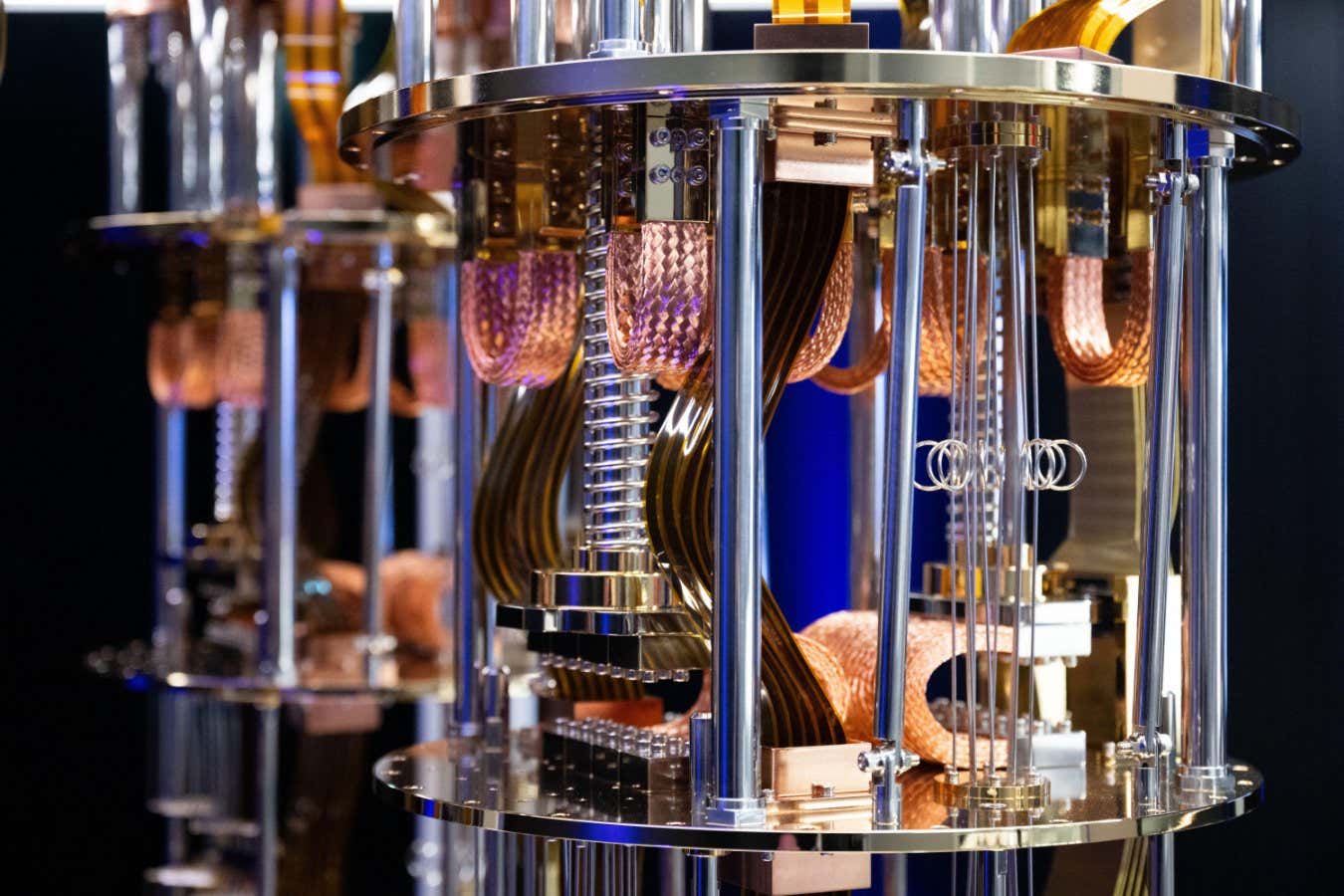
Quantum computers could benefit from a path around the Heisenberg uncertainty principle
Marijan Murat/dpa/Alamy
The Heisenberg uncertainty principle puts a limit on how precisely we can measure certain properties of quantum objects. But researchers may have found a way to bypass this limitation using a quantum version of a neural network.
Given, for example, a chemically useful molecule, how can you predict what properties it might have in an hour or tomorrow? To make such predictions, researchers start by measuring its current properties. But for quantum objects, including some molecules, this can be unexpectedly difficult because each measurement can interfere with or change the outcome of the next measurement. Notably, the Heisenberg uncertainty principle states that some quantum properties of objects simply cannot be precisely measured simultaneously. For example, if you measure a quantum particle’s momentum extremely well, measuring its position will return only an approximate number.
Now, Duanlu Zhou at the Chinese Academy of Science and his colleagues have mathematically proved that using quantum versions of a neural network may avoid some of these difficulties.
Zhou’s team explored the problem for practical reasons. When researchers run quantum computers, they need to know the properties of the computer’s building blocks, which are called qubits, either to assess and benchmark the device, or to use those qubits effectively when emulating an object like a molecule or a material. To determine a qubit’s properties, researchers typically apply some operations, similar to how you would apply “divide by 2” to determine whether a number is even. But the uncertainty principle means that some of these operations will be incompatible – equivalent to not being able to multiply a number by three then divide it by two and still have this calculation return a meaningful answer.
The researchers’ calculations now show that the incompatibility issue can be resolved if a quantum machine-learning algorithm – a quantum neural network (QNN) – is applied instead of simpler operations.
Importantly, some steps in that algorithm must be randomly chosen from a predetermined set. Past studies have found that such randomness can make QNNs more effective in determining a single property of a quantum object, but Zhou and his colleagues expanded the idea to measuring several properties, including combinations of properties normally constrained by the uncertainty principle. They could do this because the results of many consecutive, random operations can be unravelled with special statistical methods to yield more precise outcomes than when just one operation is performed repeatedly.
Robert Huang at the California Institute of Technology says that being able to measure many incompatible properties efficiently means scientists will be able to learn about a given quantum system much faster, which is important for applications of quantum computers in chemistry and materials science – as well as for understanding ever larger quantum computers themselves.
The new approach could plausibly be implemented in practice, but whether it is successful may depend on how useful it is compared with similar approaches that also leverage randomness to make informative quantum measurements, says Huang.
Topics: