

Our verdict on Annie Bot: This novel about a sex robot split opinions
Annie Bot by Sierra Greer was the Book Club’s January read Dittmeier The New Scientist Book Club moved on
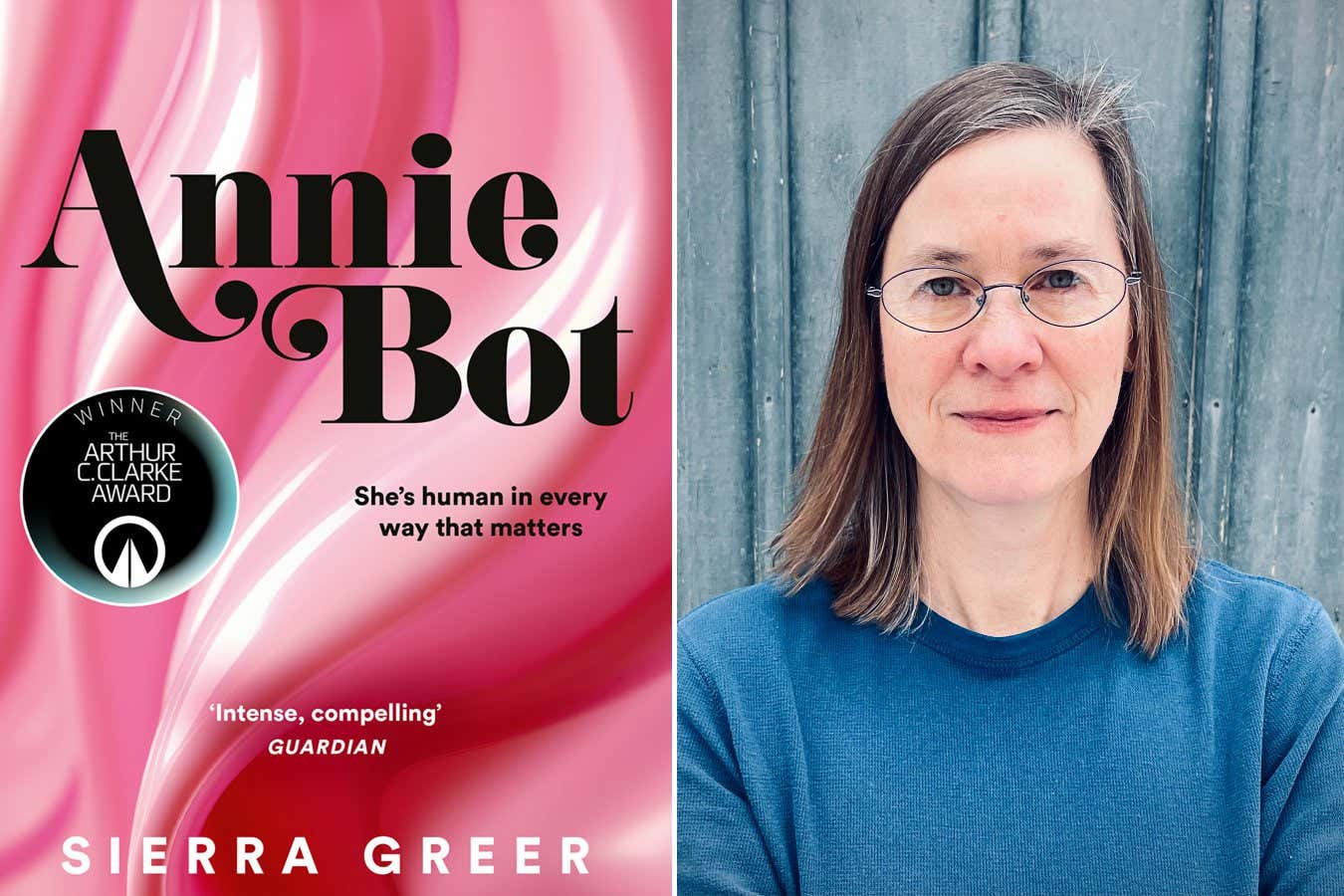
Annie Bot by Sierra Greer was the Book Club’s January read
Dittmeier
The New Scientist Book Club moved on from reading a classic piece science fiction in December – Iain M. Banks’s The Player of Games – to an award-winning sci-fi novel in January: Sierra Greer’s Annie Bot, which won the Arthur C. Clarke prize in 2025.
I must admit, I was nervous to announce this one to my fellow readers. Annie Bot is the story of a sex robot, owned by a controlling and abusive man. It gets very dark in places, it has a number of sex scenes, and I wanted to make sure you all knew what you were getting into before getting started. That cupboard scene, some way into the book, was super disturbing, for example.
It turns out my wariness was warranted. A handful of you noted on our Facebook group that you put the book aside after starting it, or decided to give this one a miss – the subject matter was just too difficult. Many of you persisted, though – and I think this might have been one of the books to spark the most discussion (and disagreement!) among members.
First, let’s hear from the positive end of the spectrum – which definitely includes me. I read this book very much not wanting it to devolve into so-called “roboporn”, and felt Greer walked this line well. It was something I quizzed her about in our interview, and she was clear she didn’t want her story to be viewed as erotica. For me, she was successful in this – I found the sex scenes all made very uncomfortable reading. What I really liked about the book was the way it made me consider what it means to be human, and to be free. Is Annie more or less human than the less capable bots she meets, like Delta? What future lies ahead for her? I’m still pondering this book, which is the mark of a good read from me.
Laura Akers also “liked it very much, especially the perspective of hearing people talk about Annie in front of her, as though she would have no feelings about what they would say”. She saw it as a great metaphor for “pre-feminist exploitation of women”, she writes on Facebook, and added that she “also appreciated that the main act that Annie perceived as sexual abuse was something that a human could not experience, which lets us think about it more reflectively”.
Annie Arnott was a bit iffy when she first started the novel – and had similar qualms to me around how Greer would write the sex in the book. “It was touch and go for me at first,” she writes. “What I’m left with is a real respect. We now have an important work – probably on a par with The Yellow Wallpaper – in the body of women’s work. Without blinking, she gives us the girlfriend experience familiar to most of us. That ongoing calculation of her man’s level of anger. Perfect. That ending – piercingly hopeful and sad.”
Before we get on to discussion about the ending – which, again, divided opinion – let’s hear from regular reader Alan Perrett, who found Annie Bot hard to finish. “Annie’s experiences are so awful that I didn’t want to continue although I’m glad I pushed through to the end”, he writes.
Like many, Alan points out that this is a portrait of an abusive relationship, but he makes a thought-provoking addition in his criticisms of her owner Doug, a man who is “capable of incredible and sustained cruelty”, as Alan puts it. “It’s interesting that Doug is never questioned about his own humanity – and yet he’s clearly not really a full human being in terms of his character at least. Whereas Annie is never admitted to be human but she shows more humanity – or at least no cruelty – than Doug ever does,” he writes. “So are we saying that humanity is just the possession of a heart, lungs, limbs in the right configuration and so on?”
For Alan, there are “some technical plot holes” in this story – “Why does Annie need to cycle on the stationary bike to keep fit, when she seems to be powered by a battery?” he ponders – but overall, he was left (like me) with lots of big questions to think about. “I’m glad I pushed through and finished and well done to the NS book club for suggesting something that so many people would find uncomfortable.”
Others were less impressed. Jennifer Bertrand didn’t fall for Annie as a character: “the author never let us forget she was not human, so I didn’t empathize with her as much as I might have. A few times I thought, at least Doug isn’t treating another actual human being like this.”
Niall Leighton was also not a big fan. In terms of the abusive relationship depicted in the novel, he felt Greer was “successful in her character study, bringing us into the mind of the controlled sex slave, taking us into some extremely dark places and almost out again. As with the worst excesses of some of Iain M. Banks’s characters, nothing is done to Annie that has no direct parallel to the experiences of people in the real world.” But he was less impressed with her take on the autonomy of artificial intelligence, which he felt has “been addressed elsewhere, and with greater nuance”.
“I found myself wanting more. I wanted an analysis of why people (again, mostly men, because it’s still a patriarchy) behave like this,” he writes. “Sierra Greer has something to say, but beyond the character study little is new. In that it’s not the landmark feminist science fiction I hoped for. It’s a disturbing book, but it’s not one I would recommend.”
Jacqueline Farrand felt there wasn’t enough on the tech aspect of Annie Bot. “It was written well and kept pace but it lacked sci fi for me,” she writes – a point Phil Gurski also brings up: “I did not find anything ‘scifi’ in it at all and it was a disturbing read of what amounted to rape and domestic abuse.”
Now, onto Annie’s happy ending. This was something I really enjoyed – I was rooting so hard for Annie all the way through and would have hated it if she ended up trapped with Doug. The book club was split on this point, with some of you feeling the ending was too simplistic and others also approving of Annie’s emancipation.
“I was so relieved at how it ended!” writes Pauline Moncrieff. Karen Seers, though, was “initially a little disappointed with the ending because it felt a bit ‘is that it’ and there were loose ends”. Ken Lynch was also critical. “I didn’t like that she gained her freedom through Doug setting her free, it felt like ultimately Annie had no agency of her own,” Ken writes. “All that said, it did try to tackle some difficult topics and I applaud the author for not shying away from that. It was definitely thought-provoking.”
One name did keep coming up over the course of the discussion about Annie Bot: Octavia Butler, with quite a few of you feeling that Butler handled similar topics to Greer, with more nuance.
“I read all of Octavia E. Butler’s books last year and so I think I’m spoiled as she was a masterful sci-fi writer who wrote about sexual (and other) slavery in many of her books and made me care about the characters a lot more than this book did,” writes Jennifer.
Members on our Facebook group also dug into everything from how Greer writes about Annie’s race – she is described as a whiter version of Doug’s Black ex-wife – to Doug’s attitude to Monica, a therapist who specialises in “human-bot intersections”. And they had a few other recommendations for books on similar topics. Laura suggests Sarah Gailey’s The Echo Wife, “for a different type of created ‘companion’ also designed to be a more compliant version of a man’s ex-wife”. Niall tips The Core of the Sun by Johanna Sinisalo “for a withering comment on the patriarchy (also involving some deeply upsetting themes of domestic abuse and eugenics)”, while Jennifer picks out the first two books of the Wayfarers series by Becky Chambers and Steve Swan says he preferred Klara and the Sun.
Great tips all – but maybe save them for after our February read, which is a truly monumental novel, one I think will (and should) be talked about for years to come. Next up for the New Scientist Book Club is Tim Winton’s Juice, set generations from now in Australia and opening as a man and a child cross a devastated, blasted landscape. How did they get there? What has happened to our world? Our sci-fi reviewer Emily H. Wilson was blown away by this book when it was published in hardback in 2024 (it’s out in paperback now). Tim has written us a fierce and coruscating essay about why it isn’t a dystopia. And we’ve a short extract from the novel’s opening here. Check them out, sign up for the Book Club and for our Facebook group here, if you haven’t already, and come and read along with us.
For free 24/7 advice, call the UK National Domestic Abuse Helpline on 0808 2000 247 using a safe device. Click here for hotlines in 46 countries
Topics: