



NASA’s Fermi Spots Young Star Cluster Blowing Gamma-Ray Bubbles
For the first time, astronomers using NASA’s Fermi Gamma-ray Space Telescope have traced a budding outflow of gas from
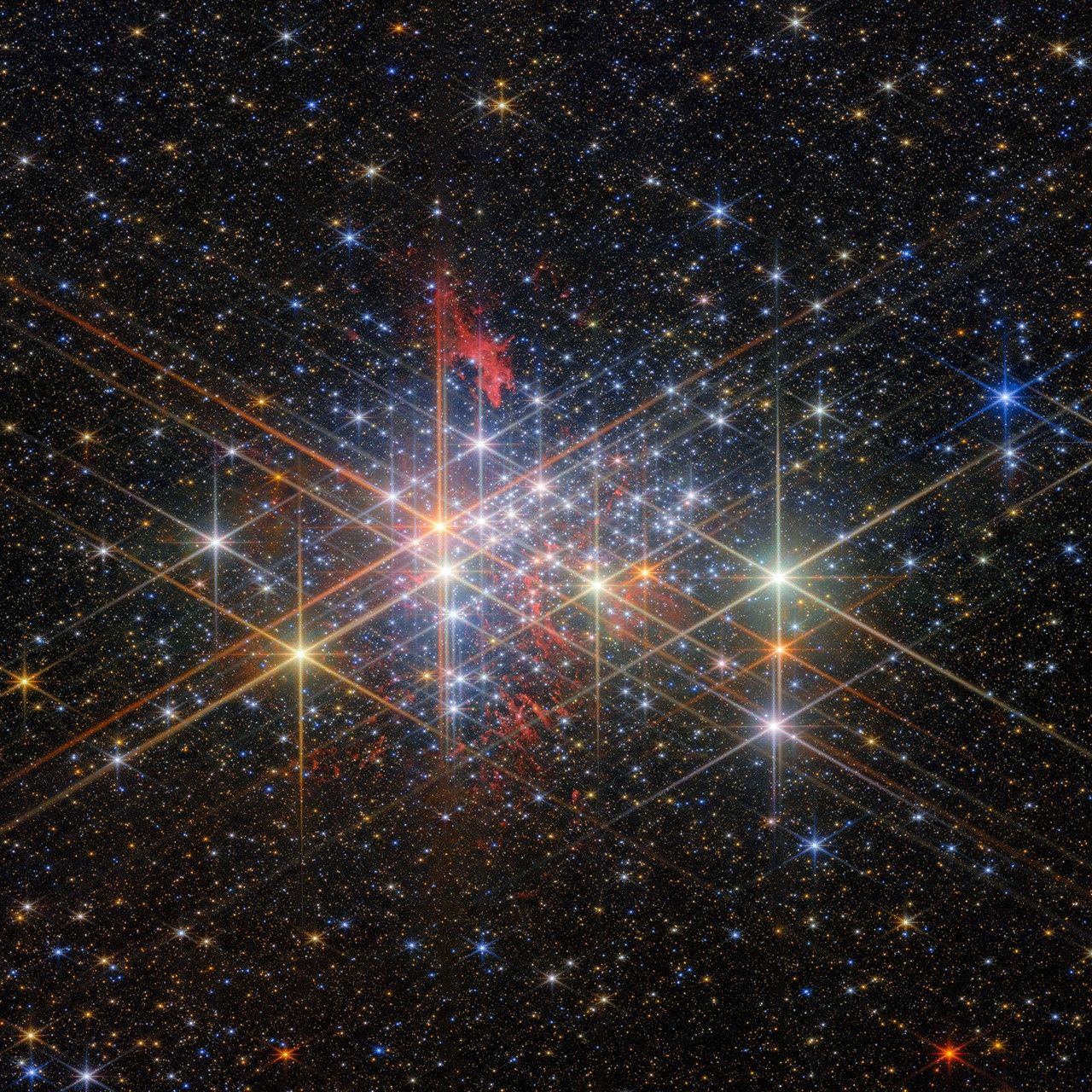
For the first time, astronomers using NASA’s Fermi Gamma-ray Space Telescope have traced a budding outflow of gas from a cluster of young stars in our galaxy — insights that help us understand how the universe has evolved as NASA explores the secrets of the cosmos for the benefit of all.
The cluster, called Westerlund 1, is located about 12,000 light-years away in the southern constellation Ara. It’s the closest, most massive, and most luminous super star cluster in the Milky Way. The only reason Westerlund 1 isn’t visible to the unaided eye is because it’s surrounded by thick clouds of dust. Its outflow extends below the plane of the galaxy and is filled with high-speed, hard-to-study particles called cosmic rays.
“Understanding cosmic ray outflows is crucial to better comprehending the long-term evolution of the Milky Way,” said Marianne Lemoine-Goumard, an astrophysicist at the University of Bordeaux in France. “We think these particles carry a large amount of the energy released within clusters. They could help drive galactic winds, regulate star formation, and distribute chemical elements within the galaxy.”
A paper detailing the results published Dec. 9 in Nature Communications. Lemoine-Goumard led the research with Lucia Härer and Lars Mohrmann, both at the Max Planck Institute for Nuclear Physics in Heidelberg, Germany.
Super star clusters like Westerlund 1 contain more than 10,000 times our Sun’s mass. They are also more luminous and contain higher numbers of rare, massive stars than other clusters.
Scientists think that supernova explosions and stellar winds within star clusters push ambient gas outward, propelling cosmic rays to near light speed. About 90% of these particles are hydrogen nuclei, or protons, and the remainder are electrons and the nuclei of heavier elements.
Because cosmic ray particles are electrically charged, they change course when they encounter magnetic fields. This means scientists can’t trace them back to their sources. Gamma rays, however, travel in a straight line. Gamma rays are the highest-energy form of light, and cosmic rays produce gamma rays when they interact with matter in their environment.
Most gamma-ray observations of stellar clusters have limited resolution, so astronomers effectively see them as indistinct areas of emission. Because Westerlund 1 is so close and bright, however, it’s easier to study.