



Life may have started as sticky goo clinging to rocks
How did life begin? A team of scientists from Japan, Malaysia, the United Kingdom, and Germany believes the answer
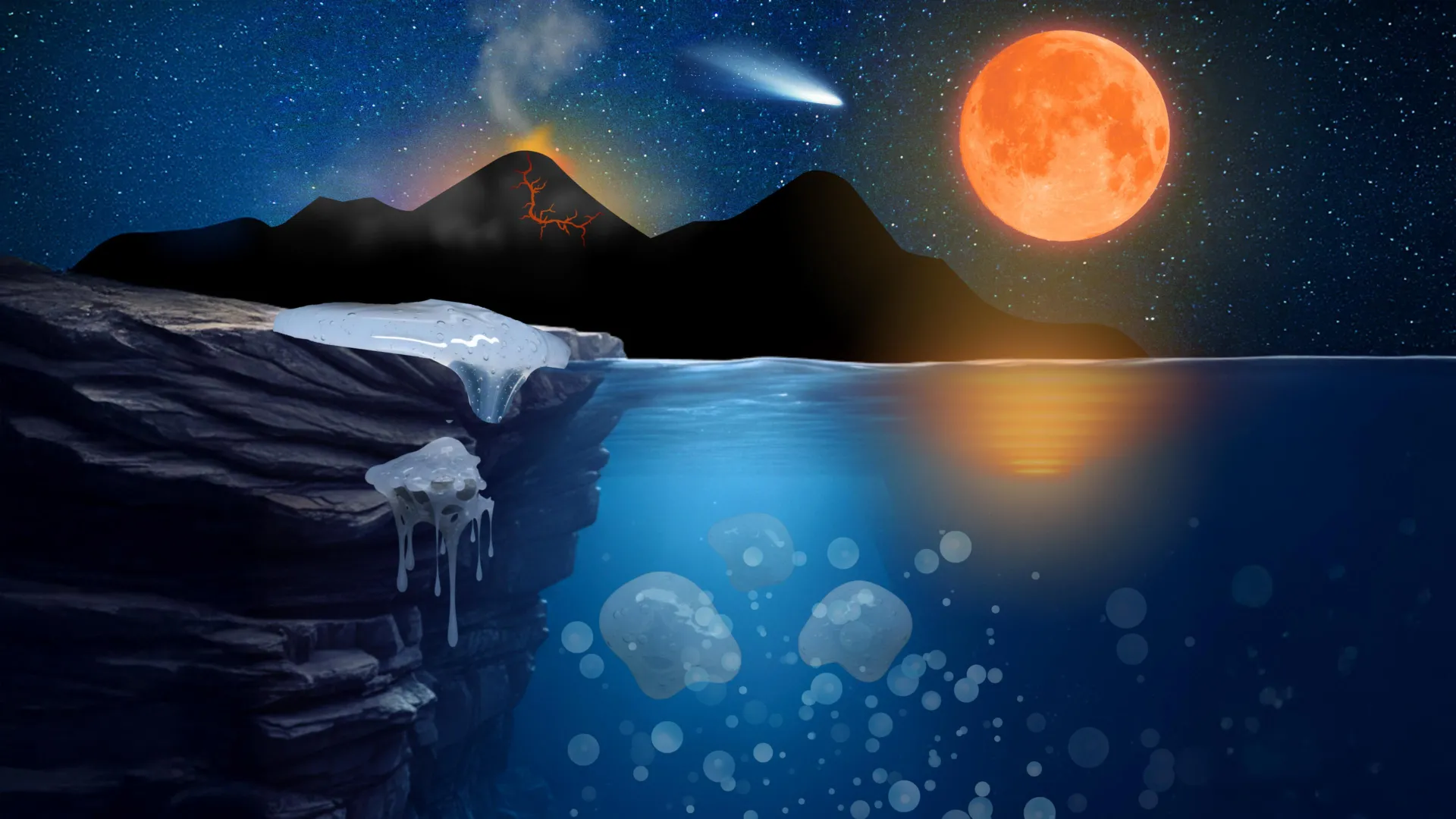
How did life begin? A team of scientists from Japan, Malaysia, the United Kingdom, and Germany believes the answer may involve sticky gels that coated surfaces on early Earth long before the first true cells appeared.
Their work, published in ChemSystemsChem, offers a fresh way to think about the origin of life on our planet and even raises new possibilities for finding life elsewhere in the universe.
For centuries, people have wondered how life first emerged. Although no one can observe those earliest moments directly, researchers continue to reconstruct what might have happened using clues from chemistry, physics, and geology.
“While many theories focus on the function of biomolecules and biopolymers, our theory instead incorporates the role of gels at the origins of life,” said Tony Z. Jia, professor at Hiroshima University and co-lead author of the paper.
The Prebiotic Gel-First Hypothesis
The researchers propose what they call a “prebiotic gel-first” framework. In this scenario, life’s earliest steps took place inside surface-attached gel matrices, which are sticky, semi-solid materials similar in some ways to modern microbial biofilms. Biofilms are the thin layers of bacteria that commonly grow on rocks, pond surfaces, and even human-made structures.
Using concepts from soft matter chemistry and insights from modern biology, the team suggests that these primitive gels could have created the right physical setting for simple chemical systems to grow more complex, well before the first cells formed.
These gels may have helped solve major challenges faced by early chemistry. By trapping and organizing molecules, they could have increased molecular concentration, held onto useful compounds, and shielded delicate reactions from environmental changes. Within such protected spaces, early chemical networks might have developed proto-metabolic activity and even basic self-replication, laying important groundwork for biological evolution.
“This is just one theory among many in the vast landscape of origin-of-life research,” said Kuhan Chandru, research scientist at the Space Science Center, National University of Malaysia (UKM) and co-lead author of the study. “However, since the role of gels has been largely overlooked, we wanted to synthesize scattered studies into a cohesive narrative that puts primitive gels at the forefront of the discussion.”
Implications for Alien Life and Astrobiology
The idea does not stop with Earth. The researchers suggest that comparable gel-like systems might exist on other planets. These hypothetical structures, described as “Xeno-films,” could function like biofilms but be built from entirely different chemical ingredients available in other environments.
This shift in thinking could expand how scientists search for extraterrestrial life. Instead of focusing only on familiar biological molecules, future missions might also look for organized, gel-like structures that create life-friendly environments.
Testing the Gel Model
The team plans to test their hypothesis in the lab. They intend to examine how simple chemicals under early Earth conditions might have formed gels and to study what properties those gels could have offered emerging chemical systems.
“We also hope that our work inspires others in the field to further explore this and other underexplored origins-of-life theories!” said Ramona Khanum, co-first author of the paper and a former intern at UKM.
The University of Leeds Research Mobility Funding, the Alexander von Humboldt Foundation, the Japan Society for the Promotion of Science, and the Mizuho Foundation for the Promotion of Science supported this research.