
Human-plant hybrid cells reveal truth about dark DNA in our genome
Cells containing human and plant DNA reveal something fundamental about our genome Es sarawuth/Shutterstock How much of our genome
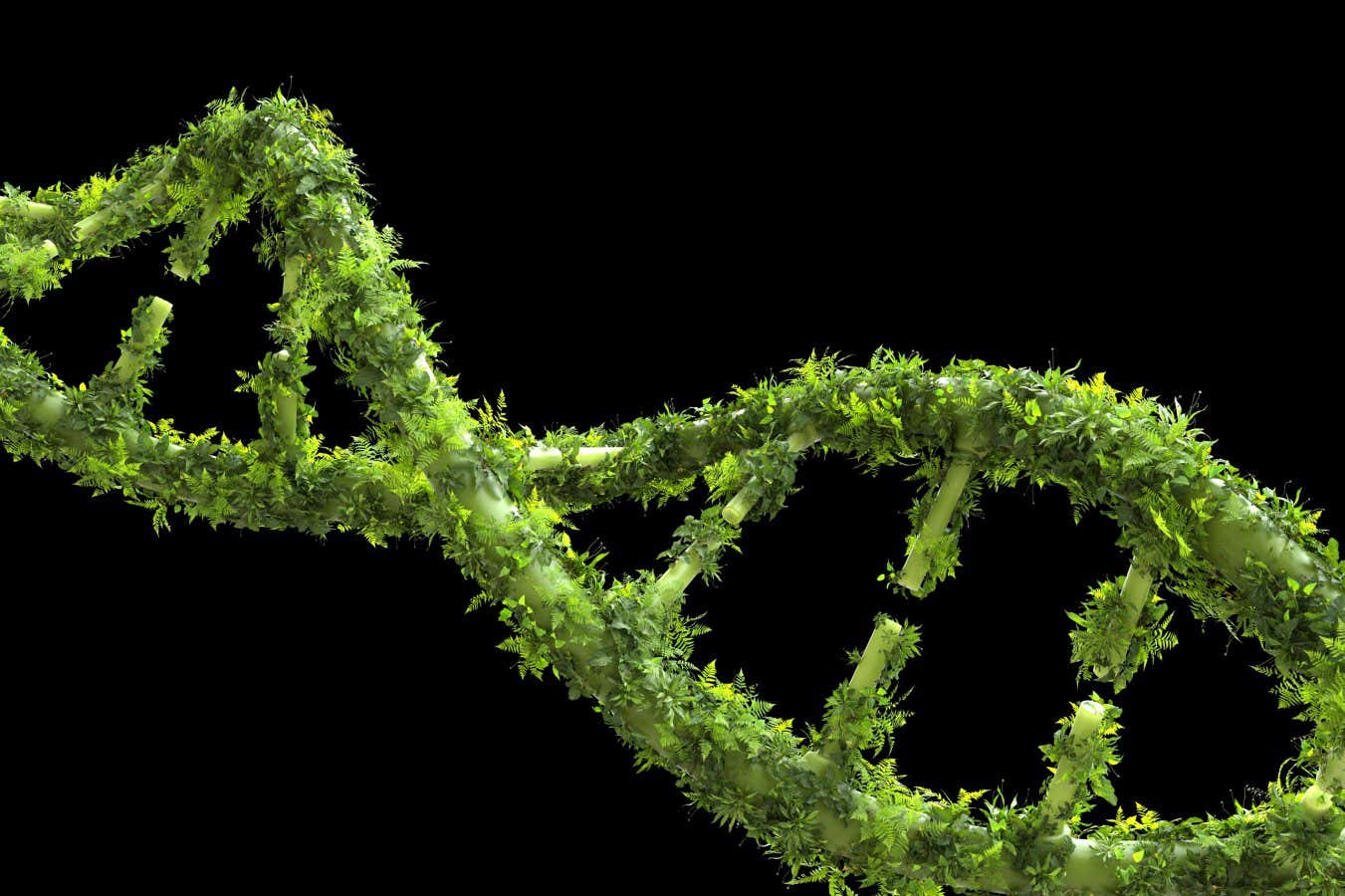
Cells containing human and plant DNA reveal something fundamental about our genome
Es sarawuth/Shutterstock
How much of our genome really matters? Some argue that because most of our DNA is active, it must be doing something important. Others say even random DNA would be highly active. This has now been put to the test by studying human cells containing massive chunks of plant DNA, New Scientist can exclusively reveal – and the effectively random plant DNA was indeed nearly as active as human DNA.
The finding shows that a high proportion of genome activity is just noise, rather than having anyn purpose, and thus adds to the evidence that most of the human genome is junk.
“A large amount can simply be explained by background noise,” says Brett Adey at the University of Auckland in New Zealand. “This seems to be broadly consistent with the junk DNA idea.”
The main function of DNA is to store the recipes for making proteins, the molecular machines that do almost all the work in cells. The DNA recipes are copied to make messenger RNAs that carry the recipes to ribosomes, the cell’s protein-making factories.
It was initially assumed almost all DNA consists of recipes for making proteins, but we now know that just 1.2 per cent of the human genome codes for proteins. So what does the rest do?
Since the 1960s, many biologists have argued that it is mostly junk. Yes, a small percentage of non-protein-coding DNA is really important and we are likely to keep discovering bits that do useful things for decades, but such discoveries, they say, won’t change the overall picture of the vast majority of non-coding DNA being junk.
For instance, a 2011 study found that only around 5 per cent of the genome is conserved over deep time – evolution doesn’t seem to care about the rest of it. Biologists in the mostly-junk camp also point out that the size of genomes varies wildly between species. Why does an onion need five times as much DNA as a human, for instance? Why does the lungfish have 30 times as much?
But other biologists have focused on whether human DNA does anything – for instance, whether it gets turned into RNA, even if that RNA has no known purpose. In 2012, a large project called ENCODE concluded that more than 80 per cent of the human genome was active in this sense, and claimed this showed that it isn’t junk after all. Some biologists in this camp use the term “dark DNA” to refer to non-coding DNA, the idea being it is important for reasons we don’t understand yet.
In response to ENCODE’s claim, in 2013, Sean Eddy at Harvard University proposed the random genome project. “Suppose we put a few million bases of entirely random synthetic DNA into a human cell, and do an ENCODE project on it,” he wrote.
Will we still see all the activities ENCODE hailed as proof of function? “I think yes,” Eddy concluded.
“You can’t really conclude anything just from measuring activity. And so that’s the brilliance of Sean Eddy’s random genome idea, that what we really need is this baseline,” says Austen Ganley, also at the University of Auckland. “Without that baseline, anything you look at is not really meaningful in terms of deciding between function and junk.”
Making synthetic DNA, however, is expensive. Until now, the only attempts at a random genome project have involved small pieces of DNA no longer than around 100,000 base pairs.
But when Adey and Ganley learned that researchers in Japan had created human-plant hybrid cells containing 35 million base pairs of DNA from thale cress (Arabidopsis thaliana), they realised this could be seen as by far the largest random genome project to date.
Eddy, who wasn’t involved in the study, agrees. Plants and animals diverged from a common ancestor at least 1.6 billion years ago, so in that time mutations have “effectively randomised” the non-coding DNA in A. thaliana. Every single site has mutated several times, Eddy estimated when asked about this approach.
After initial studies to check the plant DNA is indeed effectively random, as far as the human cell is concerned, Adey and Ganley then measured the number of starting points for turning DNA into RNA per 1000 base pairs of non-coding DNA.
If DNA being turned into RNA really is a sign of function, then hardly any plant DNA should be turned into RNA. In reality, Adey and Ganley found only slightly less activity – there were around 80 per cent as many start sites per kilobase of non-coding A. thaliana DNA compared with human non-coding DNA.
In other words, this strongly suggests that almost all the activity seen by ENCODE is noise.
“This is an excellent demonstration of how biology is, indeed, noisy,” says Chris Ponting at the University of Edinburgh in the UK. “The biochemical activities happening within this [plant] sequence clearly confer no function on the human cell.”
“This very elegant study was needed,” says Dan Graur at the University of Houston, Texas. “It offers yet more experimental evidence confirming what has been obvious for years: most of the human genome is junk. The term ‘dark DNA’ is laughable nonsense, dreamed up by people with a bad case of physics envy.”
In a perfectly designed system, there would be no noise, says Ganley, but evolution doesn’t create perfect designs. And noise can have advantages. “If you have these imperfect systems that have a lot of noise, that noise can actually create interesting things that then can then be picked up by selection,” he says.
As yet, the team can’t explain why there was 25 per cent more activity in human DNA. “All we can really say is that that needs explanation,” says Ganley.
It is possible some of the extra RNAs do have functions – this wouldn’t change the mostly-junk conclusion – but there are other potential explanations too. The researchers are now using machine learning to see if they can find ways to distinguish potentially meaningful activity from background noise.
The team plans to publish the findings, but hasn’t yet written a paper.
Topics: