


Hornet-eating frog shows remarkable venom resistance
A frog with an unexpectedly strong resistance to venom has been identified, and it routinely eats hornets despite the
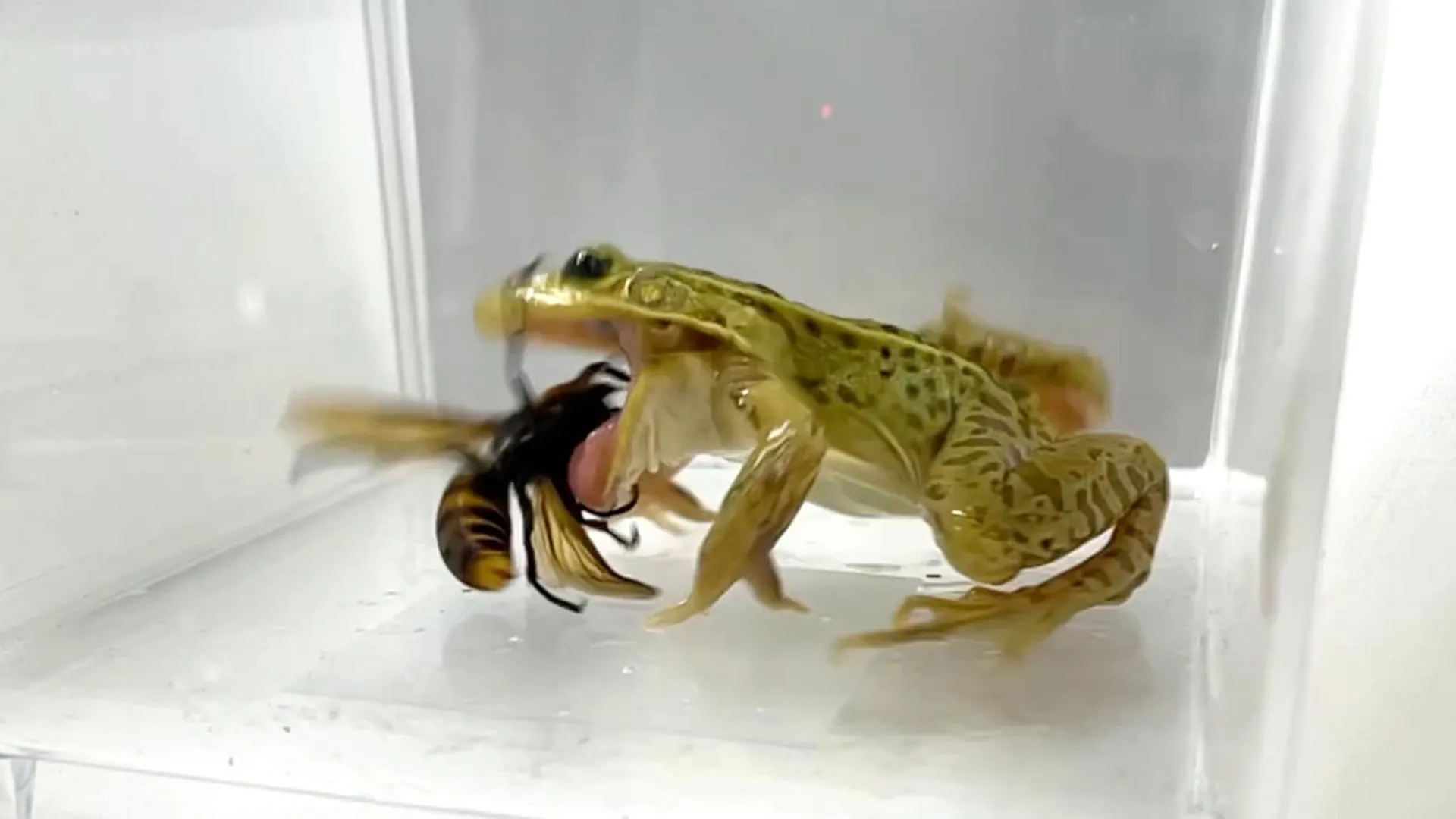
A frog with an unexpectedly strong resistance to venom has been identified, and it routinely eats hornets despite the insects’ dangerous stingers. Researchers believe this species may become a useful model organism for exploring how animals develop tolerance to venom.
For many people, even glimpsing a hornet’s stinger is enough to cause alarm. Yet certain animals, including some birds, spiders, and frogs, regularly prey on adult hornets. A hornet sting can trigger sharp pain, tissue damage, and serious systemic problems such as the destruction of red blood cells and cardiac dysfunction, any of which can be fatal. What has remained uncertain is whether hornet-eating animals actually withstand the venom or simply avoid being stung. According to Kobe University ecologist Shinji Sugiura, “Although stomach-content studies had shown that pond frogs sometimes eat hornets, no experimental work had ever examined how this occurs.”
Testing Whether Frogs Endure Hornet Stings
To investigate whether pond frogs evade or tolerate these potentially lethal stings, Sugiura presented individual adult frogs with workers of three hornet species, Vespa simillima, V. analis, and V. mandarinia, in controlled laboratory trials. Each frog was tested only once and paired with hornets that matched its size, with larger frogs being paired with Asian giant hornet (V. mandarinia) workers.
As reported in the journal Ecosphere, Sugiura found clear evidence that adult pond frogs actively launched attacks on workers of all three hornet species. Even more striking, 93%, 87%, and 79% of the frogs succeeded in consuming V. simillima, V. analis, and V. mandarinia, respectively, despite being stung inside the mouth or even in the eyes. Sugiura notes that “While a mouse of similar size can die from a single sting, the frogs showed no noticeable harm even after being stung repeatedly. This extraordinary level of resistance to powerful venom makes the discovery both unique and exciting.”
What Makes a Sting Painful or Lethal
Earlier research has shown that the pain caused by stinging insects does not always match the lethality of their venom. Some bees, wasps, and ants deliver extremely painful but non-lethal stings, while others inflict minimal pain despite possessing highly toxic venom. This suggests that the frogs in the study may have developed a dual resistance to both the painful and harmful effects of hornet venom, allowing them to successfully hunt and consume hornet workers.
Future Questions About Venom Tolerance
Sugiura explains that this finding raises major questions for future research. Scientists now hope to determine whether pond frogs possess physiological traits, such as physical barriers or specific proteins, that reduce the pain and toxicity of hornet venom, or whether hornet toxins are simply ineffective in amphibians that rarely attack hornet colonies. These frogs may therefore become important model organisms for studying how vertebrates develop resistance to venom and pain.
This research was funded by the Japan Society for the Promotion of Science KAKENHI (grants JP23K18027 and JP24K02099).