
Greenland ‘will stay Greenland’, former Trump adviser declares
Faisal Islam,Economics editor, Davosand Oliver Smith,Business reporter, Davos Gary Cohn says he thinks invading a country that is already
Faisal Islam,Economics editor, Davosand
Oliver Smith,Business reporter, Davos
Donald Trump will not be able to force Greenland to change ownership, a former top adviser to the US president has told the BBC.
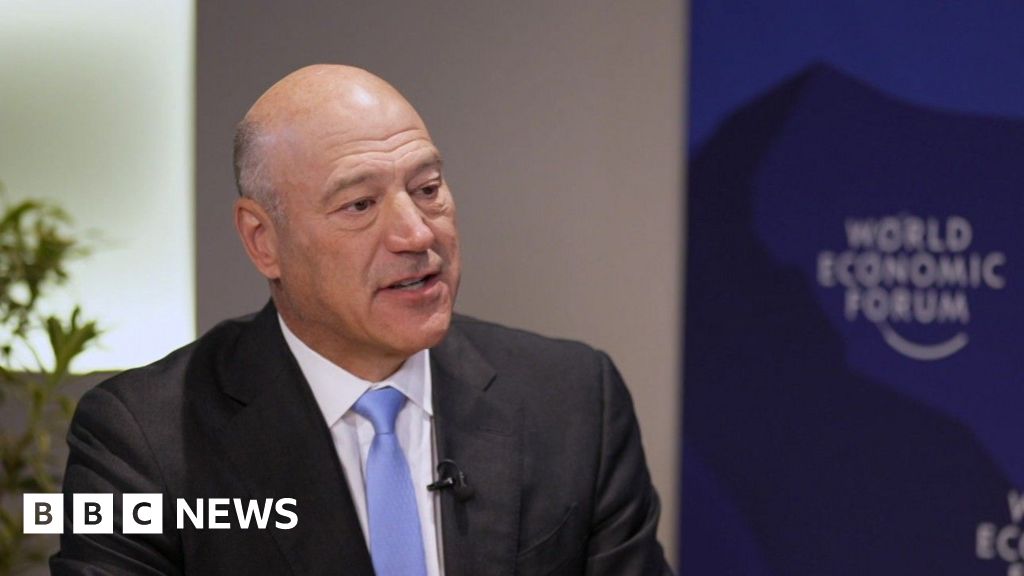
IBM’s vice chairman Gary Cohn, who advised Trump on the economy in his first term, said “Greenland will stay Greenland” and linked the need for access to critical minerals to his former boss’s plans for the territory.
Separately, US Treasury Secretary Scott Bessent urged people to “relax” and “let things play out” on the tariff threats against Europe over Greenland.
Speaking at a news conference at the World Economic Forum in Davos, Bessent compared the reaction to Trump’s announcement on US tariffs last year and claimed the current situation was different.
Cohn is one of America’s top tech bosses, a leader in the race to develop AI and quantum computing, and served under Trump as director of the White House National Economic Council.
In a sign of how seriously business leaders are taking the crisis, he warned “invading an independent country that is part of Nato” would be “over the edge”.
He also suggested the president’s recent comments about Greenland “may be part of a negotiation”.
“I just came from a US congressional delegation meeting, and I think there’s pretty uniform consensus with both Republicans and Democrats that Greenland will stay Greenland,” he said.
Greenland would be happy for the US to increase its military presence on the island, he said, with the North Atlantic and Arctic Ocean “becoming much more of a military threat”.
The US could also negotiate an “offtake” agreement for Greenland’s vast yet largely untapped supplies of rare earth minerals, Cohn suggested.
“But I think, you know, invading a country that doesn’t want to be invaded – that’s part of a militaristic alliance, Nato – seems to me to be a little bit over the edge at this point,” he said.
Cohn indicated the president may be overstating his demands as part of a negotiating tactic – something he says the president has done successfully in the past.
“You’ve got to give Donald Trump some credit for the successes he’s had and he’s many times tried to overreach to get something in a compromise situation,” he said.
“He has overreached in advertising something to end up getting what he actually wants. Maybe what he actually wants is a larger military presence and an offtake.”
 EPA
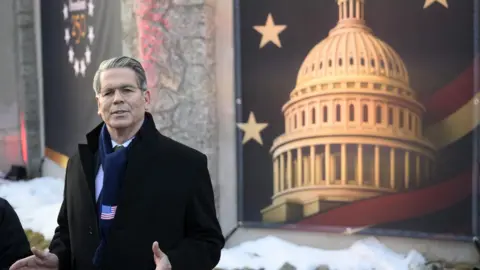
EPAThe start of this year’s World Economic Forum in the Swiss ski resort of Davos has been overshadowed by the president’s increasingly aggressive stance on the arctic territory, with many political and business leaders alarmed about the potential geopolitical and economic impact. Trump is due to address delegates at the gathering on Wednesday.
But speaking on Tuesday morning, the US treasury secretary told reporters there had been an over-reaction to the president’s comments.
“This is the same kind of hysteria we heard on April 2nd. There was a panic. And what I am urging everyone here is sit back, take a deep breath and let things play out,” Bessent said.
“The worst thing countries can do is escalate against the United States. Back then only one country, China, escalated. We ended up in an unfortunate tit-for-tat.
“What the president is threatening on Greenland is very different than the other trade deals so I would urge all countries to stick with their trade deals. We have agreed on them and it does provide great certainty,” he added.
Asked if the US was still an ally of Europe, Bessent accused the media of going to a “maximalist position”.
“Of course Europe is an ally, the US Nato membership is unquestioned, we are partners in trying to stop the tragic war between Russia and Ukraine, but that does not mean that we cannot have disagreements on the future of Greenland,” he said.
While Cohn expressed reservations about some of the president’s actions, he said the US administration had “various different motives” for what they were doing.
He said Trump’s decision to intervene in Venezuela was “a path” to disrupt the country’s relationship with China, the biggest market for its oil, as well as Russia and Cuba.
Cohn also thinks that the president has become increasingly focused on the importance of rare earth minerals, noting that “Greenland has quite a supply” of the resources.
Those minerals are critical to the development of artificial intelligence (AI) and quantum computing – also a major talking point in Davos.
AI ‘to be part of every business’
Developments in quantum computing and AI are seen as critical not just for the US economy and productivity, but for US strategic influence in the world.
“IBM is dead centre in what’s going on in quantum today. We have the largest amount of quantum computers in use today,” Cohn said, highlighting that his company has put many of these computers into use across America in firms from the banking industry to medicine.
“AI is going to be the backbone for data that feeds into quantum to solve problems we’ve never been able to solve,” he added.
“Where we’re heading is AI is going to be part of everyone’s enterprise. AI and quantum are going to be working in the enterprise behind the scenes to make every company more efficient. And we’re just at the beginning of that sort of long road, and that’s going to take probably another three to five years to get there.”
Earlier this month, US tech giant Google told the BBC it had the world’s best-performing quantum computer. The race to develop the technology is the other key talking point – apart from Greenland – at the World Economic Forum.