



Gravitational waves may reveal hidden dark matter around black holes
Scientists at the University of Amsterdam have developed a new way to use gravitational waves from black holes to
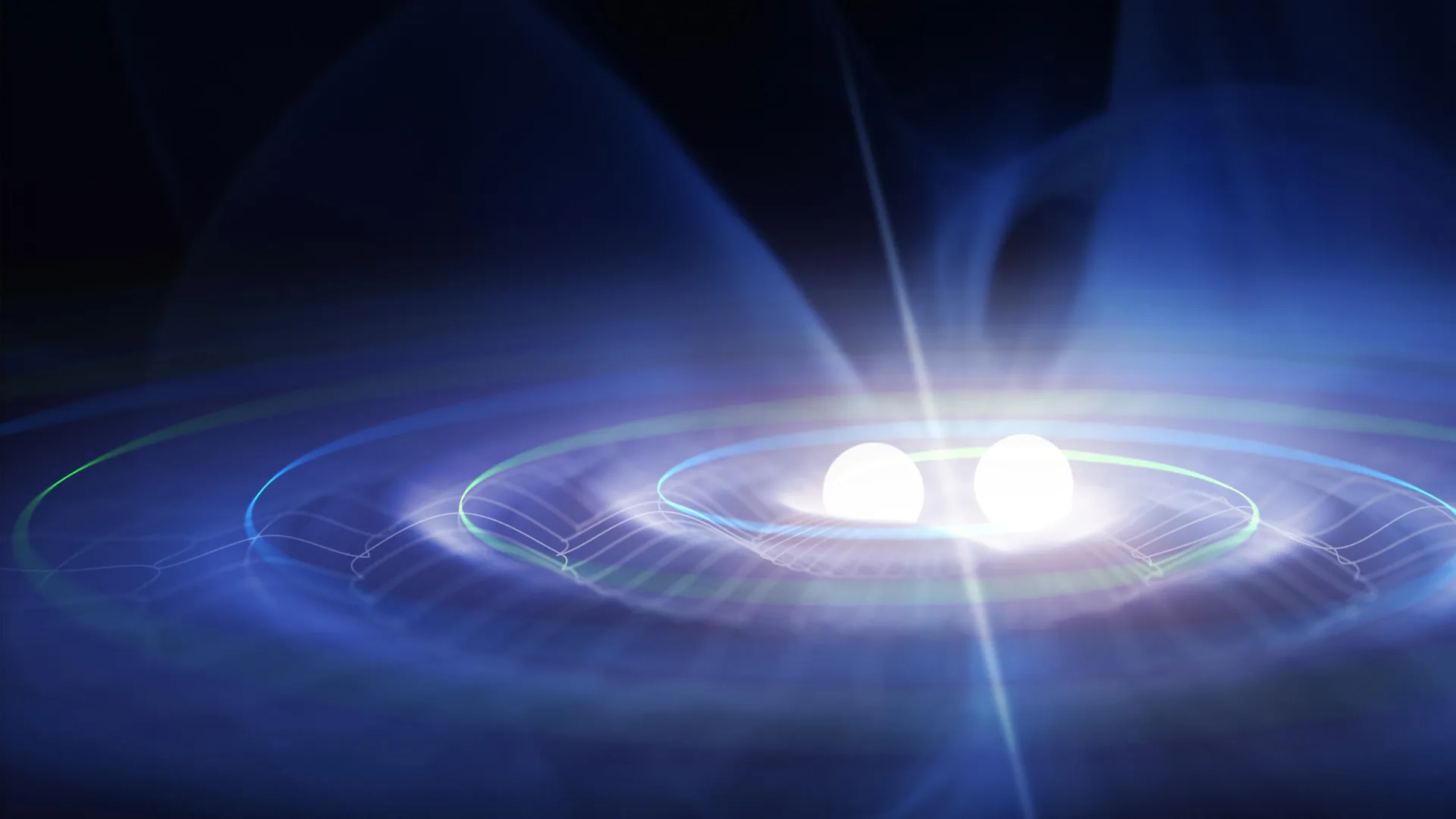
Scientists at the University of Amsterdam have developed a new way to use gravitational waves from black holes to uncover the presence of dark matter and learn more about its behavior. Their approach relies on a detailed theoretical model grounded in Einstein’s theory of general relativity. This model carefully describes how a black hole interacts with material in its immediate environment, including dark matter that cannot be seen directly.
The research was carried out by Rodrigo Vicente, Theophanes K. Karydas and Gianfranco Bertone from the UvA Institute of Physics (IoP) and the GRAPPA center of excellence for Gravitation and Astroparticle Physics Amsterdam. Their findings were published in the journal Physical Review Letters. In the study, the team presents a more advanced method for calculating how dark matter surrounding black holes subtly alters the gravitational waves those systems produce.
Extreme Mass Ratio Inspirals and Long Gravitational Signals
The study concentrates on a class of systems known as extreme mass-ratio inspirals, or EMRIs. These occur when a small, dense object — such as a black hole created by the collapse of a single star — moves in orbit around a much larger black hole, usually one located at the center of a galaxy. Over time, the smaller object gradually spirals inward, emitting gravitational waves throughout this slow descent.
Upcoming space missions, including the European Space Agency’s LISA space antenna scheduled for launch in 2035, are expected to observe these signals for very long periods. Some EMRI events may be tracked for months or even years, covering hundreds of thousands to millions of individual orbits. When scientists can model these signals with high precision, the resulting data act like detailed “cosmic fingerprints” that reveal how matter is arranged near massive black holes. This includes dark matter, which is believed to make up most of the matter in the Universe.
Why a Fully Relativistic Model Matters
Before observatories like LISA begin collecting data, researchers must understand in advance what kinds of gravitational wave patterns they should expect and how to interpret them. Until now, many studies have used simplified models that only roughly describe how the surrounding environment influences EMRIs. According to the authors, these approximations leave out important physical effects.
The new work addresses this limitation by introducing the first fully relativistic framework for a wide range of possible environments. This means the calculations rely entirely on Einstein’s theory of gravity rather than simplified Newtonian approximations. As a result, the model can more accurately describe how matter around a massive black hole changes the orbit of the smaller object and reshapes the gravitational waves that are emitted.
Dark Matter Spikes and Detectable Imprints
A key focus of the study is on dense regions of dark matter that may form around massive black holes. These concentrations are often referred to as “spikes” or “mounds.” By incorporating their relativistic model into modern gravitational waveform calculations, the researchers demonstrate that such dark matter structures would leave distinct, measurable signatures in the signals detected by future observatories.
The authors describe this research as an essential step toward a larger scientific goal. Over time, they hope gravitational waves can be used to chart how dark matter is distributed throughout the Universe and provide new insight into its fundamental nature.