

French Navy dials up stress level in crew drills after Red Sea experience
PARIS — The French Navy is toughening crew drills to better prepare sailors for the stress of coming under
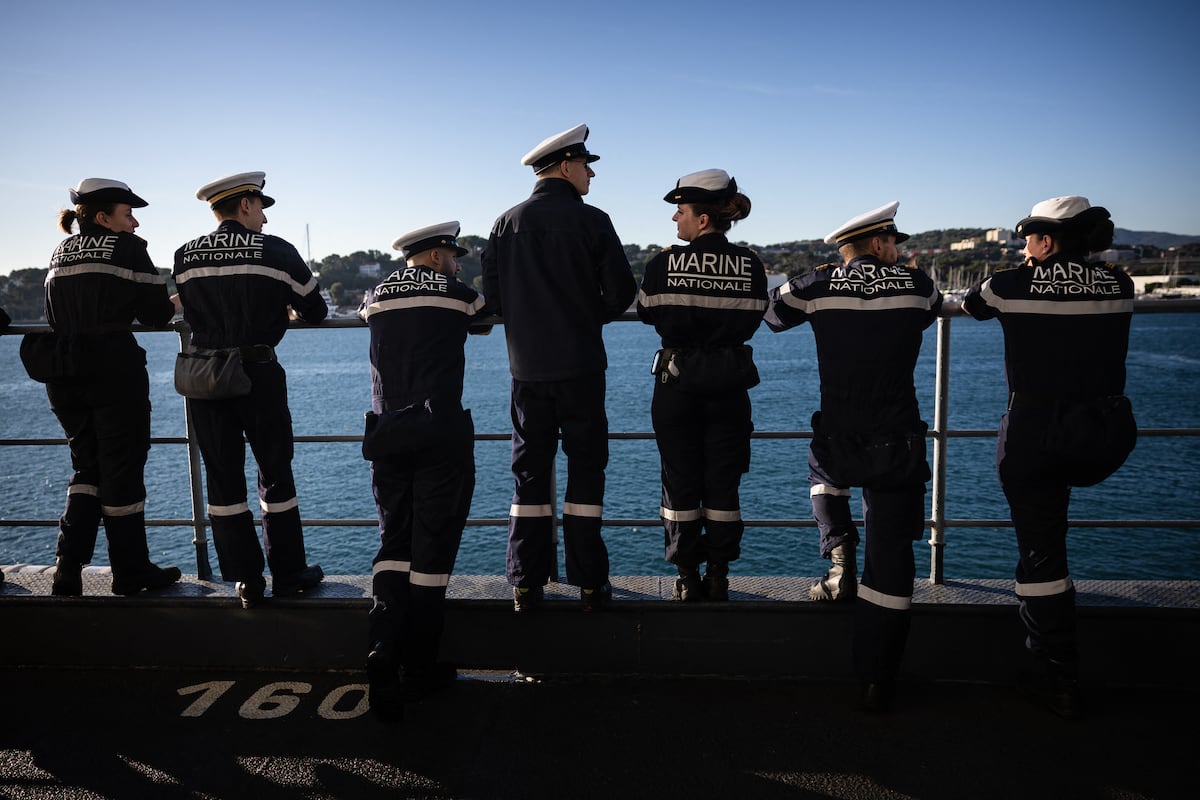
PARIS — The French Navy is toughening crew drills to better prepare sailors for the stress of coming under fire, following deployments to the Red Sea where Houthi rebels targeted Western warships and commercial traffic with drones and ballistic missiles.
The navy is experimenting with its simulator drills to put crews in “increasingly stressful situations,” said Capt. Jérôme Henry, the head of training for the navy’s surface personnel, at the Paris Naval Conference this week. Henry said he’s drawing on past experience as commander of the frigate Alsace, which came under attack multiple times in the Red Sea, to “toughen up our crews.”
“What I saw in the Red Sea is that when you’re under intense stress, people react more or less well but in any case, you lose some of your composure, you get what’s called tunnel vision,” Henry told Defense News on the sidelines of the conference. “If we’re going to be in high-intensity combat, our crews need to be ready for that stress, and the question is, how are we going to prepare them?”
RELATED
Training tweaks include crews going for a run or doing push-ups right before stepping into weapon simulators to get heart rates up, creating sensory overload by adding noise, smoke and drone swarms to simulations, and adding weapon malfunctions in drills, said Henry, who took on his current role last year.
Henry says he adopted the idea of stress drills from the French Navy’s special forces, the Commandos Marine, and is seeking to find out how American and Israeli forces include stress in their training.
The goal for now is to dial up stress levels “as high as possible” to ensure that reflex actions are always the right ones, the training chief said. Henry said the challenge is the difficulty of putting people under such stress “that they feel like their final hour has come.”
The training division is trying to create the most disruptive environment possible in its simulators, so that personnel including gunners and missile operators “can mechanize their actions” to ensure they’ll be able to perform in combat whatever the situation, according to Henry.
“I know what it feels like to take a missile on the nose at four times the speed of sound,” Henry said. “So we know where we start to get stressed, we know we have to prepare for that.”
The most important lesson learned from the Red Sea is the need to be ready at all times, Adm. Harold Liebregs, commander of the Royal Netherlands Navy, told Defense News.
“The time when we could leave port, then build up and then see what mission we were going to do, that has changed,” Liebregs said. “It’s about training, but also about buildup. It’s about everything becoming more and more realistic, and it starts with having your war plans ready.”
Liebregs said the officer who commanded the support ship Karel Doorman during its deployment in the Red Sea, Paul Bijleveld, is now the navy’s commander for Sea Training, “so all the lessons we learned there, he’ll take onboard. Perhaps that is no coincidence.”
Western navies lack combat experiences in terms of high-intensity naval war, said Capt. Bryan McCavour, deputy assistant chief of staff for information warfare at the United Kingdom’s Royal Navy, who spoke on a panel with Henry. With fewer and fewer platforms in national fleets, ongoing problems with ship maintenance and availability, training is consistently getting compressed, he said.
“If we’re going to engender that war-fighting spirit and maintain it, and have that culture as a decisive factor in battle, we need to invest more time in high-end war-fighting training than I think we currently do,” McCavour said.
McCavour said it’s been longer since the Falklands War than between that conflict and World War II, and “combat-ready naval forces in that sense maybe don’t exist today in the way we think, because it’s been a very long time since we had a high-end conflict.”
He said Russia was reminded of that lesson with the sinking of the cruiser Moskva in the Black Sea, and Western forces need to take that into account when they look at responding in the South China Sea or the High North around the Kola Peninsula.
The Red Sea was also “a little bit the rediscovery” of low-end threats, with renewed focus on small-caliber weapons and cannons, and a pipeline of defensive layers including jamming, light missiles and laser-guided rockets, according to Henry, who directed the navy’s annual Wildfire drone exercise to focus on saturation as well as the risk of friendly fire in a busy environment.
“When you have a lot of things flying around you, and you open fire with other friendly units, we saw in the Red Sea that mistakes can be made,” Henry said. “So we’re working on that.”
The French Navy is furthermore training for combat while minimizing radio emissions, relying on adversary emissions to build situational awareness, according to Henry. The force is working to cut reliance on satellite positioning, helped by improved inertial-navigation systems as well as astral sights using the stars for positioning.
Henry mentioned the ‘Back to the ‘80s’ exercises by the French carrier strike group, which entails forgoing satellite communications and instead using HF and UHF radio for comms, “and above all, to be more frugal in our exchanges.”
Cyber warfare is the prime example of a threat likely to deprive naval forces of capabilities “at the worst possible moment,” according to Capt. Florian El-Ahdab, commanding officer of the French frigate Languedoc. He said preparing for eventualities such as loss of connectivity requires ‘Back to 80s’ type exercises and placing forces in situations of “great discomfort.”
“Today’s sailors reflect today’s society, so if I took your smartphone away today and told you to go somewhere, I’m not sure you’d feel very comfortable,” said El-Ahdab. He said “it’s the same thing” for the navy.
“If you take away all the tools available to the commander today, and all the amazing tools that are currently being developed, if I suddenly tell you that all of that is no longer available for one reason or another, how would you respond?” El-Ahdab asked. “That seems like a very, very good challenge to explore.”
Rudy Ruitenberg is a Europe correspondent for Defense News. He started his career at Bloomberg News and has experience reporting on technology, commodity markets and politics.