


Earth may have been ravaged by “invisible” explosions from space
Touchdown airbursts are a form of cosmic impact that may happen more often than the well-known, crater-forming events linked
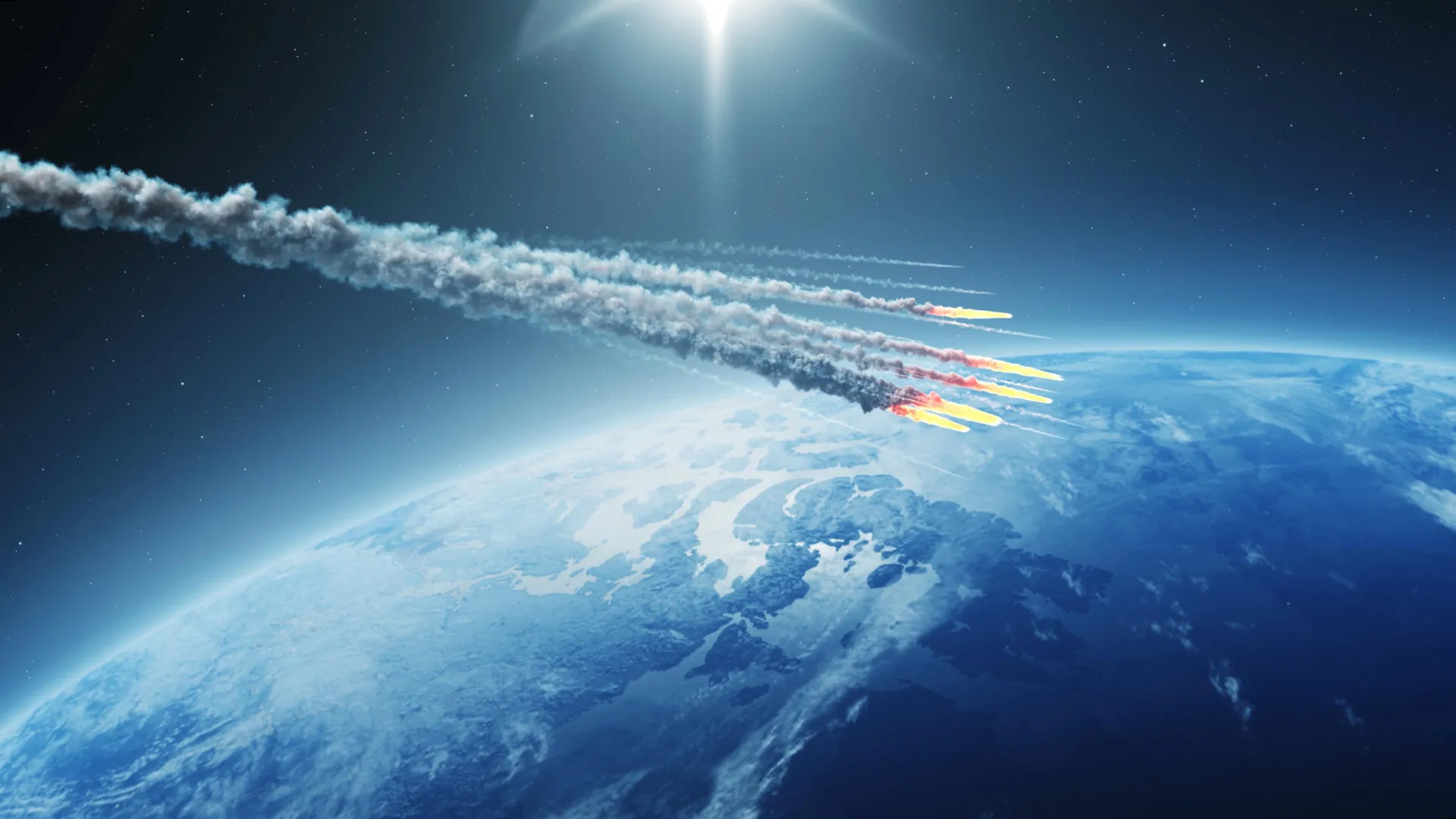
Touchdown airbursts are a form of cosmic impact that may happen more often than the well-known, crater-forming events linked to mass extinctions. Despite their potential for destruction, these explosive encounters remain poorly understood. UC Santa Barbara Earth Science Emeritus Professor James Kennett and his colleagues argue that these powerful events deserve far more scientific attention.
“Touchdown events can cause extreme damage through very high temperatures and pressures,” Kennett said. “And yet they don’t necessarily form a crater, or they form ephemeral surface disturbances, but they’re not the classic major craters that come from direct impacts.”
Recent research led by Kennett includes four newly published studies presenting evidence for multiple airburst events that occurred at different points in the past. In these events, an incoming object such as a comet detonates above the ground, releasing intense heat and shockwaves that reach Earth’s surface. The evidence comes from a wide range of locations, including deep ocean sediments in the North Atlantic and the ruins of an ancient desert city. Across these sites, researchers identified signs of extreme conditions, including rare elements tied to the original space object, glassy material formed from melted Earth sediments, tiny spherical particles created by intense heat, and shocked quartz showing distinctive crack patterns.
Younger Dryas Evidence Found Beneath the Ocean
One of the studies, published in the journal PLOS One, describes the first discovery of airburst-related impact markers in marine sediments connected to the Younger Dryas Impact Hypothesis (YDIH). The material was found in deep-sea cores recovered from Baffin Bay, off Greenland’s western coast.
“Baffin Bay is very significant because it’s the first time we’ve found evidence for the Younger Dryas cosmic impact event in the marine record,” Kennett said. The Younger Dryas hypothesis proposes that around 12,800 years ago, fragments of a comet exploded above Earth, setting off a sudden global cooling episode known as the Younger Dryas. This period coincided with the disappearance of many large animals and major changes in human populations and cultures. Because the comet broke apart, multiple explosions likely occurred, igniting widespread fires. These fires left behind a distinctive carbon-rich layer known as a “black mat,” found mainly across the Northern Hemisphere in parts of the Americas and Europe. This layer is also rich in platinum, iridium, metallic melt particles, shocked quartz, and fused minerals known as meltglass.
“They’re preserved in marine sediments as deep as about 2,000 meters,” Kennett said. He explained that while these materials do not directly measure the strength of the explosions, they demonstrate how powerful and far-reaching the event was and hint at its influence on climate. “The material was thrown up into the atmosphere, and was globally transported and deposited in a broadly distributed layer that we earlier have described.”
Searching for a Missing Crater
Cosmic impacts vary widely, ranging from the constant fall of fine extraterrestrial dust to massive collisions that occur only once every tens of millions of years. Large impacts usually leave craters, which have long served as the strongest physical evidence for such events. Because touchdown airbursts often fail to deform the landscape in lasting ways, confirming their occurrence is much more difficult. This stands in contrast to famous sites like the Chicxulub crater near Mexico’s Yucatán Peninsula, which is directly linked to the extinction of the dinosaurs.
“Previously, there has been no evidence for the Younger Dryas boundary (YDB) event of any crater or possible crater,” said Kennett. “So these events are more difficult to detect, especially when they are older than a few thousand years and after being buried, leave little or no superficial evidence.”
However, a shallow seasonal lake near Perkins in southeast Louisiana may represent the first known crater dating to the Younger Dryas Boundary. Writing in the ScienceOpen journal Airbursts and Cratering Impacts, the research team revisited a suggestion made in 1938 by the landowner, who noted the lake’s circular shape and a “crater-like rim raised about 1 meter above the surrounding terrain.” Detailed sediment studies did not begin until 2006. Between then and 2024, researchers examined multiple sediment cores from the site and identified meltglass, spherules, and shocked quartz. Radiocarbon dating placed these materials within the Younger Dryas period. Even so, the team emphasized that “further research would be beneficial for testing the hypothesis that the lake/depression resulted from a cosmic impact.”
Reexamining Tunguska and Tall el-Hammam
Shocked quartz has long been recognized as a sign of extreme heat and pressure from cosmic impacts. Traditionally, this evidence has been associated with large crater-forming events that produce straight, parallel cracks in quartz grains. In two additional papers published in Airbursts and Cratering Impacts, the researchers argue that airbursts can generate a wider range of fracture patterns. To support this, they analyzed samples from the site of the Tunguska explosion in Siberia in 1908 and revisited findings from Tall el-Hammam, an ancient city in the Levant believed to have been destroyed by a similar event about 3,600 years ago.
“The interesting thing about Tunguska is that it is the only recorded historical touchdown event,” Kennett said. The explosion was witnessed by people on the ground, who described a bright fireball, and photographs later documented vast areas of flattened forest. Despite decades of study focused on fallen trees and soil damage, scientists had rarely searched for microscopic impact evidence. The new work represents the first comprehensive identification of airburst-related impact materials at Tunguska.
At the Tunguska site, researchers found shocked quartz showing clear planar fractures, some of which were filled with meltglass. They also identified tiny impact-formed spheres, along with melted metal and carbon. The energy released by the blast may have also created small depressions in the ground that later filled with water, forming today’s swamps and lakes.
The team also strengthened the case for an airburst over Tall el-Hammam during the Middle Bronze Age. Alongside previously reported spherules, carbon, meltglass, and rare minerals, they documented shocked quartz displaying a wide variety of crack patterns. These included classic parallel fractures as well as curved, web-like, and sub-planar features, suggesting intense pressures and complex blast directions similar to those observed at Tunguska.
A More Common and Widespread Threat
Together, the new studies support the idea that cosmic impacts, particularly touchdown airbursts, may be far more frequent than scientists once assumed.
“They’re far more common, but also possess much more destructive potential than the more localized, classic crater-forming asteroidal impacts.” said Kennett. “The destruction from touchdown events can be much more widespread.And yet they haven’t been very well studied, so these should be of interest to humanity.”