
Curiosity Blog, Sols 4852–4858: When Data Take Their Time…
Written by Susanne P. Schwenzer, Professor of Planetary Mineralogy at The Open University, UK Earth planning date: Friday, April
Written by Susanne P. Schwenzer, Professor of Planetary Mineralogy at The Open University, UK
Earth planning date: Friday, April 3, 2026
I was the geology science team lead on Monday for planning Sols 4852-4853, when our data did not arrive on time for planning. Thus, we got creative as a team thinking what we could do, not knowing where exactly our rover might be. And for that we first thought about AEGIS, the capability of the rover to find a target for ChemCam LIBS measurements on its own.
We normally use this capability after drives, before we have seen the data here on Earth, to get an extra LIBS measurement. This time, we put two of those observations into the plan, and added many atmospheric and environmental observations, such as dust-devil movies, too. It’s an interesting planning session that always makes the team talk more than normal, because there are no routines for those days! I find it both tense and rewarding at the same time. Anything that isn’t quite as expected adds levels of complexity that require more focus and more thinking, hence making me tense. But it is also really nice when we’ve succeeded in making the best of those days. My colleagues also seem to have lots of energy and are especially supportive of each other. That said, like everyone else I prefer the routine days where everything goes right and we focus on the science.
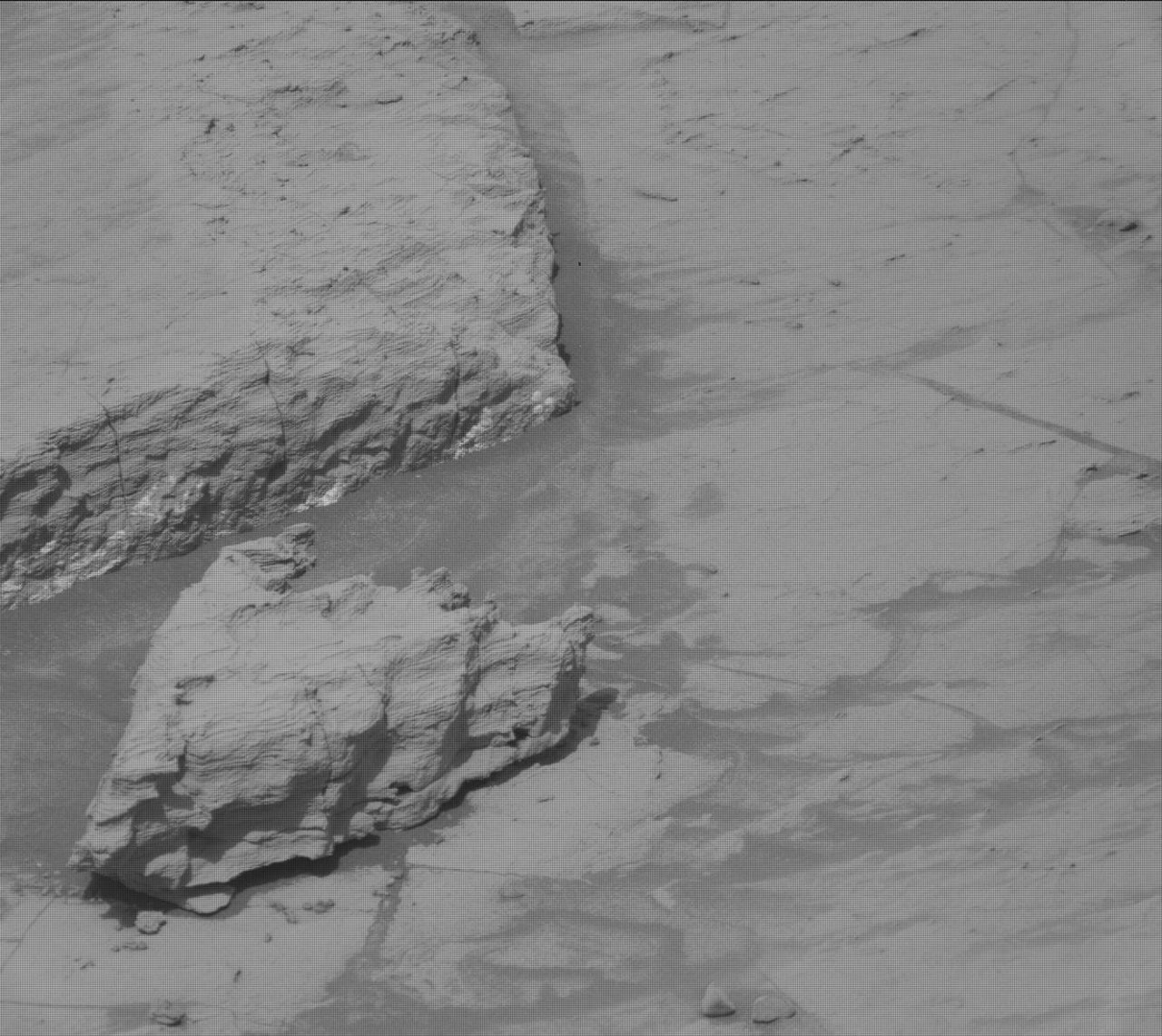
All our data arrived perfectly fine in time for planning on Wednesday and we found ourselves in a terrain with many blocks that have polygons on their top surface. Do check out the images, it’s a wild terrain that reminded me of some boulder-rich terrains we have seen back on the margins of the Gediz Vallis Channel. It is interesting to see the distribution of the blocks, and I am curious how they might change along the traverse up Mount Sharp. For now, we have an activity that we call “MARDI sidewalk” in the plan. This means the MARDI camera takes images while the rover is driving, on Sol 4855. Those image sequences give great insights into changing terrains, and we are looking forward to the data reaching us!
Over the course of the week, ChemCam did three AEGIS observations and four human-pointed observations on the targets “Las Petas,” “Punta Negra,” “Pampa del Molle,” and “Los Condores.” We were trying to measure the normal-looking bedrock and all the different features, some of which you can see in the image above. We want to find out what the higher-standing materials are that form those prominent polygons. APXS is getting four targets in the plan, also looking at the diversity of rocks. These are called “Rio Espiritu Santo,” “La Escalera,” “Los Condores,” and “Tropico de Capricornio.” It’s all focused on understanding what forms the polygons, because any differences in chemistry could tell us a lot about what happened and how the polygons came to be. By extension, this will then allow the team to deduce the environmental conditions at the time the polygons formed.
As you may guess, imaging is very important in a landscape as varied as this! Mastcam is looking in many directions in the near-field and further up the road — our projected drive path. In addition, ChemCam is taking long-distance images with its Remote Micro Imager (RMI) to get a closer look at the walls around us. The butte called “Mishe Mokwa” is still one of the RMI and Mastcam favorites because it gives us many insights into its structure as we are driving past and also somewhat around it.
Atmospheric and environmental observations occur all across the plans and include atmospheric opacity measurements, dust-devil searches and, in Friday’s plan, also an APXS atmospheric measurement. The DAN instrument is monitoring water in the subsurface across all plans. So, it’s three full plans, despite the little extra wait on the data!
And while I am writing this, four astronauts in the Orion capsule are on the way around the Moon. I am very excited! When Apollo 8 was the very first mission to ever fly around the Moon in December 1968, I wasn’t born yet. In fact, I arrived a few months after Apollo 11 had landed on the Moon for the first time. Now being able to witness these lunar missions myself, to hear the voices between the Integrity spacecraft and the control room in Houston, and to see the pictures as they arrive … magnificent! Go, Artemis II!