


Collapse of key ocean current would cause carbon feedback
The seas around Antarctica might begin releasing CO2 Nigel Killeen/Getty Images Global warming caused by humanity’s carbon emissions has
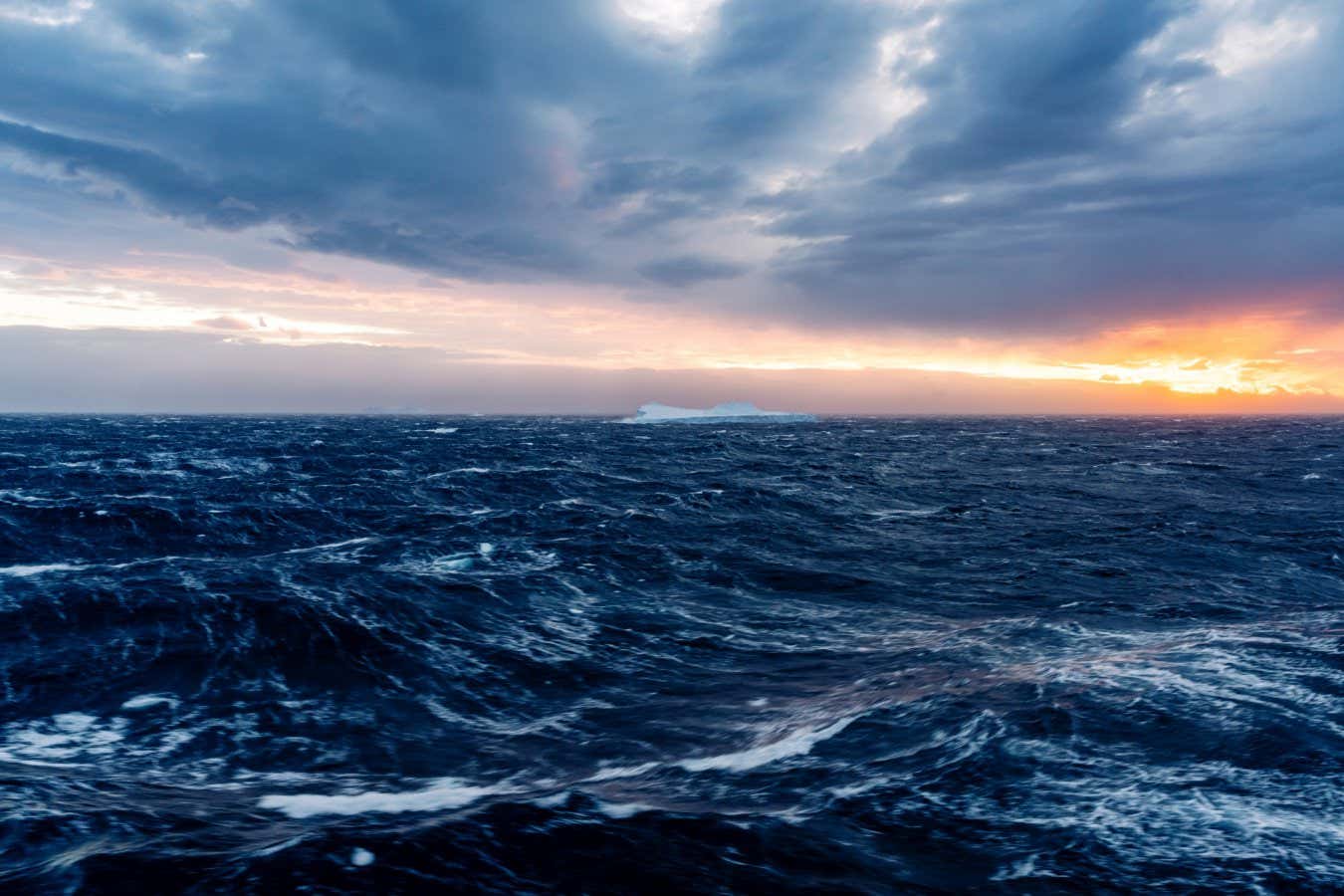
The seas around Antarctica might begin releasing CO2
Nigel Killeen/Getty Images
Global warming caused by humanity’s carbon emissions has been slowing the Atlantic Meridional Overturning Circulation (AMOC), a system of currents including the Gulf Stream that warms Europe. If the AMOC collapsed entirely, it could release massive amounts of carbon from the deep Southern Ocean into the atmosphere, a feedback that would warm the Earth even more.
Previous research has shown that AMOC shutdown could cause colder winters in Europe, disrupt monsoons in Africa and Asia, and increase global temperatures. But new computer modelling has shown it would also emit as much as 640 billion tonnes of carbon dioxide near Antarctica, heating the planet by an additional 0.2°C.
“AMOC collapse could trigger (in the) Southern Ocean big mixing and release the carbon stored in the deep water,” says Da Nian at the Potsdam Institute for Climate Impact Research in Germany, who led the study. “It’s a quite new result.”
“The key message is that a very bad occurrence… could have even worse implications than we previously thought,” says co-author Johan Rockström, also at the Potsdam Institute. “We have to be very careful, because when one thing goes wrong, it can have these domino effects.”
Driven by differences in water density, the AMOC brings warm, salty water from the Gulf of Mexico to the northern Atlantic, where it cools and sinks, returning southward along the seafloor. But scientists think fresh meltwater from the Greenland ice sheet is diluting the AMOC and slowing this sinking process.
Buoy measurements recently showed the southward returning flow is weakening, and the AMOC has already declined by an estimated 15 per cent. Model projections suggest it could collapse anywhere from decades to centuries from now.
The new study modelled AMOC collapse in different future climate scenarios. It found that when CO2 concentrations in the atmosphere are 350 parts per million or higher, the AMOC doesn’t recover after it shuts down. Since CO2 is currently at 430 ppm, this suggests AMOC collapse would be irreversible.
The study also found that shutdown of the AMOC, which is part of the global “conveyor belt” of currents extending into the Southern and Pacific oceans, would unleash convection of deep water to the surface near Antarctica. The deep water here, which is largely trapped beneath a layer of fresher surface water, has accumulated carbon from the atmosphere as well as from the sinking of dead plankton. The model suggests much of this carbon would be released into the atmosphere.
Previous research on AMOC collapses in the distant past explains why convection would begin near Antarctica. It suggests that because less-salty water is sinking and flowing from the northern Atlantic to the Southern Ocean, the seas around Antarctica also become less salty. This breaks down the layering of fresher surface water above saltier deep water, and allows deep water to reach the surface.
“Seeing it play out in a warmer climate like this, and with such a large CO2 increase, is quite striking,” says Jonathan Baker at the UK Met Office. “It’s an interesting study, but it hinges on whether Southern Ocean convection strengthens, and that’s still quite uncertain, with different models showing different responses.”
AMOC collapse would cool the Arctic by 7°C, freezing Canada, Scandinavia and Russia, the study also found. At the same time, it would heat up Antarctica by 6°C. While the West Antarctic Ice Sheet is at risk of crossing a tipping point even today, this temperature increase could also trigger the collapse of the much larger East Antarctic Ice Sheet, causing dozens of metres of sea level rise.
While the impact of the CO2 release would play out over 1000 years or more after the AMOC shuts down, humanity’s greenhouse gas emissions could potentially lock in that future AMOC collapse within the next few decades, Rockström warns.
“That commitment time may be… within the next 25 to 50 years. It’s literally now,” he says. “What matters is not the impact time, it is the commitment time, because what right do we have to hand over to all future generations a less and less liveable planet?”
Topics: