Breakthrough lets scientists watch plants breathe in real time
[ad_1] Scientists have long understood that plants take in air through tiny openings on their leaves known as stomata.
[ad_1]
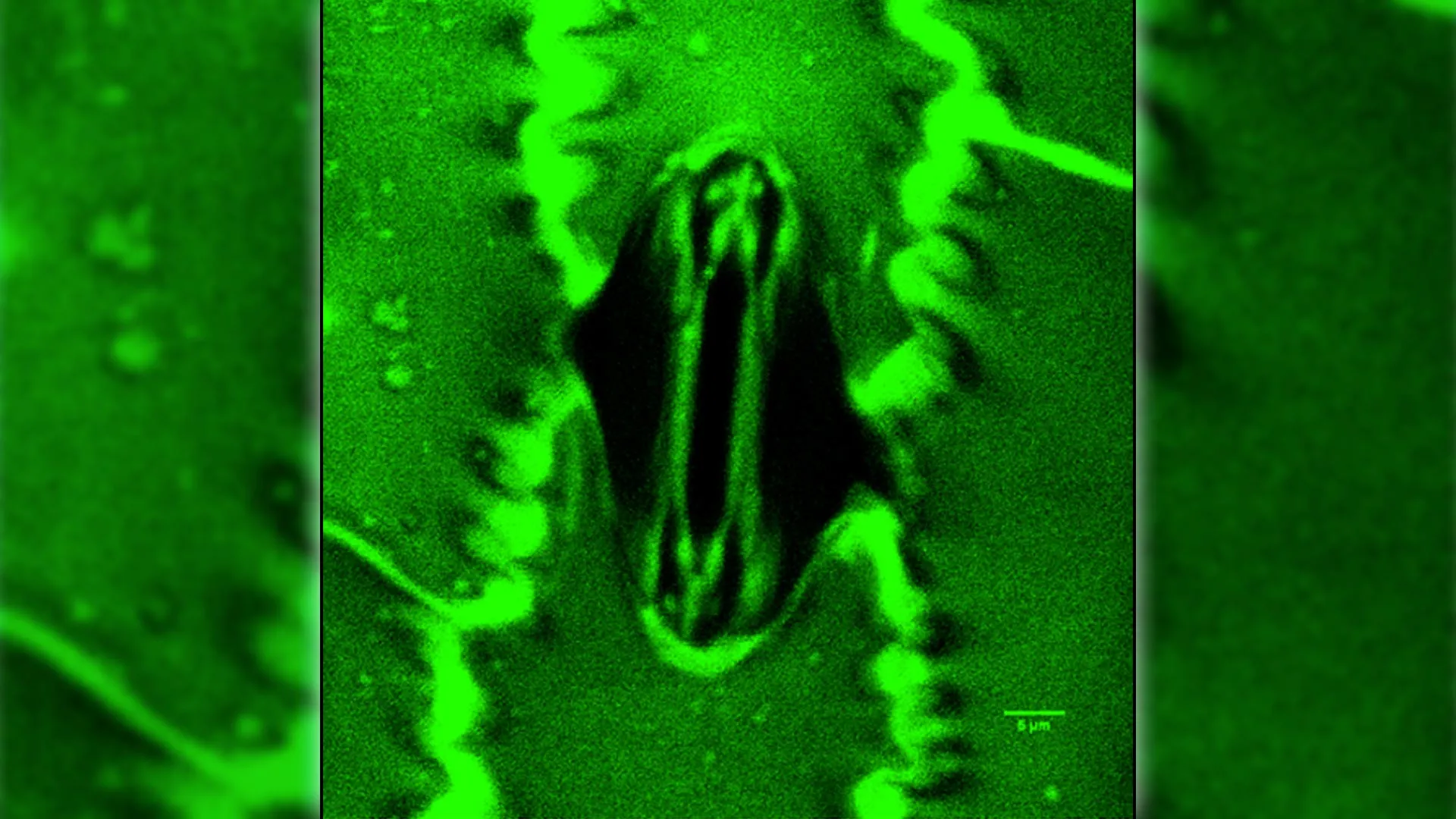
Scientists have long understood that plants take in air through tiny openings on their leaves known as stomata. These microscopic pores act like adjustable valves, letting carbon dioxide enter the leaf for photosynthesis while allowing water vapor to escape into the air. Until now, closely tracking this balancing act as it happens has been extremely difficult.
Researchers at the University of Illinois Urbana-Champaign have now created a powerful new system that makes this possible. Their study, published in the journal Plant Physiology, introduces a tool called “Stomata In-Sight.” It overcomes a major obstacle in plant science by allowing scientists to observe the minute movements of stomata while also measuring, at the same time, how much gas the leaf is exchanging with the atmosphere under carefully controlled conditions.
Why Stomata Matter for Crops and Water Use
Stomata (Greek for “mouths”) play a central role in agriculture worldwide. When these pores open, plants absorb the carbon they need to grow. But this process also leads to water loss. Because of this tradeoff, the number of stomata on a leaf and how they open and close directly affect how efficiently a plant uses water.
Understanding this process is essential for developing crops that can grow with less water and still reliably produce food, biofuel and bioproducts, especially in regions facing drought. As the research team explained, “Traditionally, we’ve had to choose between seeing the stomata or measuring their function.”
Earlier approaches often relied on taking leaf impressions (like taking a dental mold), which only show a frozen moment in time. Other methods used standard microscopes that could view the leaf but offered no control over the surrounding environment. This limitation matters because stomata respond quickly to changes in light, temperature, humidity and carbon dioxide levels.
A Window Into the Living Leaf
The new “Stomata In-Sight” system brings together three advanced technologies in a single setup:
-
Live Confocal Microscopy
This laser-based imaging method produces sharp, three-dimensional images of living plant cells without cutting into the tissue. -
Leaf Gas Exchange Measurement
Highly sensitive instruments track exactly how much CO2 the leaf absorbs and how much water vapor it releases. -
Environmental Control
A specialized chamber allows researchers to precisely adjust light, temperature, humidity and carbon dioxide to simulate real-world growing conditions.
By combining these tools, scientists can directly observe how stomata behave as environmental conditions change, providing a real-time view of plant responses that was not possible before.
Why This Breakthrough Matters
This detailed look at plant function could reshape how crops are bred. By pinpointing the physical and chemical signals that tell stomata when to open or close, and by understanding how stomatal density affects this behavior, researchers can identify genetic traits linked to “smarter” plants — crops that use water most efficiently.
This is especially important because water availability is the single greatest environmental limit on agricultural production. Improving water-use efficiency could help crops withstand increasing heat and drought stress.
The system was developed by Joseph D. Crawford, Dustin Mayfield-Jones, Glenn A. Fried, Nicolas Hernandez and Andrew D.B. Leakey at the Department of Plant Biology and the Institute for Genomic Biology at the University of Illinois.
About the Study
The research was supported by the U.S. Department of Energy’s Center for Advanced Bioenergy and Bioproducts Innovation, the National Science Foundation and a philanthropic gift. The findings appear in an open-access paper titled, “Stomata In-Sight: Integrating Live Confocal Microscopy with Leaf Gas Exchange and Environmental Control,” published in Plant Physiology.
[ad_2]
Source link