As US ramps up munitions production, South Korea and Australia want in
[ad_1] CHRISTCHURCH, New Zealand — South Korea and Australia are offering to relieve Washington’s strained defense supplier network, as
[ad_1]

CHRISTCHURCH, New Zealand — South Korea and Australia are offering to relieve Washington’s strained defense supplier network, as U.S. defense planners grapple with bottlenecks in munitions production.
One partial solution is for overseas-based arms manufacturers to set up shop in the United States – something that Hanwha Aerospace from South Korea is proposing – and another is for American companies to build manufacturing facilities offshore.
An example of the latter tactic is a new Lockheed Martin factory that recently opened in South Australia.
Korean capacity
Hanwha Aerospace plans to establish an automated plant in the United States for producing propellant, modular charge systems and so-called base-bleed units for artillery systems.
The addition of base-bleed technology extends an artillery round’s range by reducing the drag of the projectile’s base during flight.
“Our goal is to bring this vertically integrated, fully automated production capability to the United States,” Juliana Kim, project lead for Hanwha’s precision guided munition division, told a group of journalists during a company-sponsored factory tour in South Korea last month.
Hanwha is set to announce a site for the company-owned, company-operated propellant plant soon. Ground-breaking should occur in Q3 of 2026, with construction set to take three years.
The plant will manufacture nitrocellulose, nitroglycerin, nitroguanidine, triple-base propellant, and feature a load-assemble-pack line for modular artillery charge systems.
Capable of producing approximately 1.5 million modules for 155mm artillery modular charge systems per year, Hanwha executives said they are ready to invest $1 billion in the facility. Once fully operational, the plant could generate $500 million in revenue annually, according to the company.
A base-bleed unit line would require additional investment of $240 million, according to Hanwha calculations.
“By 2030, our goal is to produce fully U.S.-localized modular charges using U.S.-made raw materials from our plant,” Kim explained. Future options include solid rocket motor production in the U.S. too.
Hanwha Aerospace produces more than 90% of South Korea’s warhead and propulsion systems. The company is in the process of building a factory for modular charges at its Boeun site in South Korea.
That factory is slated to take just two years to construct.
Lee Woo Jin, head of the company’s Yeosu Plant, explained this factory will have an annual capacity of about 250,000 complete modular charge systems.
“This new facility will begin operations in early to mid-2027, effectively doubling Hanwha’s export-ready modular charge system capacity,” he said.
Australian alternate
The U.S. can also assure production resilience by setting up facilities overseas. This is what Lockheed Martin has done, as it leverages the Australian government’s desire for greater self-sufficiency.
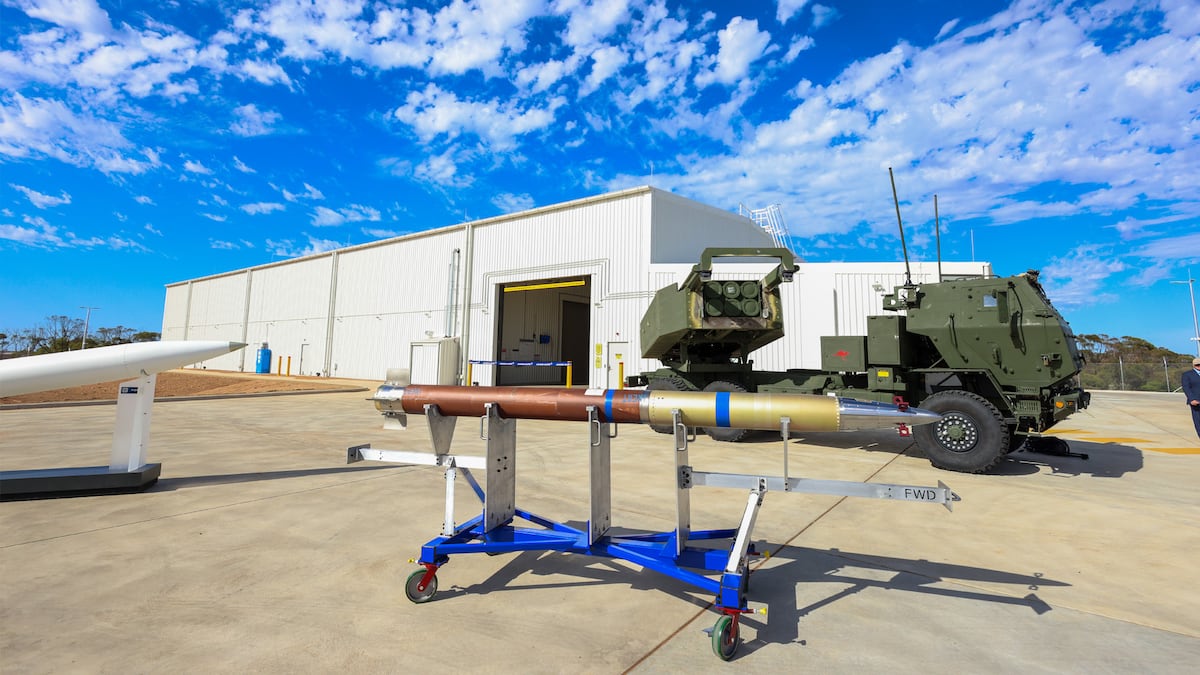
Under Australia’s Guided Weapons and Explosive Ordnance (GWEO) Enterprise, Lockheed Martin Australia opened a new government-owned factory in Port Wakefield, around 60 miles from Adelaide, on Dec. 5.
The first product to emerge from the facility is Guided Multiple Launch Rocket System (GMLRS) rockets and launch pod containers. In fact, this is the first time GMLRS has been assembled outside the U.S.
“Starting missile production in Australia this year is a major step in building the industrial strength our nation needs,” Defence Minister Richard Marles said. “It’s about creating advanced manufacturing capability that will serve Australia for decades to come.”
Initially, the facility is only assembling GMLRS kit components, with fuller production integrating selected domestic components to occur from 2029.
A bilateral government agreement inked in March 2024 forged a pathway for production of up to 4,000 GMLRS rockets annually.
This is more than ten times what Australia needs for itself, so exports have always been part of Lockheed Martin’s thinking.
“So we’re not just looking at Australian consumption; we’re looking at the global supply chain,” James Heading, director and general manager of missiles and fire control at Lockheed Martin Australia, said.
The company already has eyes on producing additional, longer-range weapons in Australia, including the GMLRS-ER and the Precision Strike Missile and perhaps hypersonic technology later on, Heading said.
As for pricing, the executive said that within three to five years “we should be achieving price parity, if not better, in the Australian market,” compared to U.S. production.
Gordon Arthur is an Asia correspondent for Defense News. After a 20-year stint working in Hong Kong, he now resides in New Zealand. He has attended military exercises and defense exhibitions in about 20 countries around the Asia-Pacific region.
[ad_2]
Source link