

Ancient giant kangaroos could have hopped despite their huge size
Procoptodon goliah was 2 metres tall, but it might have hopped MICHAEL LONG/SCIENCE PHOTO LIBRARY Even the giant kangaroos
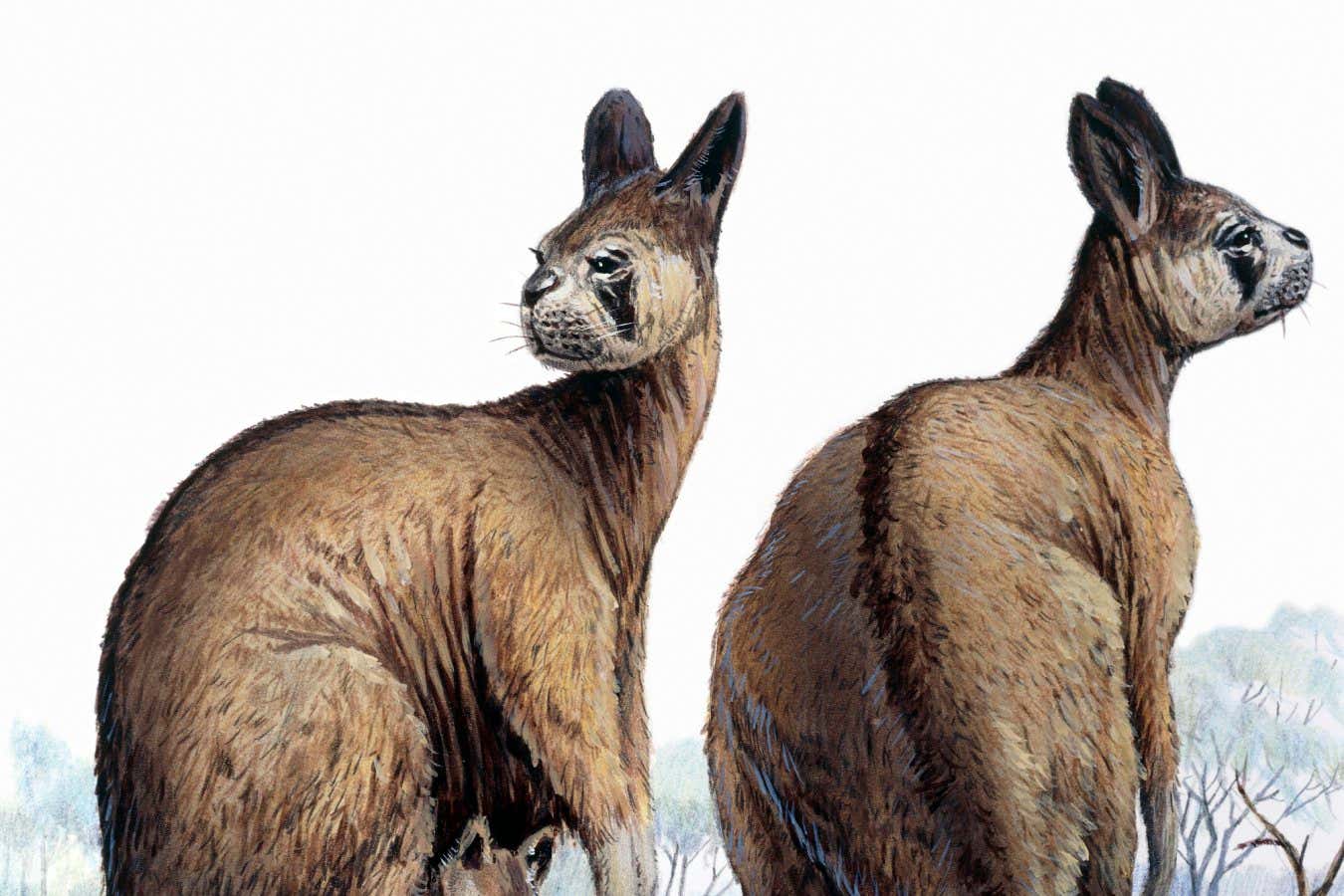
Procoptodon goliah was 2 metres tall, but it might have hopped
MICHAEL LONG/SCIENCE PHOTO LIBRARY
Even the giant kangaroos that roamed Australia thousands of years ago might have been able to hop, according to a new analysis of bones.
Some of the kangaroos living during the Pleistocene were more than twice as heavy as those that live today. One group, the sthenurines, were so bulky that it was thought they couldn’t possibly hop – they must only have walked on their hind legs.
“Sthenurines are what most people are talking about when they talk about giant kangaroos. They’re the really weird ones,” says Megan Jones at the University of Manchester, UK. “They have these really short, boxy skulls and a single toe on each foot. A large male red kangaroo is the biggest you’re going to get today, at about 90 kilograms, but the largest sthenurine was about 250 kilograms.”
That giant was Procoptodon goliah, the biggest kangaroo species known to have existed, standing at about 2 metres tall. It died out about 40,000 years ago.
However, there has always been debate about how much stress its legs could have taken. To try to get a better handle on this, Jones and her colleagues collated bone measurements from 67 species of macropods, a group that includes existing kangaroos, wallabies, potoroos, bettongs and rat kangaroos, as well as the extinct giant kangaroo lineages.
Taking measurements of leg bones including the femur, tibia and calcaneus – the bone the Achilles tendon inserts into – and data on body mass, the researchers estimated how big the attached tendons would be and how much force they could handle.
“The Achilles tendon in today’s kangaroos is quite dangerously close to breaking, but that serves a purpose,” says Jones. “It allows them to store a lot of elastic energy so they can push into the next hop. If you just took today’s kangaroo and scaled it up, you’d be running into problems.”
But she says the ancient kangaroos aren’t just scaled up. They have shorter feet and a wider calcaneus, for example. The researchers’ calculations show that this would have helped the bones of the giant kangaroos resist the bending moments involved in hopping and accommodate tendons large enough to resist the loads generated during the activity.
“It’s evidence that they weren’t mechanically barred from hopping,” says Jones. “Whether they did hop is a different question.”
Hopping almost certainly wasn’t their primary mode of locomotion, but they might have used it for short bursts of speed, she says.
“The study supports what is now a solidifying picture of the iconic kangaroo hop as a functionally adaptable component of a surprisingly variable gait repertoire,” says Benjamin Kear at Upsala University in Sweden. This repertoire has been key to the ecological success of macropods over many millions of years, he says.
That flexibility is still in evidence today. Although we may think of red kangaroos, for example, as always hopping, they can also walk using their tail as a fifth limb, says Jones. “And tree kangaroos basically do everything under the sun: they walk, they hop, they bound, they walk quadrupedally and even bipedally.”
Topics: