
AI-assisted mammograms cut risk of developing aggressive breast cancer
Spotting cancer tumours in mammograms seems to be easier with AI AMELIE-BENOIST/BSIP/Universal Images Group via Getty People who are
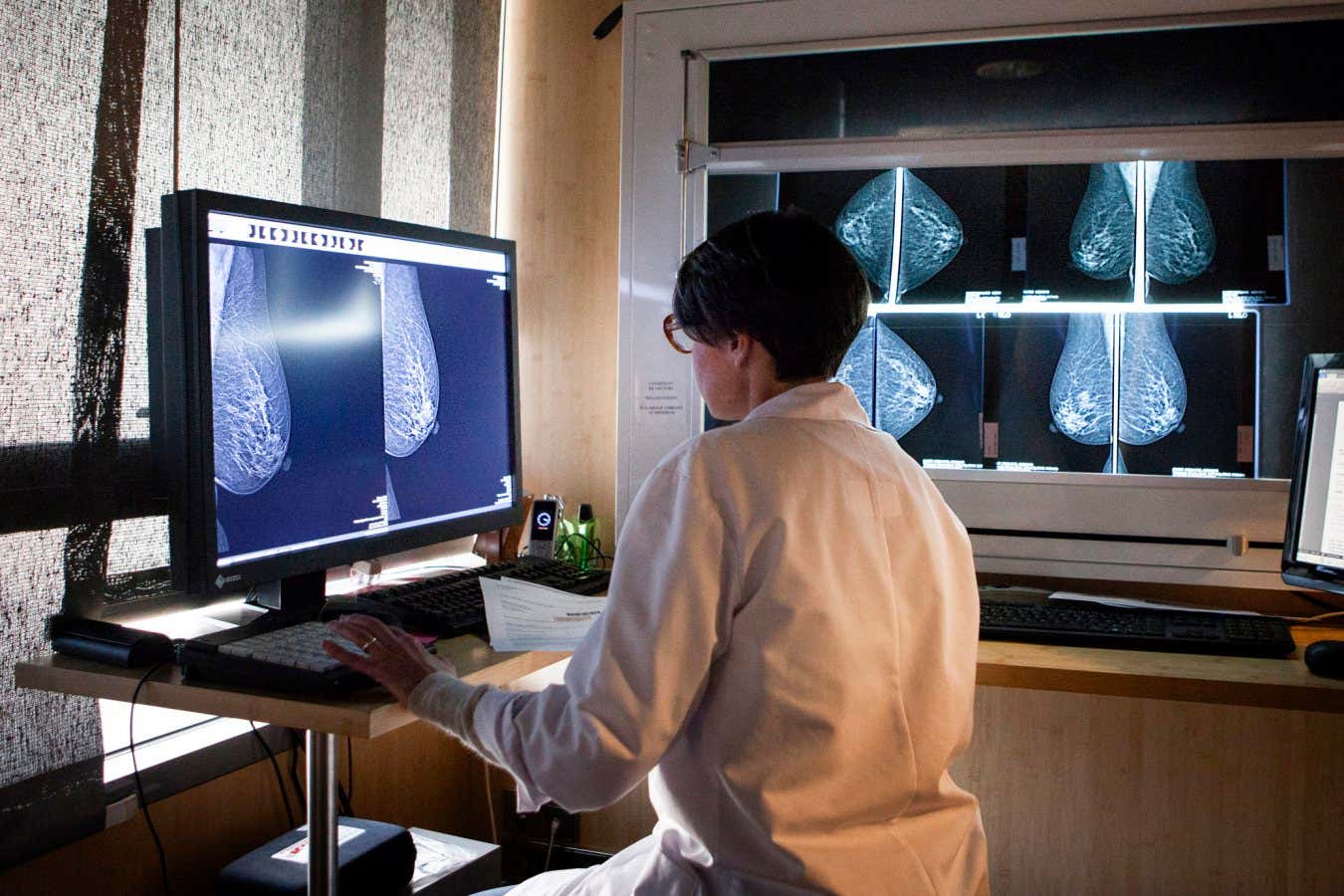
Spotting cancer tumours in mammograms seems to be easier with AI
AMELIE-BENOIST/BSIP/Universal Images Group via Getty
People who are screened for breast cancer by AI-supported radiologists are less likely to develop aggressive cancers before their next screening round than those who are screened by radiologists alone, raising hopes that AI-assisted screening could save lives.
“This is the first randomised controlled trial on the use of AI in mammography screening,” says Kristina Lång at Lund University in Sweden.
The AI-supported approach involves using the software – which has been trained on more than 200,000 mammography scans from 10 countries – to rank the likelihood of cancer being present in mammograms on a scale of 1 to 10, based on visual patterns in the scans. The scans receiving a score of 1 to 9 are then assessed by one experienced radiologist, while scans receiving a score of 10 – indicating cancer is most likely to be present – are assessed by two experienced radiologists.
An earlier study found that this approach could detect 29 per cent more cancers than standard screening, where each mammogram is assessed by two radiologists, without increasing the rate of false detections – where a growth is flagged but follow-up tests reveal it isn’t actually there or wouldn’t go on to cause problems. “That was terrific,” says Fiona Gilbert at the University of Cambridge, who wasn’t involved in the trial.
Now, Lång and her colleagues have found that the AI approach also reduces the likelihood of people developing so-called interval cancers. These are tumours that develop rapidly in the time interval between screenings – hence the name – and that consequently tend to be particularly aggressive and more likely to spread elsewhere in the body.
Lång and her colleagues made the discovery during an analysis of more than 100,000 women in Sweden, aged 55 on average. They randomly assigned about half of the women to receive their standard round of breast cancer screening, where each mammogram is assessed by two radiologists. The remaining participants were screened initially by the AI model – which was developed by biotech firm ScreenPoint Medical in Nijmegen, the Netherlands – and then the scans were assessed by radiologists, most of whom had at least five years of experience in analysing mammograms.
The women who received the AI-assisted screening were 12 per cent less likely, on average, to develop an interval cancer than the women who received the standard screening. “When we got the results, we were extremely thrilled,” says Lång.
This result may be down to the fact that the AI is better able to detect cancers at a very early stage. So while radiologists might overlook small tumours that would develop into an interval cancer, the AI can spot them.
Even so, the study was only designed to explore whether AI can work as well as standard screening, not to see if it can perform better, meaning further trials are needed to confirm it really is superior, says Lång.
What’s more, the team didn’t assess whether the AI-supported approach performs better in certain ethnic groups. Further trials, including an ongoing trial in the UK, will help to address this, says Gilbert.
Research should also be conducted to test whether less experienced radiologists see the same benefit when using AI, but Gilbert doesn’t expect a huge difference.
Off the back of these results, Lång expects the AI approach to be rolled out across south-west Sweden, where the trial was performed, within a few months. But it will probably take about five years for other countries to complete similar trials that justify the roll-out elsewhere, says Gilbert. “Countries need to see what the impact is on their own population, where people are screened more or less often, and are of different ethnicities,” she says.
They also need to establish whether the AI approach is cost-effective. By some estimates, AI assistance may be worth investing in if it cuts interval cancer rates by at least 5 per cent. Radiologists will also need to be trained, although that probably won’t be too cumbersome as the software is fairly easy to use, says Lång.
It’s important to note that, even as AI improves, breast screening should always involve radiologists, says Lång. “Women that participate in screening say they do not want to have AI as a standalone tool, they want to have a human in the loop, and I agree with them. I think it’s very important that it’s a tool for radiologists,” she says.
Topics: