
A strange kind of quantumness may be key to quantum computers’ success
Google’s Willow quantum computer Google Quantum AI What is it about quantum computers that makes them more powerful than
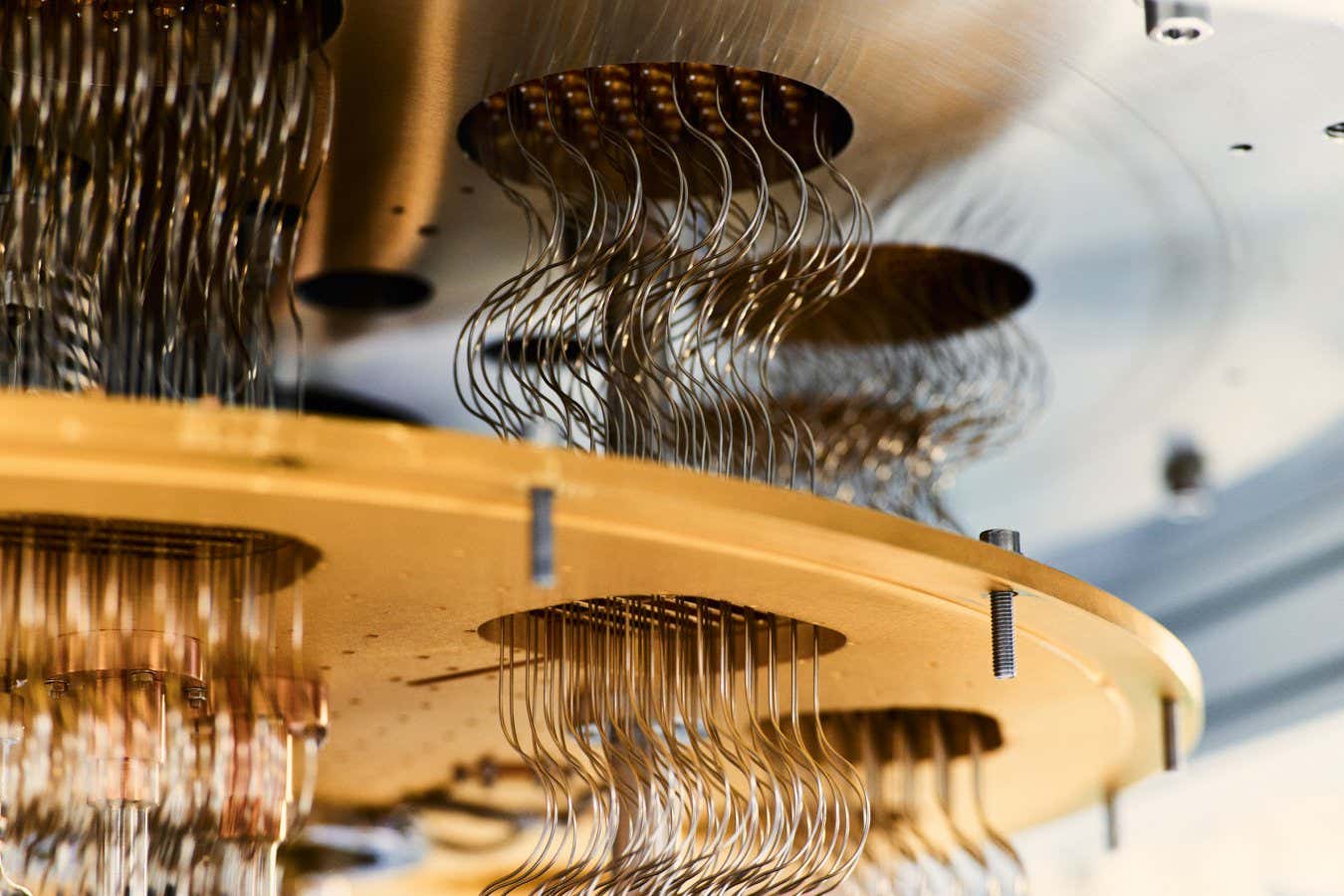
Google’s Willow quantum computer
Google Quantum AI
What is it about quantum computers that makes them more powerful than conventional machines? A new experiment shows that the property of “quantum contextuality” may be a key ingredient.
Quantum computers are fundamentally different from all other computers because they harness uniquely quantum phenomena absent from conventional electronics. For instance, their building blocks, which are called qubits, are routinely put into superposition states – they seemingly assume two properties at once that are normally mutually exclusive – or they get connected through the inextricable link of quantum entanglement.
Now, researchers at Google Quantum AI have used their Willow quantum computer to carry out several demonstrations showing that the property of quantum contextuality also plays a significant role.
Quantum contextuality captures an oddity about measuring the properties of quantum objects. While the colour of a pen, say, isn’t affected by whether you measure it before or after measuring the length of the pen, for a quantum object, the results of measurements cannot be treated as pre-existing properties that are independent of all other measurements.
This contextuality has previously been studied in specialised experiments with quantum light, and in 2018, a team of researchers mathematically proved that it could also be used in a quantum computing algorithm.
Notably, this algorithm would allow a quantum computer to find a mathematical formula hidden within a bigger mathematical object in a fixed number of steps, regardless of how large that object gets. In other words, quantum contextuality enables something akin to finding a needle in a haystack regardless of the haystack’s size.
Google’s experiment implemented this algorithm on an increasing number of qubits, from just a few up to 105, equivalent to growing the haystack. Because Willow has more noise, meaning it is less error-free, than the ideal theoretical quantum computer the algorithm was written for, the number of steps did increase with the qubit number. However, Willow still used fewer steps than the researchers estimated that a traditional computer would need.
In this way, quantum contextuality seems to lead towards quantum advantage – a case of a quantum computer leveraging its quantumness to beat the performance of classical devices. Additionally, the team implemented several other quantum computing protocols that hinge on quantum contextuality and found its effects to be stronger than in previous studies.
“When I first heard about this, I said that it cannot be true. It is quite amazing,” says Adán Cabello at the University of Seville in Spain.
“These results clearly demonstrate how current quantum computers are pushing the boundaries of experimental quantum physics,” says Vir Bulchandani at Rice University in Texas. He says any quantum computer that is a candidate for useful quantum advantage ought to be able to perform these tasks, as a benchmark of its quantum character.
However, the demonstration isn’t yet a proof of a quantum advantage that could be put to practical use because the 2018 algorithm rigorously proved the quantum computer’s superiority over classical computers only for a larger number of qubits than Willow has, and by using qubits that are less error-prone, says Daniel Lidar at the University of Southern California. The next step may be to connect the new work with quantum error-correction algorithms, he says.
In addition to offering a new benchmark for quantum computers, this experiment also underscores the importance of the most fundamental aspects of quantum physics. Cabello says researchers still lack a comprehensive theory of what exactly causes quantum advantage, but unlike entanglement, which often has to be created, contextuality is, in a way, built into quantum objects. Quantum computers such as Willow are now good enough to force us to take the strangeness of quantum physics really seriously, he says.
Topics: