
Chernobyl at 40: The past, present and future of a nuclear disaster
The bleak landscape of the Chernobyl exclusion zone Mykhaylo Palinchak It was 1.23am when disaster struck. A routine safety
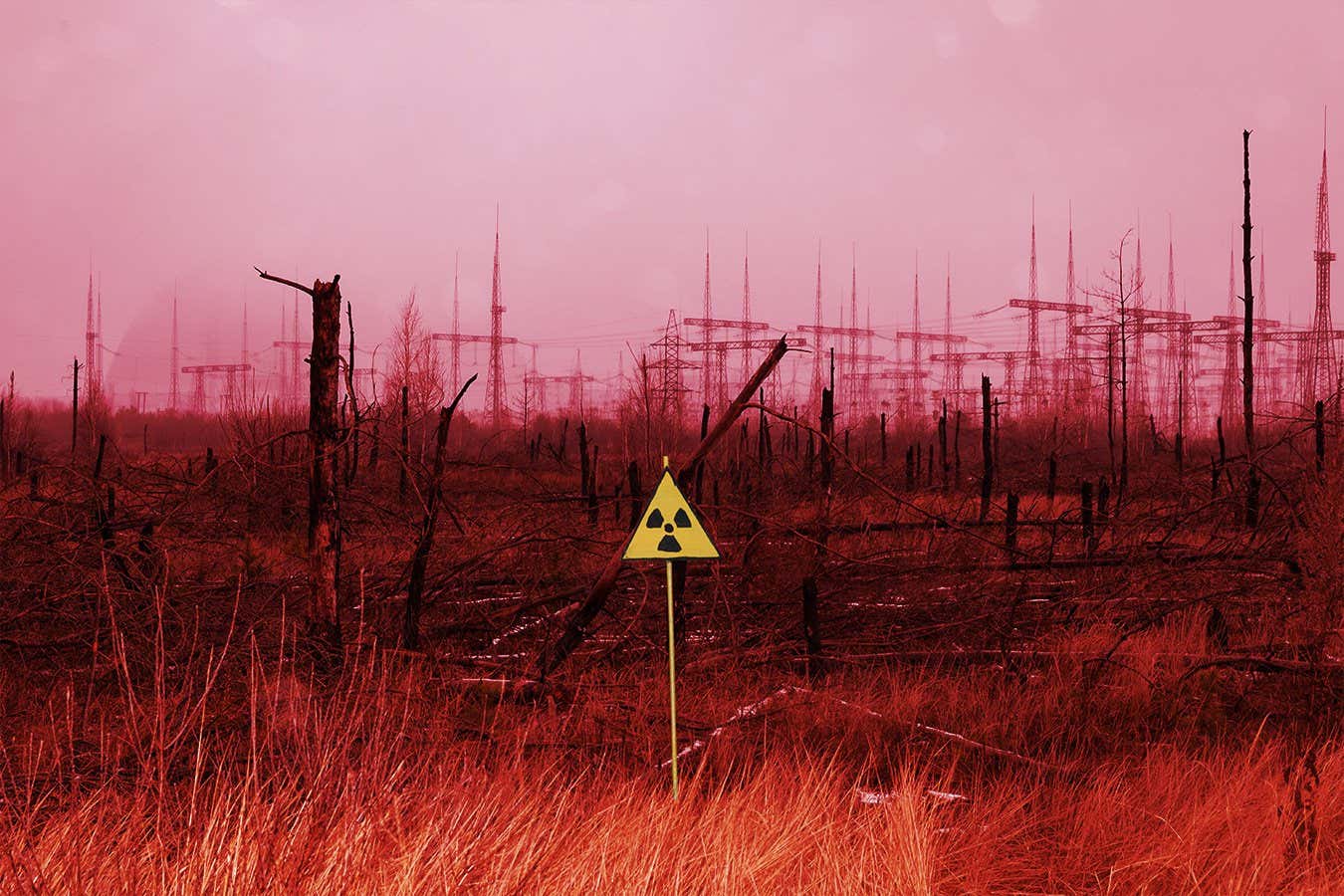
The bleak landscape of the Chernobyl exclusion zone
Mykhaylo Palinchak
It was 1.23am when disaster struck. A routine safety test led to a catastrophic explosion. Poor design and inadequate safety procedures saw radioactive material scattered around the globe. In just 48 hours, Chernobyl became the site of the world’s worst nuclear disaster. Forty years later, I have come to Ukraine to learn about its legacy.
My first guide is Kateryna Shavanova, an academic who was studying radiation-consuming bacteria at Chernobyl when Russia invaded in 2022, but now works for the Ukrainian army’s chemical, biological, radiological and nuclear risk team. A patch on her uniform roughly translates to “It’s not time to drink iodine yet”, an optimistic reference to the emergency treatment for radiation poisoning. As we shelter from the cold in a former family home in the city of Chernobyl, which sits 15 kilometres south of the nuclear power plant that shares its name, Shavanova explains that, in truth, there is no straightforward answer to whether this region is now safe. It depends on who is asking and what they intend to do.
What we can say for certain is that more than 100 different radioactive materials were released by the explosion of Chernobyl’s reactor 4 in 1986. One of the most dangerous was iodine-131, which the human body concentrates in the thyroid. With a half-life of just over a week, this radionuclide was a relatively short-term concern. The risk from some more dangerous materials, such as caesium-137 and strontium-90, which both have a half-life around 30 years, is also beginning to fade.
But make no mistake – we will be living with the Chernobyl disaster for a long time. By far the most contaminated part of the site is reactor 4 itself, which contained 1900 kilograms of uranium-235 and 760 kilograms of plutonium-239 at the moment it exploded. These have half-lives of 704 million years and 24,110 years respectively. Thankfully, far fewer of these contaminants were released than the shorter-lived ones, and much of the localised radioactive detritus was collected and buried, at great personal risk, by the army of as many as 600,000 “liquidators” who responded to the disaster.
Still, I am troubled. I have written about nuclear safety for years. I have stood within metres of deadly nuclear material inside UK reactors, safely hidden behind shielding. But Chernobyl feels different. Radioactive material lurks just below the soil. I know that if I follow the instructions of my tour guides, I will be safe, with only an infinitesimally increased risk of radiation-related illness. But the potential danger creates a tingle somewhere in the back of my brain. The intangible nature of radiation makes the risk somehow harder to grapple with and understand. I’m not ashamed to admit that lingering radiophobia made me throw away my boots before I got back home.
After the disaster, the once-bustling cities of Chernobyl and nearby Pripyat were evacuated, with power station staff and their families transferred to the newly built city of Slavutych. Chernobyl workers live there to this day, but their work is made harder because they now face a 260-kilometre drive each way via the nearest crossing of the Dnieper river. The previous short train ride dips briefly into Belarus, a country with dangerously close ties to Russia.
For decades, most of the workers at Chernobyl were scientists monitoring contamination and researching the environmental effects of radiation exposure. That changed in 2010 with the start of work on the New Safe Confinement (NSC) arch, a gigantic shelter built to protect both the ruins of reactor 4 and the concrete sarcophagus that was hastily erected over it in the months after the explosion. Scientists breathed a sigh of relief when the NSC was completed in 2016 and began to hatch long-term plans for decommissioning reactor 4 and safely storing its deadly remains – a process that was expected to last a century.
The people I meet speak fondly of that time, and say the site is as beautiful as it is intriguing. “People who work here, they love it. They can’t leave. They have roots,” says Shavanova. It is easy to empathise – this place feels like the most picturesque nature reserve on Earth. The absence of people and the crumbling hulks of alien infrastructure add an otherworldly layer.

The remains of reactor 4 are entombed by the New Safe Confinement arch
Mykhaylo Palinchak
This surprising idyll was broken in 2019, when HBO broadcast a hugely popular drama portraying the horror of the disaster in lurid detail to a new generation. “After that, it was like Disneyland,” says Shavanova. “We couldn’t do our job because there were a lot of tourists.”
But that influx was nothing compared with what was to come. When Russia’s full-scale invasion of Ukraine began on 24 February 2022, Chernobyl stood directly between its troops and the capital Kyiv. Driving to Chernobyl today, you see clear signs of that invasion force: bomb-damaged buildings, military graveyards and endless minefields.
When Russian soldiers seized Chernobyl, they dug trenches in contaminated areas, pillaged anything of value and destroyed laboratories, experiments and data. Denys Vyshnevskiy at the Chornobyl Radiation and Ecological Biosphere Reserve returned after the Russian occupation to find his office had been raided. Shoes, a microwave and maps were stolen. His library was completely untouched, save for a missing copy of Keith Richards’s autobiography.

An office looted during the 2022 Russian occupation of the Institute for Safety Problems of Nuclear Power Plants has been left untouched
Mykhaylo Palinchak
Computers were taken, so he changed his passwords, assuming the equipment was stolen by intelligence agencies for valuable data or maps. But he later found components scattered around abandoned Russian trenches: bored soldiers had simply been removing parts that could be used or sold. “It’s typical behaviour for a medieval army,” says Vyshnevskiy, as a smartphone alert interrupts us to warn of an air raid in Kyiv.
The occupation, which ended in April 2022 when Ukrainian forces recaptured the plant, remains part of Chernobyl’s identity. Inside a building belonging to the Institute for Safety Problems of Nuclear Power Plants (ISPNPP), I saw several ransacked rooms kept as time capsules. Papers and equipment are strewn around, computers smashed, furniture broken. It feels as if Russian troops just left. ISPNPP researcher Olena Pareniuk showed me her laboratory, where her work to find bacteria that can eat radioactive waste was irreparably set back by this vandalism.
A complex problem
New Scientist agreed not to disclose specific details of the military forces and fortifications I saw in the 2600 square kilometres of the exclusion zone around the ruined reactor, but the area is now extremely heavily protected against future Russian incursions. So, what will happen now, and what of the work to clean up Chernobyl? A complex scientific and environmental problem has been exacerbated by a thorny geopolitical and logistical one.
Sergii Obrizan, a colleague of Vyshnevskiy’s at the Chornobyl Radiation and Ecological Biosphere Reserve, says that the depth and breadth of research they used to do is no longer possible. “The war and everything around it – troops, occupation, militarisation – influences the zone a lot, and our work,” he says. Part of Vyshnevskiy and Obrizan’s job is to monitor wildlife in the exclusion zone, and the range of species in the zone is hard to fathom. I saw wolf and moose footprints, although the animals themselves were elusive. “They’re smart, they avoid humans,” says Vyshnevskiy. He has seen wolves five or six times in his 26 years working in the exclusion zone, and although he has never seen a lynx or a bear, colleagues have.
Sadly, such excursions are no longer possible in many of Chernobyl’s habitats, which are now strewn with landmines placed by both Russian and Ukrainian forces. Vyshnevskiy tells me of a firefighter tackling a forest fire caused by a downed Russian drone who stepped on a mine. His remains were found 70 metres away. He knows of three wild horses killed the same way, but the size of the zone means most animal casualties will go unnoticed.

A road in the Chernobyl exclusion zone
Mykhaylo Palinchak
During my travels, minefields and military checkpoints became familiar. Areas that were once tourist attractions or public buildings are now highly classified sites. This militarisation has squeezed scientists out – at one point, there would have been hundreds here, but during my visit, we all fit around the same table while Vyshnevskiy cooks dinner.
Before the war, institutions and research groups occupied a row of houses just off Lenin Street, taking one each. Tonight, we are gathering at one that was a makeshift laboratory for the Ukrainian Institute of Agricultural Radiology. Its large garden has several mature apple trees, whose fruit, I’m told, is sometimes eaten. Cotton bags suspended from the ceiling of an outbuilding are experiments on insect life. Notebooks full of pencilled scientific data from old research line bookshelves.
Art historian Oksana Semenik tells me over dinner that her father was devastated to hear that his former home in an evacuated village had recently been demolished. Nobody knows why, or whether it was by Russia or Ukraine. When she was a child, residents used to be allowed – informally – to return for a visit once a year. She jokes that the Soviets told radiation to take the day off.
Some moved back permanently. Around 1200 evacuees returned to Chernobyl in the late 1980s and early 90s, and there was no official effort to remove them. They exist in a legal grey area that has become even murkier since 2022. Obrizan says their numbers have dwindled over time due to old age, but that there are still 40 civilians living in the city of Chernobyl, and another six in a nearby village.

Yevhen Markevich has lived in the city of Chernobyl for almost his entire life
Mykhaylo Palinchak
One of these is retired teacher Yevhen Markevich, now 88. He has lived in Chernobyl all his life, except for the month after the 1986 disaster, when he was briefly relocated. Markevich and his wife, Galyna, warmly invited me inside the wooden house they share with a dog and 15 cats, which come and go as they please through a hatch built into the kitchen wall. Although understandably slowing with age, the pair don’t appear to be experiencing the effects of radiation. Their garden is tended with love, and they speak with affection about their home.
In truth, the idea that Chernobyl has been deserted since the accident in 1986 is a myth. Reactor 2 was operational until 1991, reactor 1 kept going until 1996 and reactor 3 wasn’t shut down until 2000. Workers carried out relatively normal work in typical offices, just hundreds of metres from one of the most radioactive sites on Earth.
Chernobyl’s deadliest legacy
Jim Smith at the University of Portsmouth, UK, says that around two-thirds of the exclusion zone is technically safe for human occupation. “The danger to humans isn’t so great now, and really never has been,” says Smith. “The Soviets spent a lot of effort: once they’d acknowledged that they’d done this terrible thing, they almost went over the top in evacuating people and in some of the measures they took.”
Smith says that millions of people around the world get higher natural radiation doses from rocks or from flying in aeroplanes than the Markevichs and other self-settlers experience from living in the exclusion zone. But this isn’t to say that Chernobyl didn’t cause illness and death. Two people were killed by the explosion itself, while some 28 firefighters and emergency workers died within three months due to radiation exposure. It is much harder to attribute individual incidents years or decades later to the disaster. The most reliable estimate, using large population models, points to a death toll of 15,000, says Smith. Poor data prior to 1986, some inflated figures and a public misunderstanding of radiation have led to a perception that is far worse than can be supported by real data.
Chernobyl’s deadliest legacy may have been souring public opinion on nuclear power. A recent paper estimated that increased fossil fuel use as a result of this led to more air pollution, cutting our collective lifespan by 318 million expected life years globally.
By studying Chernobyl, the researchers here hope to mitigate the public’s distrust of nuclear power and apply their world-class expertise to other nuclear disasters. Several of them visited Fukushima after the 2011 disaster, where their knowledge was crucial. While the physics is similar, the economics and politics are dramatically different. Ukraine had enough space to essentially fence off Chernobyl and leave it, but in Japan, land is scarce and there’s a cultural requirement to rectify your mistakes, so the affected land was scrubbed clean in a way that could never be economically feasible in Ukraine. Despite these efforts, former residents of the Fukushima region have been reluctant to move back. Radiation remains a concerning unknown for the public. Its effects are sometimes minimal and sometimes catastrophic, and understanding why requires a grasp of physics, biology and geography.

Radiation control is a serious concern at Chernobyl
Mykhaylo Palinchak
To learn more, I feel the need to enter the heart of Chernobyl’s exclusion zone, the site of reactor 4. Approaching the 36,000-tonne NSC shelter, built from 2010 to 2016 at a cost of €1.5 billion, I struggled to comprehend the scale. It looks squat, but then you see the size of the external staircase on its end and its immensity becomes clear. The arches span 257 metres and rise 100 metres. Some 650,000 bolts hold its frame together.
Of all the unusual structures and sights in this region, the shelter is the most uncanny. It is relatively new and featureless, but inside – just metres away – is the shattered reactor, the hastily constructed sarcophagus put together by the Soviet Union, the body of at least one plant worker and some of the most infamous and deadly rooms on Earth, where touching the wrong thing or lingering in the wrong area could rapidly prove fatal. Part of me wishes I could explore inside, crawling through the debris to see the fuel fragments, the grotesque lava forms and the rusting machinery, while part of me wants to get as far away as possible.

Inside, on the ceiling of the NSC, there are crane gantries designed to allow the slow, painstaking deconstruction of both the sarcophagus and reactor. But last year, Russia struck the NSC roof with a drone, blasting a hole all the way through its multi-layer construction. Footage from that night shows fire and smoke billowing from a gaping hole – luckily, it was far enough towards the edge of the building that debris didn’t fall onto the fragile reactor or sarcophagus below, which could have caused collapse and stirred up dangerously radioactive material. Today, I can see the temporary patch on the roof, until plainclothes men from the security services emerge from nowhere and usher me away.
The NSC arch is made of two layers, separated by about 12 metres of open space. Each layer is a sandwich of insulation material between metal sheeting. Viktor Krasnov, the acting director for science at the ISPNPP, shows me a small cross-section of the roof he has stored in a bin bag behind his desk. He says that the metal can’t burn, and he plucks part of the insulation from the interior of the section, takes his cigarette lighter and demonstrates that this won’t burn either. The problem lies right in the middle, with a rubber sheet that’s buried inside the insulation to keep the whole thing airtight.

Viktor Krasnov, acting director for science at the Institute for Safety Problems of Nuclear Power Plants
Mykhaylo Palinchak
It was this rubber that caught fire and smouldered for three weeks. Anatoly Doroshenko, a young scientist at the ISPNPP, spent that time flying a drone with an infrared camera over the building to look for hotspots and direct firefighters. It was also equipped with radiation sensors to ensure they didn’t receive dangerous doses. By the end, the initial hole, around 60 square metres or the size of a squash court, was the least of the problems. Firefighters were forced to riddle the structure with around 200 new holes to get their hoses into position to extinguish the rubber fire, and the material had burned away over much of the enormous building.
Krasnov says that the careful monitoring of conditions inside reactor 4 had hurriedly resumed after the Russian occupation, but that now they faced the challenge of making the building safe once again – a setback they could do without. “You cannot tell radioactivity to stop being radioactive,” he says. “The war didn’t stop us. We’re working on how to restore it.”
In April 2025, engineers temporarily patched the inner and outer shell of the NSC, working to get it sealed before winter rain and snow. Krasnov says that it is now airtight once more, but that the remains of the drone landed on a gantry inside the NSC and the tracks on which the overhead cranes run are also damaged. Without these cranes, the long-term plans to decommission reactor 4 face yet another engineering challenge. Ordinarily, fixing these wouldn’t be overly difficult. But this is Chernobyl, so a huge neutron flux is still shooting straight up from the reactor’s shattered remains. So, how do you repair the gantry and cranes? “Well, I wouldn’t like to do it,” says Pareniuk. “And I wouldn’t like to be responsible for the people who are repairing it.”
“To see this building destroyed, which was very, very difficult to build in the first place, is extremely painful,” says Balthasar Lindauer at the European Bank for Reconstruction and Development, which oversaw funding and construction of the NSC. Money left in the pot that would have been spent on decommissioning work had already been diverted to make the site safe after Russian occupation, and now further funds are needed just to repair the NSC. “If Ukraine is left alone with this problem, I see very difficult times ahead,” says Lindauer. “A hundred years was quite a luxurious kind of timeframe. That luxury may have been reduced.” There is currently no detailed plan to permanently dismantle and safely store the radioactive remains of reactor 4.

Radiobiologist Olena Pareniuk next to a model of the destroyed reactor 4
Mykhaylo Palinchak
Elsewhere, though, there are positive signs of change. Chernobyl’s cooling ponds were vast, human-made lakes continuously maintained 7 metres above the level of the Pripyat river by pumps. Entire villages predating the plant were submerged by the ponds’ creation – today you can see concrete electricity pylons that once ran across the area, long before a power station existed.
One scientist tells me they would swim in a cooling pond years ago to clean off after a day taking radiation measurements in the dusty exclusion zone. This sort of jarring and seemingly illogical thing is a constant at Chernobyl, where risks are weighed up by experts who have to live with them daily. The cooling pond pumps were shut down in 2014, and it took four years for water to reach equilibrium with the river. The lowest points remain flooded, revealing the shape of old, meandering river paths that were hidden for decades, and have collected the heavy radioactive elements, meaning that they are even more dangerously contaminated today than the larger ponds were immediately after the accident.

I take a short hike across a now-dry part of the ponds with Olena Burdo at the Kyiv Institute for Nuclear Research. We crunch over a thick bed of shells left over from the ponds, past wild boar bones and through young birch forests, staying within areas sectioned off with white tape, where army sappers have checked for mines. We walk past abandoned boats and a fire engine. In less than a century, this area has been land, lake and land once more. “Before 2022, we thought only about radiation,” says Burdo. “Now we think about radiation and mines.”
Burdo says the land created by draining the ponds is relatively safe on the surface, but contaminants like strontium can be found just 20 centimetres below. She now carries out studies on rodents to see what wildlife is moving into the newly drained land. As we walk, Burdo spots a tiny burrow that she suspects shows a new species of rodent not yet seen on the pond land – something for future study.
Two years ago, the vegetation really started to flourish, but that means strontium is being dredged up. Grass with high levels of contamination is eaten by rodents, which, in turn, are eaten by larger animals. Radiation certainly has an influence on animals in the cooling ponds area, but that doesn’t mean it is dangerous. Burdo wants to do experiments to separate ecological effects from radiation effects. “It’s new territory. Maybe in the whole world we don’t have the same place. I think it’s really unique.”
There are signs that these cooling ponds may be on their way to returning to their previous state: a functioning forest and healthy ecosystem. “Maybe it can be, but we don’t know,” says Burdo. “We’ll learn about this maybe in the future, 10 years later, something like this.”

Denys Vyshnevskiy walking in the Chernobyl exclusion zone
Mykhaylo Palinchak
The rapid pace of change, and the unexpected consequences that can arise from human intervention, shows that any future use of this territory needs to be thoughtfully considered. Vyshnevskiy says that the first 10 years after the disaster saw a series of failed experiments, with politicians seemingly desperate to put the exclusion zone to some sort of agricultural use. Fish farms, beekeeping, grain crops, dairies – nothing really worked. All these plans seemed to ignore that the area was never particularly fertile land before the plant existed, he says. “It was nonsense,” says Vyshnevskiy. “They wasted a lot of money.”
There are those who believe that agriculture could work, even if the zone’s status as a nature reserve makes that unlikely on a large scale. Smith worked on a project to create vodka in the exclusion zone. While the grain they grew near the city of Chernobyl had enough caesium to mean it exceeded the European Union limit on radioactivity of 1250 becquerels per kilogram, the vodka distilled from it contained no detectable levels of strontium or caesium. Last year, 2000 bottles were sold, with proceeds being donated to Ukraine.
Chernobyl’s future
If the exclusion zone is unlikely to be repopulated, or farmed, then what can it be used for? Most people I meet are clear on one thing: they don’t want to see a return of “dark tourism”, where people scour abandoned homes in Pripyat looking for diaries, dolls or gas masks to take an exciting picture for Instagram. “It’s not respectful,” says Pareniuk. “It’s like going to a graveyard just to see ghosts and zombies. But the people who lived here were real people, not ghosts and zombies.”
Many people also point out that Chernobyl enables research into radiological disasters and that the place should be teeming with scientists once more. “The Chernobyl zone is a unique place for researchers, and there’s no other place like this in the world,” says Obrizan. He talks fondly of Western universities that used to visit before the war, and clearly misses the work they did together.
Vyshnevskiy also sees it as a “supermarket for researchers”. Want to determine the effects of caesium radiation on ponds or rivers? Or the effects of strontium on insects, rodents, birds or large mammals? Want to research how to restore nature at former industrial sites? Test new safety or monitoring equipment for other reactors? It can all be done here.
It is a bleak thought, but such information is likely to come in useful. Nuclear disasters have happened and are likely to happen again. A recent study suggests that we can expect one every 25 years, or once for every 3704 years of reactor operation, counted across all reactors on the planet, so we are perhaps overdue. “It’s not a matter of belief, it’s a matter of the calculations,” says Pareniuk.
On the positive side, like in the aviation industry, we learn from every accident, and future accidents become less likely. But we are also in the unprecedented situation of having a war raging near nuclear power plants, with fighting at Zaporizhzhia Nuclear Power Plant in southern Ukraine continuing to undermine safety. “It’s a pity, but Russia will always be our neighbour, and they have a lot of nuclear weapons and they have a lot of nuclear power plants, and they don’t treat them well,” says Shavanova. “You should understand our experience and use it. You can practise here. We can use it for something good.”
To call Chernobyl’s exclusion zone a dangerous wasteland is at once technically accurate and also completely missing the point. Hundreds of species are doing better here than anywhere else. Nature is being given space to recover and thrive. The radiation is still there, either fizzing away in isolated hotspots or locked up by plants and animals. And although forest fires, floods and the Russian military threaten to unleash this at times, if left alone, it is safe enough. With careful stewardship and a resumption of peace, Chernobyl could become a European treasure rather than a disaster.
Topics: