Radar evidence suggests a massive lava tube beneath Venus
[ad_1] Volcanoes are not just an Earthly phenomenon. Scientists have already identified volcanic features, including lava tubes, on both
[ad_1]
Volcanoes are not just an Earthly phenomenon. Scientists have already identified volcanic features, including lava tubes, on both Mars and the Moon. Now researchers from the University of Trento report strong evidence that Venus also contains an empty lava tube beneath its surface. The finding adds to growing evidence that volcanic forces have played a dominant role in shaping Venus’s landscape and internal structure.
The underground cavity was detected through detailed radar data analysis as part of a project supported by the Italian Space Agency. The research was published in Nature Communications.
A Rare Glimpse Beneath Venus’s Surface
“Our knowledge of Venus is still limited, and until now we have never had the opportunity to directly observe processes occurring beneath the surface of Earth’s twin planet. The identification of a volcanic cavity is therefore of particular importance, as it allows us to validate theories that for many years have only hypothesized their existence,” explains Lorenzo Bruzzone, the coordinator of the research, full professor of Telecommunications and head of the Remote Sensing Laboratory at the Department of Information Engineering and Computer Science of the University of Trento.
“This discovery contributes to a deeper understanding of the processes that have shaped Venus’s evolution and opens new perspectives for the study of the planet,” he adds.
Why Lava Tubes Are Difficult to Detect
Lava tubes form below ground, which makes them hard to spot on any planet. Typically, they remain concealed unless part of the ceiling collapses. When that happens, a pit becomes visible at the surface. These openings can signal the presence of an underground passage and may even mark a potential entry point.
Venus presents an added challenge. Thick clouds permanently cover the planet, blocking direct surface views from traditional cameras. To study its terrain, scientists must rely on radar imaging capable of penetrating the cloud layer.
Magellan Radar Reveals a Subsurface Conduit
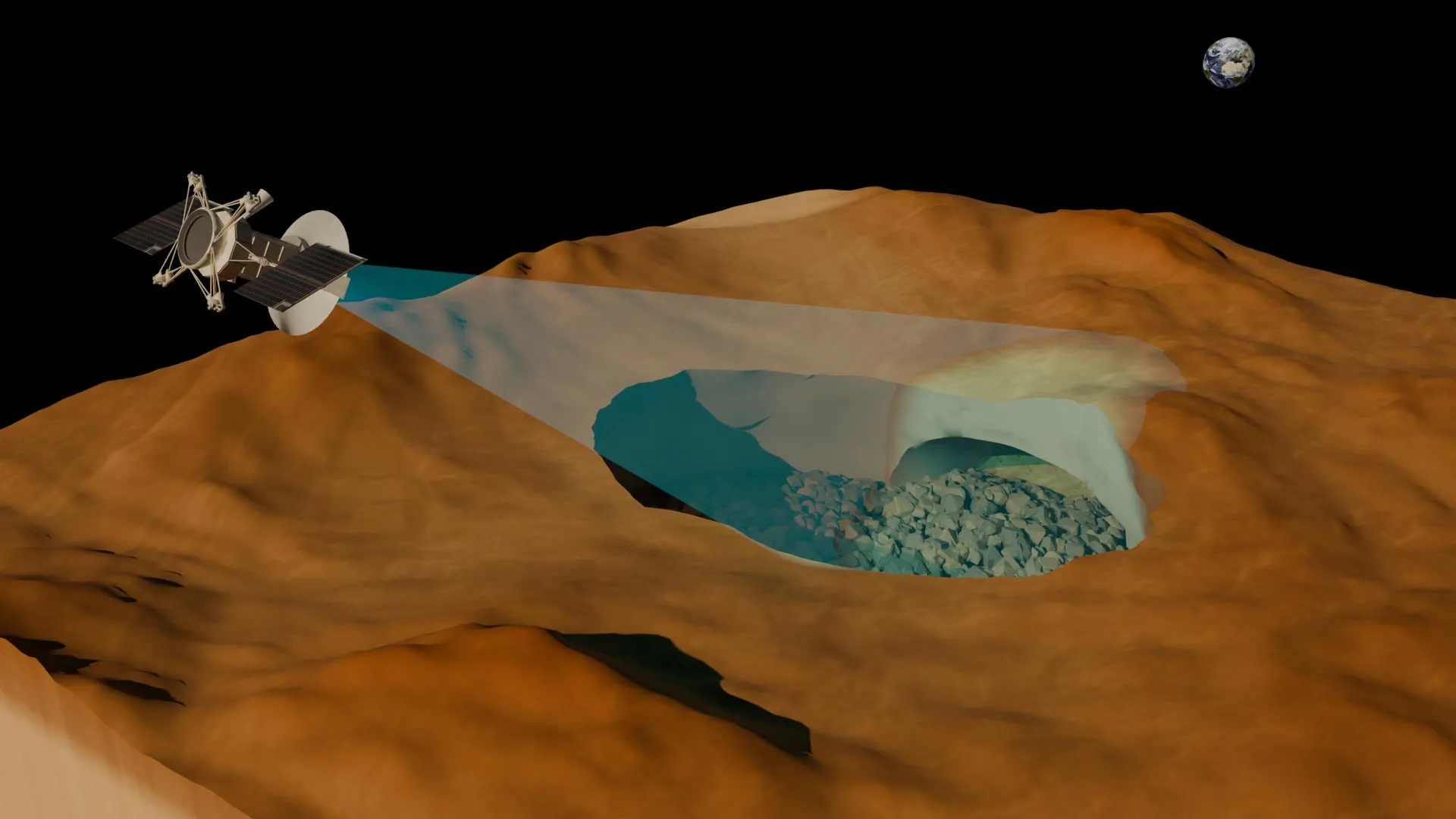
From 1990 to 1992, NASA’s Magellan spacecraft mapped Venus using a Synthetic Aperture Radar system. The team focused on radar images showing localized surface collapses and applied a specialized imaging technique they developed to detect and analyze underground conduits near skylights. Their investigation identified a large subsurface structure in the Nyx Mons region, named after the Greek goddess of the night.
“We analyzed Magellan’s radar images where there are signs of localized surface collapses using an imaging technique that we have developed to detect and characterize underground conduits near skylights. Our analyses revealed the existence of a large subsurface conduit in the region of Nyx Mons, the area named after the Greek goddess of the night. We interpret the structure as a possible lava tube (pyroduct), with an estimated diameter of approximately one kilometer, a roof thickness of at least 150 meters and an empty void deep of no less than 375 meters,” says Bruzzone.
Why Venus Could Produce Giant Lava Tubes
Venus’s environmental conditions may actually support the development of large lava tubes. The planet has lower gravity than Earth and a much denser atmosphere. These factors could help molten lava quickly form a thick insulating crust once it flows away from its source, preserving broad underground channels.
The newly identified structure appears larger than lava tubes observed on Earth or projected for Mars. Its dimensions place it at the upper limit of what scientists have proposed, and in one instance observed, on the Moon. This scale aligns with other volcanic features on Venus, where lava channels exceed the size and length of those found on other rocky worlds.
Implications for Future Venus Missions
“The available data allow us to confirm and measure only the portion of the cavity close to the skylight. However, analysis of the morphology and elevation of the surrounding terrain, together with the presence of other pits similar with the one studied, supports the hypothesis that the subsurface conduits may extend for at least 45 kilometers. To test this hypothesis and identify additional lava tubes, new higher-resolution images and data acquired by radar systems capable of penetrating the surface will be required. The results of this study are therefore very important for future missions to Venus, such as the European Space Agency’s Envision and NASA’s Veritas. Both spacecraft will carry advanced radar systems capable of capturing higher-resolution images, allowing scientists to study small surface pits in greater detail. In addition, Envision will carry an orbital ground penetrating radar (Subsurface Radar Sounder) capable of probing Venus’s subsurface to depths of several hundred meters and potentially detecting conduits even in the absence of surface openings. Our discovery therefore represents only the beginning of a long and fascinating research activity,” he concludes.
[ad_2]
Source link