Spain slashes speed limit on popular train route after fault found
[ad_1] Spanish rail authorities have temporarily reduced the speed limit on part of the high-speed line between Madrid and
[ad_1]
Spanish rail authorities have temporarily reduced the speed limit on part of the high-speed line between Madrid and Barcelona after a fault was detected on the track.
Transport Minister Óscar Puente said a crack had been found on Sunday night in the line 110km (68 miles) west of Barcelona, between Alcover and l’Espluga de Francolí, in the Catalonia region.
It comes days after a high-speed collision killed 45 people in southern Spain and amid severe disruption to local rail services in the north-east of the country.
The transport ministry said the fault in the line did not pose a danger to trains travelling along it and that they would continue to move along it.
This is the latest and most drastic of several speed reductions on high-speed lines in recent days, following the accident in Adamuz, in Andalusia, earlier this month.
The speed limit on the section of track affected will be 80km/h (50mph) until further notice. High-speed trains travel as fast as 300km/h between Madrid and Barcelona – one of Spain’s most heavily used long-distance links.
Last week, the limit on several sections of the Madrid-Barcelona line was temporarily reduced to 230 km/h after drivers had reported vibrations or other anomalies on the route, before being restored to 300km/h following technical checks.
Some sections of the Madrid-Valencia line also had their speed limit cut temporarily to 160km/h and 200km/h.
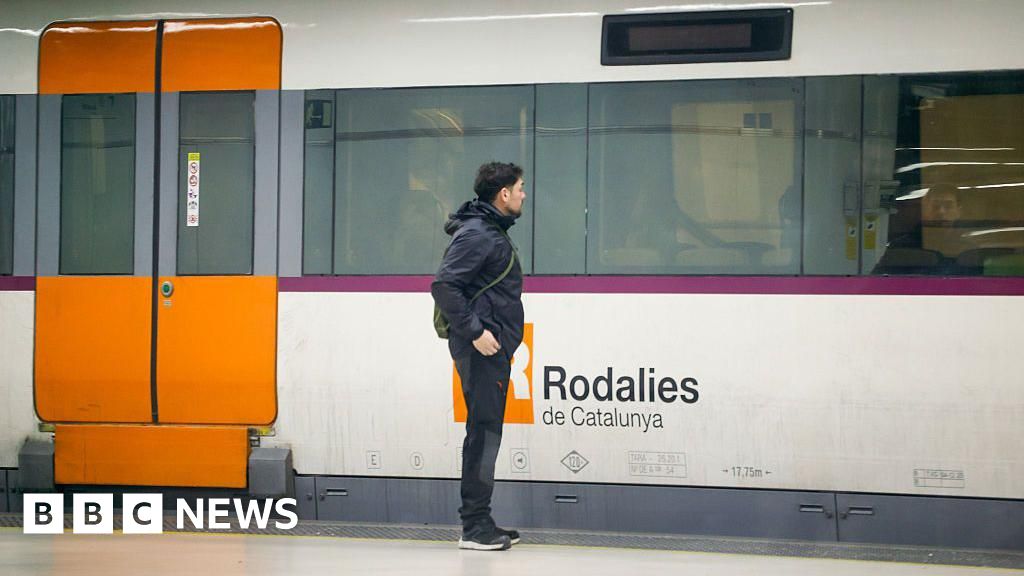
Meanwhile, the local Rodalies rail service in Catalonia has been severely disrupted.
Last week, a trainee driver was killed when a train struck a collapsed wall, the Rodalies service was grounded as drivers demanded improved safety guarantees and lines were reviewed.
On Monday, two separate incidents caused further chaos in the region, as the service was again suspended, before partially resuming later in the day. The Spanish government said it did not know the cause of the incidents – but did not rule out a cyberattack.
The Catalan Republican Left (ERC) party said the Rodalies network had suffered “decades of lack of investment”.
“The reputational damage is as bad as or worse than the economic losses,” said Ramon Talamàs, president of the Chamber of Commerce of Terrassa.
Socialist Prime Minister Pedro Sánchez is due to appear before Congress on 11 February to be questioned about the rail crisis.
These measures come as the investigation continues into the Adamuz high-speed crash, in which the rear carriages of a train heading north towards Madrid were derailed on a straight section of track, causing a collision with an oncoming train.
Investigators have been examining a 40cm (16in) section of track that broke loose, apparently shortly before the derailment.
The transport ministry has said that the line on which it happened had been renovated and undergone recent technical reviews.
However, it has emerged that the piece of damaged rail, which was made in 2023, had been welded onto an older section, reportedly manufactured in 1989, and the join between the two appears to be where it cracked.
The head of the independent commission investigating the crash, Iñaki Barrón, said that “everything appears to suggest that” the separation of the two welded pieces of track was the cause of the tragedy.
Opposition politicians are demanding the resignation of Óscar Puente, accusing him of misleading the public in the wake of the tragedy.
[ad_2]
Source link