Astronomers just revealed a stunning new view of the Milky Way in radio colors
[ad_1] Astronomers at the International Centre of Radio Astronomy Research (ICRAR) have produced the largest low-frequency radio color image
[ad_1]
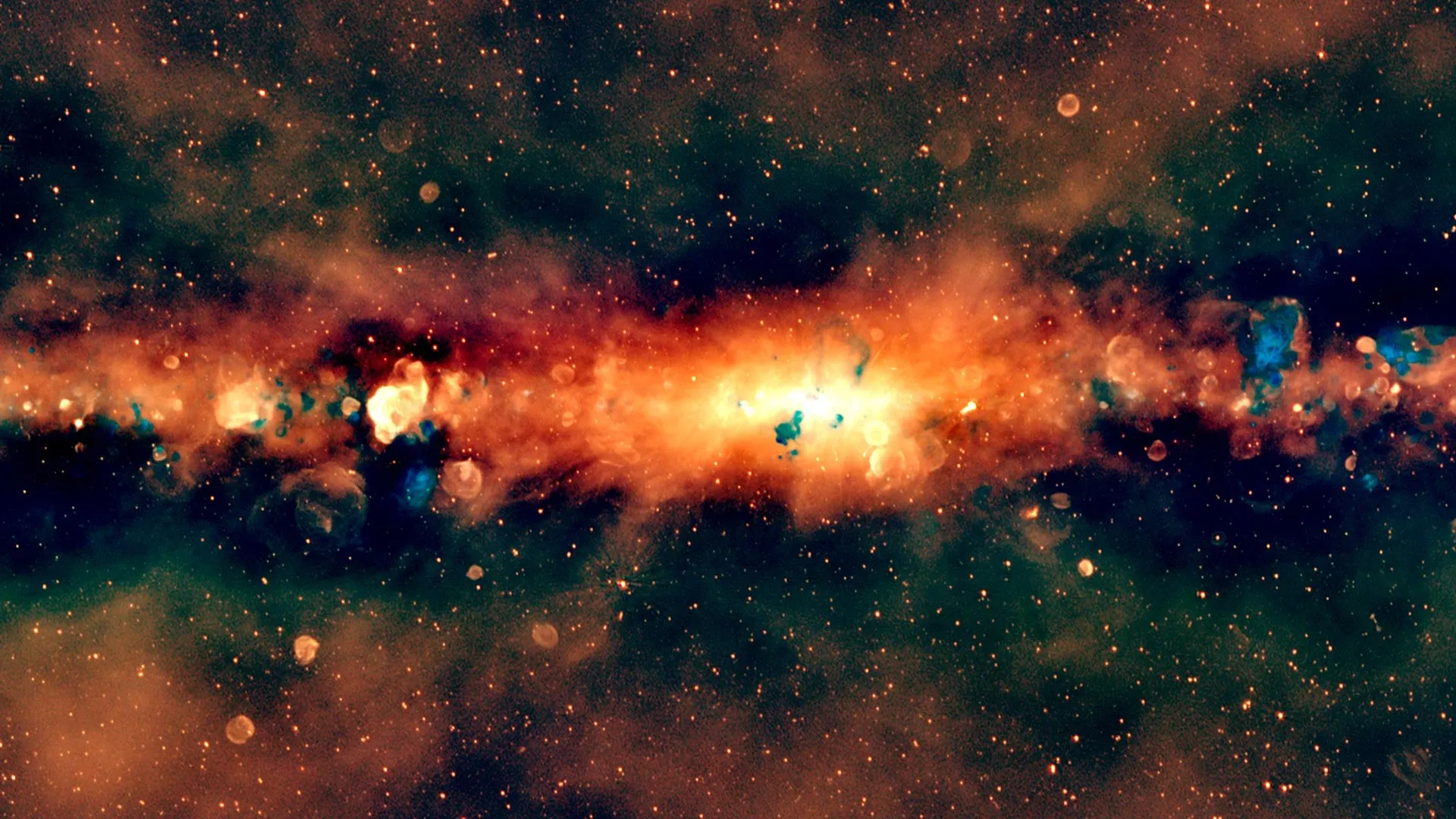
Astronomers at the International Centre of Radio Astronomy Research (ICRAR) have produced the largest low-frequency radio color image of the Milky Way ever assembled. The new image presents an extraordinary view of our galaxy as seen from the Southern Hemisphere, revealing the Milky Way across a broad range of radio wavelengths, often described as different colors of radio light.
By capturing the galaxy in this way, the image opens up powerful new opportunities to study how stars are born, how they evolve, and how they ultimately die within the Milky Way.
Years of Computing Power Behind the Image
The image was created by Silvia Mantovanini, a PhD student at the Curtin University node of ICRAR. She spent 18 months working on the project and used roughly 1M CPU hours on supercomputers at the Pawsey Supercomputing Research Centre. These systems were needed to process and combine massive amounts of data collected during two major sky surveys.
The observations were carried out with the Murchison Widefield Array (MWA) telescope, located at Inyarrimanha Ilgari Bundara, the CSIRO Murchison Radio-Astronomy Observatory on Wajarri Yamaji Country in Western Australia.
The data came from the GaLactic and Extragalactic All-sky MWA (GLEAM) survey and its follow-up, GLEAM-X (GLEAM eXtended). GLEAM was observed over 28 nights during 2013 and 2014, while GLEAM-X gathered data across 113 nights from 2018 to 2020.
Sharper, Deeper, and Wider Than Before
Focusing specifically on our own galaxy, the new image represents a major leap forward compared with the earlier GLEAM image released in 2019. It delivers twice the resolution, ten times the sensitivity, and covers twice as much of the sky.
These improvements allow astronomers to examine the Milky Way in far greater detail than before, uncovering features that were previously difficult or impossible to see.
“This vibrant image delivers an unparalleled perspective of our Galaxy at low radio frequencies,” Ms. Mantovanini said.
“It provides valuable insights into the evolution of stars, including their formation in various regions of the Galaxy, how they interact with other celestial objects, and ultimately their demise.”
Tracing Exploded Stars and Stellar Nurseries
Ms. Mantovanini’s research focuses on supernova remnants, the expanding clouds of gas and energy created when a star explodes at the end of its life. While astronomers have already identified hundreds of these remnants, many researchers believe thousands more remain undiscovered.
The new image makes it easier to separate the material surrounding newly forming stars from the gas left behind by dead ones, revealing clearer structures throughout the galaxy.
“You can clearly identify remnants of exploded stars, represented by large red circles. The smaller blue regions indicate stellar nurseries where new stars are actively forming,” Ms. Mantovanini said.
New Clues About Pulsars
The image may also help scientists better understand pulsars, the rapidly spinning remnants of massive stars. By analyzing how bright pulsars appear across different GLEAM-X frequencies, astronomers hope to learn more about how these objects produce radio waves and where they are distributed throughout the Milky Way.
A Milestone in Mapping the Milky Way
Associate Professor Natasha Hurley-Walker, a member of the same ICRAR team and the principal investigator of the GLEAM-X survey, highlighted the importance of the achievement for studying the structure of our galaxy.
“This low-frequency image allows us to unveil large astrophysical structures in our Galaxy that are difficult to image at higher frequencies,”
“No low-frequency radio image of the entire Southern Galactic Plane has been published before, making this an exciting milestone in astronomy.”
“Only the world’s largest radio telescope, the SKA Observatory’s SKA-Low telescope, set to be completed in the next decade on Wajarri Yamaji Country in Western Australia, will have the capacity to surpass this image in terms of sensitivity and resolution,” concluded Associate Professor Hurley-Walker.
Tens of Thousands of Cosmic Sources Revealed
The surveys behind the image required hundreds of hours of observations using the MWA radio telescope at Inyarrimanha Ilgari Bundara, the CSIRO Murchison Radio-astronomy Observatory. Using this data, ICRAR researchers catalogued around 98,000 radio sources across the portion of the Galactic Plane visible from the southern hemisphere.
These sources include pulsars, planetary nebulae, compact HII regions — which are dense, ionized gas clouds in space — as well as distant galaxies that lie far beyond the Milky Way.
[ad_2]
Source link