How Long, Not Long – NASA Science
[ad_1] On March 24, 1965, a march from the campus of City of St. Jude to the Alabama state
[ad_1]
On March 24, 1965, a march from the campus of City of St. Jude to the Alabama state capitol building in Montgomery marked the culmination of a campaign that transformed voting rights in the United States.
The historic event included more than 25,000 civil rights activists—including more than 3,000 people who had walked from Selma—who gathered and camped at the Catholic social service complex during the final leg of the third and final Selma-to-Montgomery march. On that last night of the multi-day protest, marchers camped on a rain-soaked field at St. Jude and drank in the music of some of the day’s biggest stars, including Harry Belafonte, Joan Baez, Sam Cooke, Billy Eckstine, Tony Bennett, Leonard Bernstein, Odetta Holmes, Nina Simone, Sammy Davis Jr., and Peter, Paul and Mary.
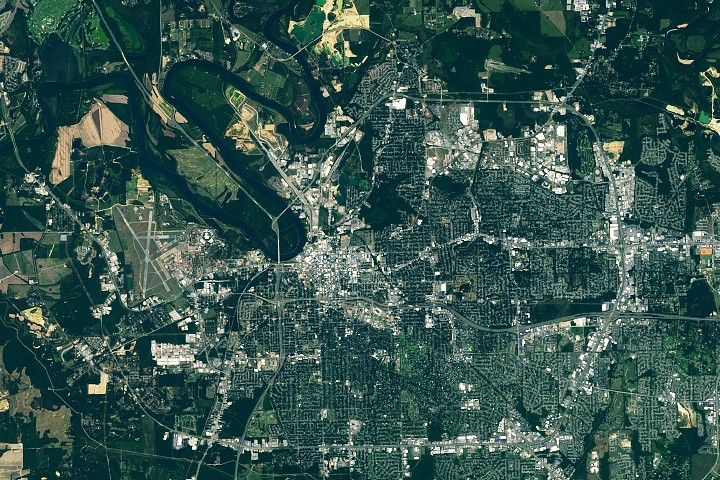
Early the next morning, Dr. Martin Luther King Jr. led the procession of marchers on a five-mile route to the state capitol. Decades later, on September 16, 2025, the OLI (Operational Land Imager) on Landsat 8 captured this image of Montgomery, showing the ground the marchers covered. As documented in a series of aerial photographs, marchers departed from St. Jude in a long line, headed north toward downtown, turned east onto Dexter Avenue, passed the Baptist church where King was once a pastor, and concluded on the steps of the state capitol building (below).
From there, King gave his “How Long, Not Long” speech (also called Our God is Marching On), which many historians consider among his most consequential. On that warm, sunny day, he called out to the crowd assembled before him:
“I know you are asking today, ‘How long will it take?‘
Somebody’s asking, ‘How long will prejudice blind the visions of men, darken their understanding, and drive bright-eyed wisdom from her sacred throne?‘
Somebody’s asking, ‘When will wounded justice, lying prostrate on the streets of Selma and Birmingham and communities all over the South, be lifted from this dust of shame to reign supreme among the children of men?‘”
Then came his answer:
“I come to say to you this afternoon, however difficult the moment, however frustrating the hour, it will not be long, because ‘truth crushed to earth will rise again.‘”
Then, a bit later, he delivered a line that would become one of his most famous and enduring:
“How long? Not long, because the arc of the moral universe is long, but it bends toward justice.“
The Selma to Montgomery march proved to be a turning point in the Civil Rights Movement, helping galvanize public support for the passage of the Voting Rights Act of 1965 later that year, a law that prohibited racial discrimination in voting.
NASA Earth Observatory image by Lauren Dauphin, using Landsat data from the U.S. Geological Survey. Photograph by the Department of Defense via the Digital Public Library of America. Story by Adam Voiland.
- The Bernstein Experience (2018, March 24) The Night the ‘Stars’ Came Out in Alabama. Accessed January 16, 2026.
- Digital Public Library of America (1965, March 25) Aerial Photographs Relating to the Selma to Montgomery Civil Rights March. Accessed January 16, 2026.
- Encyclopedia of Alabama (2008, January 9) Martin Luther King Jr. Accessed January 16, 2026.
- MPI Speeches of Martin Luther King, Jr. – SELMA, ALABAMA AND THE MARCH TO MONTGOMERY, 1965. Accessed January 16, 2026.
- National Park Service (1965, March 24) The “Stars for Freedom” Rally. Accessed January 16, 2026.
- National Park Service The Selma to Montgomery Marches. Accessed January 16, 2026.
- National Park Service (2021, July 1) Selma to Montgomery Storymap. Accessed January 16, 2026.
- Stanford University (1965, March 25) Our God is Marching On! Accessed January 16, 2026.
- United States Civil Rights Trail Montgomery. Accessed January 16, 2026.
- U.S. House of Representatives The House and Selma: Bridging History and Memory. Accessed January 16, 2026.
[ad_2]
Source link