Spain train crash continues as investigators probe ‘gap’ in rail
[ad_1] Watch: At the scene of Spain’s worst rail disaster in over a decade Heavy machinery is being used
[ad_1]
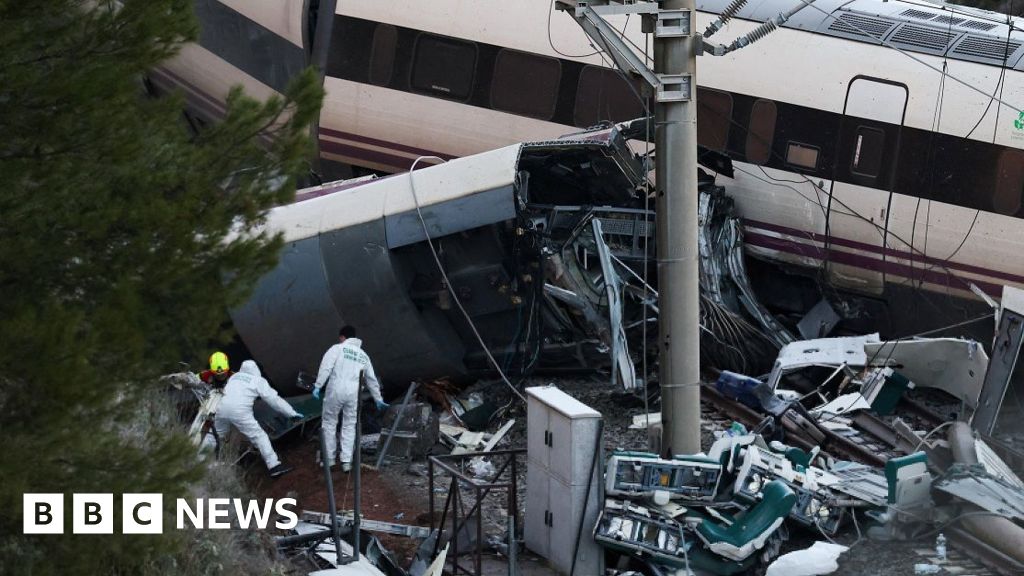
Heavy machinery is being used to assist in the recovery following a two-train crash in southern Spain which killed at least 41 people.
Rescuers worked through a second night as more bodies are feared to be trapped in the wreckage.
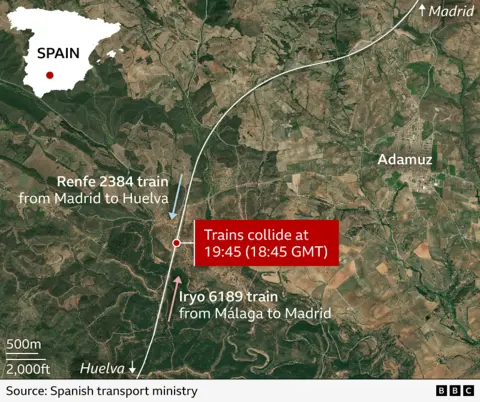
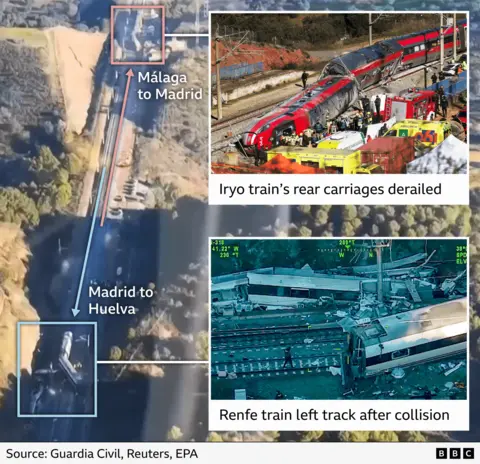
More than 120 people were injured when carriages on a Madrid-bound train derailed and crossed over to the opposite tracks, hitting an oncoming train in Adamuz on Sunday evening.
A faulty or damaged weld on a rail is being investigated as a factor in the crash, Spanish media report.
Prime Minister Pedro Sanchez has cancelled his planned trip to the World Economic Forum in Davos, pledging to get to the bottom of Spain’s worst train disaster in more than a decade.
Spain’s King Felipe and Queen Letizia will visit the site later on Tuesday.
Three days of national mourning have been announced.

Transport Minister Óscar Puente said the death toll “is not yet final”.
Officials are working to identify the dead.
Puente said the investigation could take at least a month, describing the incident as “extremely strange”.
Spanish media report that a 30cm gap in one of the rails is the current focus of the investigation.
Technicians told the El Mundo newspaper that a “bad” or “deteriorated” weld was “more than likely” the cause for the derailment.
Ignacio Barron, head of Spain’s Commission of Investigation of Rail Accidents (CIAF), said on RTVE: “What always plays a part in a derailment is the interaction between the track and the vehicle, and that is what the commission is currently [looking into].”
However, Spain’s El País newspaper reports that it was not clear whether the fault was a cause or a result of the crash.
On Monday, Renfe President Álvaro Fernández Heredia apparently ruled out “human error”, telling RNE programme Las Mañanas that, if “the driver makes a mistake, the system itself corrects it”.
Heredia also told RNE that both trains were travelling under the maximum speed limit on the stretch of track where the crash happened.
As the investigation into the crash continues, Spanish media reported that train drivers warned about the state of the Madrid-Andalusia line in August and requested a speed limit of under 250kph.
In a letter to the state-owned rail infrastructure administrator, Adif, the drivers union reportedly said the increase in the number and weight of high-speed trains was causing a greater number of failures.
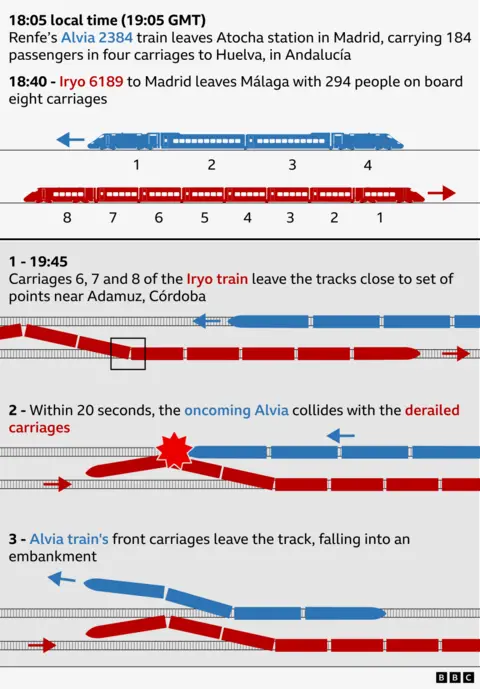
Four hundred passengers and staff were on board the two trains, the rail authorities said. Emergency services treated 122 people, with 41, including children, still in hospital. Of those, 12 are in intensive care.
Most of those killed and injured were in the front carriages of the Huelva-bound train, officials said.
Salvador Jimenez, a journalist with RTVE who was on one of the trains, said the impact felt like an “earthquake”.
“I was in the first carriage. There was a moment when it felt like an earthquake and the train had indeed derailed,” Jimenez said.
Footage from the scene appears to show some train carriages had tipped over on their sides. Rescue workers can be seen scaling the train to pull people out of the lopsided train doors and windows.
A Madrid-bound passenger, José, told public broadcaster Canal Sur: “There were people and screaming, calling for doctors.”
Rail network operator Adif said the collision happened at 19:45 local time (18:45 GMT) on Sunday, about an hour after one of the trains left Málaga heading north to Madrid, when it derailed on a straight stretch of track near the city of Córdoba.
The force of the crash pushed the carriages of the second train into an embankment, according to the transport minister.
All high-speed services between Madrid and the southern cities of Malaga, Cordoba, Sevilla and Huelva have been suspended until Friday.
[ad_2]
Source link