Spacecraft capture the Sun building a massive superstorm
[ad_1] The Sun completes one full rotation about every 28 days. Because of this slow spin, observers on Earth
[ad_1]
The Sun completes one full rotation about every 28 days. Because of this slow spin, observers on Earth can only see any given active region on the Sun’s surface for about two weeks. Once that region rotates away from our line of sight, it disappears from view for another two weeks before returning.
“Fortunately, the Solar Orbiter mission, launched by the European Space Agency (ESA) in 2020, has broadened our perspective,” says Ioannis Kontogiannis, solar physicist at ETH Zurich and the Istituto ricerche solari Aldo e Cele Daccò (IRSOL) in Locarno.
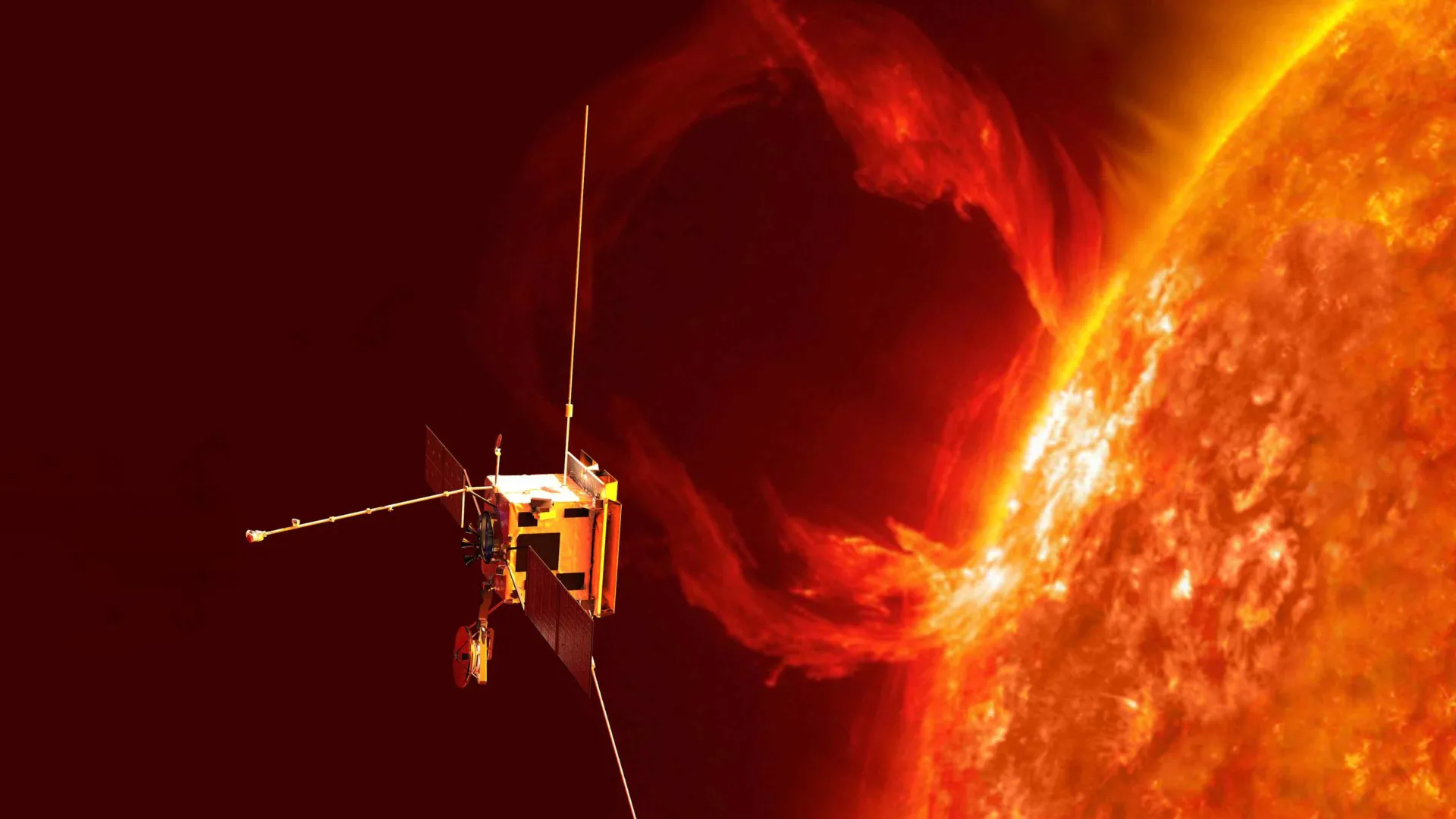
Unlike Earth-based observatories, Solar Orbiter follows a wide orbit that circles the Sun once every six months. This path allows the spacecraft to observe areas of the Sun that are normally hidden from Earth, including its far side.
A Rare View of an Exceptionally Active Solar Region
Between April and July 2024, Solar Orbiter captured detailed observations of one of the most intense solar regions seen in the past two decades. In May 2024, this region, known as NOAA 13664, rotated into view from Earth and immediately made its presence known.
It went on to trigger the strongest geomagnetic storms to hit Earth since 2003. “This region caused the spectacular aurora borealis that was visible as far south as Switzerland,” says Louise Harra, professor at ETH Zurich and director of the Davos Physical Meteorological Observatory.
Combining Data From Two Spacecraft
To better understand how extreme solar regions form and evolve, Harra and Kontogiannis assembled an international research team. The scientists combined observations from two different spacecraft to create a much more complete picture of NOAA 13664.
Solar Orbiter provided data from the far side of the Sun, while NASA’s Solar Dynamics Observatory supplied continuous observations from the Earth-Sun line, where it monitors the side of the Sun facing Earth.
By merging these datasets, researchers were able to follow NOAA 13664 almost without interruption for 94 days.
A Record-Breaking Solar Observation
“This is the longest continuous series of images ever created for a single active region: it’s a milestone in solar physics,” says Kontogiannis.
The team observed NOAA 13664 from its initial emergence on 16 April 2024, when it first appeared on the far side of the Sun, through its full evolution and eventual decay after July 18, 2024. This extended timeline allowed scientists to capture changes that would normally go unseen.
How Magnetic Fields Drive Solar Storms
Active regions on the Sun are dominated by powerful and complex magnetic fields. These regions form when highly magnetized plasma rises from the Sun’s interior and breaks through its surface. When magnetic fields become tangled and unstable, they can release energy in dramatic ways.
Such eruptions produce intense bursts of electromagnetic radiation called solar flares. They can also hurl massive amounts of plasma and high-energy particles into space, creating solar storms that travel across the solar system.
Real-World Impacts on Modern Technology
While solar storms are famous for producing auroras, their effects extend far beyond colorful skies. Severe space weather can disrupt power grids, interfere with communication systems, and increase radiation exposure for aircraft crews. Satellites are also vulnerable.
One recent example occurred in February 2022, when 38 of 49 Starlink satellites belonging to US space company SpaceX were lost just two days after launch due to heightened solar activity.
Disruptions Closer to Home
“Even signals on railway lines can be affected and switch from red to green or vice versa,” says Harra. “That’s really scary.”
NOAA 13664 caused additional disruptions in May 2024. “Modern digital agriculture was particularly affected,” says the scientist. “Signals from satellites, drones and sensors were disrupted, causing farmers to lose working days and leading to crop failures with considerable economic losses.”
“It’s a good reminder that the sun is the only star that influences our activities,” adds Kontogiannis. “We live with this star, so it’s really important we observe it and try to understand how it works and how it affects our environment.”
Watching a Solar Region Across Multiple Rotations
For the first time, researchers were able to follow a single superactive solar region through three full solar rotations. This allowed them to observe how its magnetic structure evolved step by step, becoming increasingly complex over time.
Eventually, the magnetic fields formed a tightly intertwined structure. This buildup culminated in the most powerful solar flare of the past twenty years, which erupted on the far side of the Sun on May 20, 2024.
Improving Space Weather Forecasts
Scientists hope these observations will lead to better predictions of solar storms and their potential effects on Earth. More accurate space weather forecasts could help protect satellites, power systems, and other sensitive technologies.
“When we see a region on the sun with an extremely complex magnetic field, we can assume that there is a large amount of energy there that will have to be released as solar storms,” explains Harra.
For now, predicting the exact timing and strength of eruptions remains difficult. Researchers cannot yet determine whether a region will produce one major event or several smaller ones, or precisely when those eruptions will occur.
“We’re not there yet. But we’re currently developing a new space probe at ESA called Vigil which will be dedicated exclusively to improving our understanding of space weather,” says the scientist. The mission is planned for launch in 2031.
[ad_2]
Source link