What countries do business with Iran and what could new US tariffs mean?
[ad_1] Jemma Crew and Faarea MasudBusiness reporters EPA/Shutterstock US President Donald Trump has said countries doing business with Iran
[ad_1]
Jemma Crew and Faarea MasudBusiness reporters

 EPA/Shutterstock
US President Donald Trump has said countries doing business with Iran will face a 25% tariff on trade they do with America.
It comes as Iran cracks down on anti-government protests, with thousands of people feared dead.
Trump has used the threat of tariffs before to exert pressure on countries. Here’s what we know so far.
What has Trump said?
On Monday Trump posted on Truth Social: “Effective immediately, any country doing business with the Islamic Republic of Iran will pay a tariff of 25% on any and all business being done with the United States of America.
“This order is final and conclusive. Thank you for your attention to this matter!”
The president has not gone into any detail beyond that.
What countries trade with Iran?
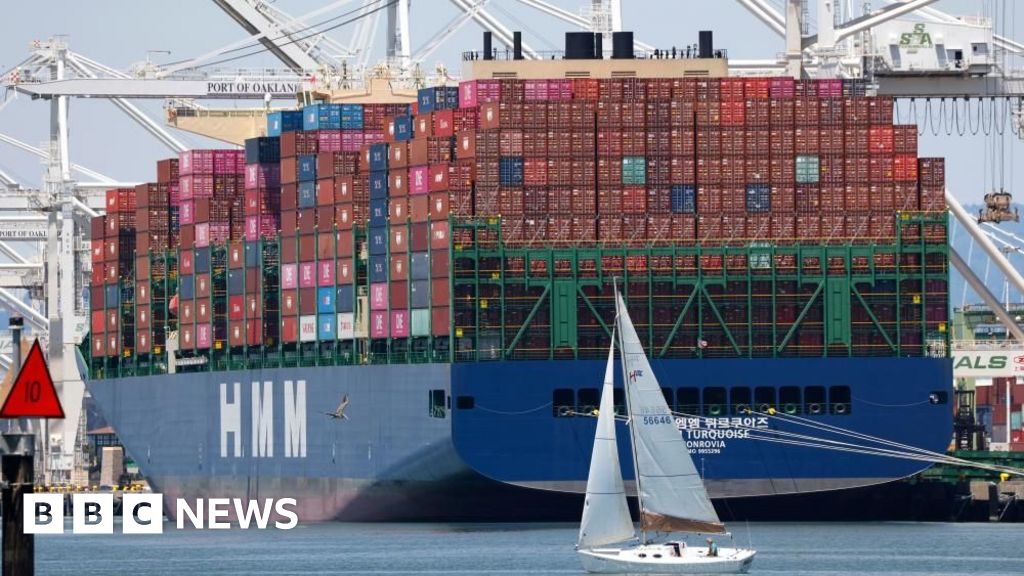
Of the 100-plus countries that trade with Iran, China is its biggest export partner.
In the year to October 2025, it bought more than $14bn (£10.4bn) of products from Iran, according to figures from Trade Data Monitor which are based on statistics from the Islamic Republic of Iran Customs Administration.
China is followed by Iraq, which received $10.5bn worth of goods from its neighbour. Iran also counts the United Arab Emirates and Turkey among its largest customers.
In fact, exports from Iran to Turkey jumped substantially from $4.7bn in 2024 to $7.3bn last year.
Almost all of Iran’s top 10 exports are fuel-related – it is one of the world’s largest oil producers.
It also ships food to other nations, including pistachios and tomatoes. But it is, by far, a much larger buyer of staples from its trade partners.
Food makes up about a third of Iran’s imports, in particular corn, rice, sunflower seeds and oils as well as soybeans.
But Iran’s biggest import is gold.
In the 12 months to October, it imported $6.7bn worth of gold compared to $4.8bn in the year before.
How could the tariff be implemented?
Trump’s post says the 25% tariff is “effective immediately”, and the order is “final and conclusive”.
However, there has been no detail as yet from the White House as to how it would work in practice, or which countries specifically it would apply to.
We don’t know if it would cover all countries who deal with Iran or just its biggest trade partners.
It is also unclear whether the 25% tax will come on top of existing tariffs the Trump administration has already imposed.
The US has also not specified under what law the new tariff would be introduced. Sweeping tariffs announced last April were imposed under the International Emergency Economic Powers Act.
But this is currently subject to legal challenge – with the US Supreme Court due to rule as soon as Wednesday. On Monday Trump said the US would be “screwed” if these tariffs aren’t upheld.
Enforcing the proposed tariff could be difficult. Iran is estimated to have made billions from oil exports in 2024 using a fleet of shadow ships that are hard to track and by selling its oil in Chinese yuan rather than the more traditional US dollars.
How might this affect US-China relations?
On the face of it, Trump’s announcement risks reigniting the trade conflict between the US and China.
If the president meant what he wrote, it would mean Chinese goods sent to the US should immediately be subject to the new 25% tariff.
However, these are already subject to an average tariff rate of 30.8%, according to Bloomberg Economics.
So will the new tariff be imposed in addition to the current levy? Or will allowances be made?
China has previously shown a willingness to push back against what it perceives as disproportionate action by the US.
It has done so partly by introducing its own tariffs, but more importantly by announcing restrictions on exports of rare earths, which the US desperately needs for its tech-heavy industries.
China currently dominates the global supply, giving it crucial leverage, which helped Beijing reach a temporary trade truce with the US in November that defused tensions.
So introducing a new 25% tariff on China now would be highly provocative, and Beijing has already warned it will “take all necessary measures to safeguard its legitimate rights and interests”.
Analysts question whether it will actually happen, given the real-world impact of previous Trump announcements not always matching the initial headline.
What is happening with Iran’s economy?
Iran’s huge oil reserves make it one of the world’s top 10 oil producers and it should be a source of great wealth.
However, its economy has been crippled by years of mismanagement of the public finances, a fall in oil sales and biting international sanctions.
Many of the country’s 92 million people are struggling to afford basics such as food and utilities, and the cost of living is at the heart of the protests seen in recent weeks.
Household spending has fallen compared to its 2008 peak, according to BBC analysis, and government restrictions on women’s ability to work has pushed the employment rate down from 42.4% two decades ago to around 37%.
At the same time things have become more expensive thanks to high inflation, which hit 48.4% in October amid government policy changes that have led to the value of the rial to fall against the US dollar.
That makes imports even more expensive. Those are even more important because significant under-investment in the electricity and water systems mean they are unreliable and have undermined government pledges to increase domestic production of everything from food to consumer goods.
A reduction of fuel subsidies in December and potentially even less foreign trade due to these latest tariffs means inflation could yet climb higher and push the economy even closer towards collapse.
Additional reporting by Theo Leggett and Jonathan Josephs.
[ad_2]
Source link