Is there an evolutionary reason for same-sex sexual behaviour?
[ad_1] A male Hamadryas baboon (Papio hamadryas) displays his dominant status by mounting a lower-ranking male Ger Bosma/Alamy Same-sex
[ad_1]

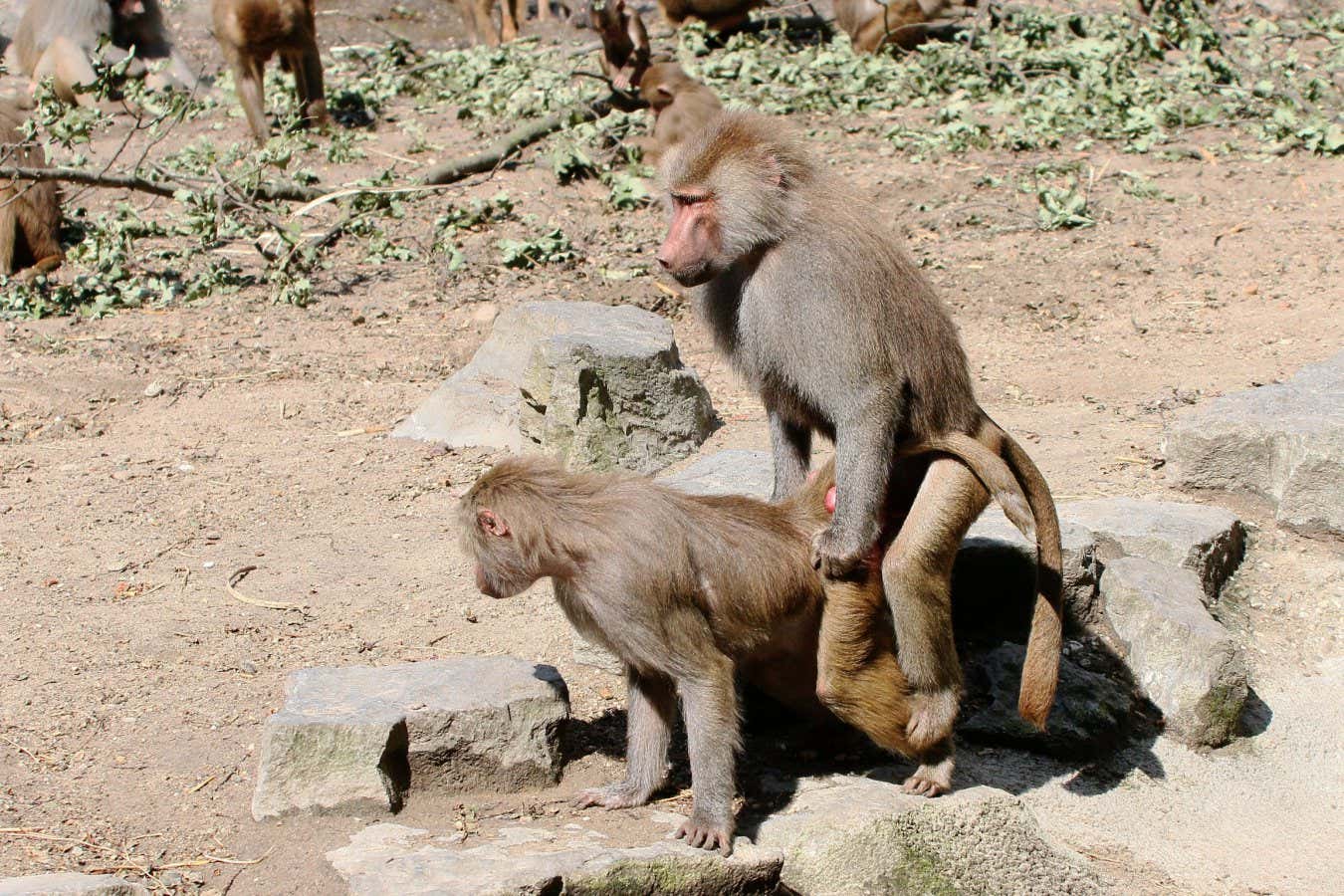
A male Hamadryas baboon (Papio hamadryas) displays his dominant status by mounting a lower-ranking male
Ger Bosma/Alamy
Same-sex sexual behaviour may help monkeys and apes rise up the social ranks and ultimately have more offspring – and it seems to be especially beneficial in harsh environments where there are lots of predators, say, or a shortage of food.
That’s the implication of a study looking at why the level of same-sex behaviour varies in different primate species. It supports the idea that, contrary to what is commonly assumed, same-sex sexual behaviours in apes and monkeys are an adaptive trait that boosts survival.
It has often been claimed that same-sex behaviour is somehow “unnatural”. But in addition to people, it has now been reported in at least 1500 animals, from insects and dolphins to bison and bonobos.
There are many reasons to think this is the tip of the iceberg. Most species haven’t been closely studied; same-sex behaviours often aren’t recognised when seen because the sexes of the individuals involved may not be clear; and even when such behaviours are recognised they may not be reported.
Of the 20 or so mammal species that have been closely studied over long periods, same-sex behaviour has been seen in 80 per cent. In a colony of rhesus macaques (Macaca mulatta) on the Puerto Rican island of Cayo Santiago that has been studied for many decades, for instance, three-quarters of males engage in same-sex behaviour, Vincent Savolainen at Imperial College London and his colleagues reported in 2023.
In other words, there can now be no doubt that same-sex behaviour is entirely natural. The question is why?
This has sometimes been referred to as “the Darwinian paradox”, because of the common assumption that homosexual behaviour is non-adaptive – that is, that it doesn’t help individuals have more offspring, or boost the survival chances of those they do have.
Various explanations have been proposed for why same-sex behaviour is so common if it is non-adaptive. One is that same-sex behaviour occurs because of a lack of discrimination, that is, because individuals can’t tell the difference between males and females. This is probably true of simple animals such as insects, but it’s certainly not the case for highly intelligent animals such as apes and dolphins.
Another is that it’s a side effect of selection for other traits. For instance, it has been suggested that some traits that boost reproductive success in women may be linked to a greater likelihood of homosexuality in men.
It’s also possible that same-sex behaviour is adaptive, after all. One idea is that it helps males build coalitions that ultimately give them more access to more females. “Same-sex behaviour is, if you want, a currency that you can use to navigate your way in these societies,” says Savolainen.
His team has now analysed data on the prevalence of same-sex behaviour in 59 primate species and looked for associations with environmental and social factors. Among other things, they found that it was more likely to occur in drier environments where food was scarce or where there was more predation pressure, as well as in more complex societies.
For a behaviour to become more common in stressful environments does suggest it is adaptive. If, say, same-sex behaviour was done for pleasure only, you’d expect it to be less common in stressful environments.
“Same-sex behaviour may facilitate better cooperation and cohesion by strengthening social bonds, which is particularly important in these stressful environments,” says team member Chloë Coxshall, also at Imperial.
“But to demonstrate adaptive value, the behaviour needs to be linked to increased fitness, that is, a higher number of offspring,” says Savolainen. “This is precisely what I intend to test in macaques.”
So we are not yet at the point where we can conclusively say same-sex behaviour in at least some primates is adaptive, but it could be that science is about to turn yet another of our preconceptions about this behaviour on its head.
What does this tell us about homosexual behaviours in people? Well, if these findings are confirmed, it might help explain why it is as common as it is. What it does not tell us, the researchers stress, is anything about the rights or wrongs of such behaviour – this is the so-called naturalistic fallacy. That is, human behaviours should not be judged based on what animals do.
That said, there is a certain delicious irony in the idea that when it comes to the survival of the fittest, we may need to redefine who the fittest really are.
Topics:
[ad_2]
Source link