What looked like a planet was actually a massive space collision
[ad_1] Young star systems are chaotic environments where space rocks constantly collide. Asteroids, comets, and larger bodies crash into
[ad_1]
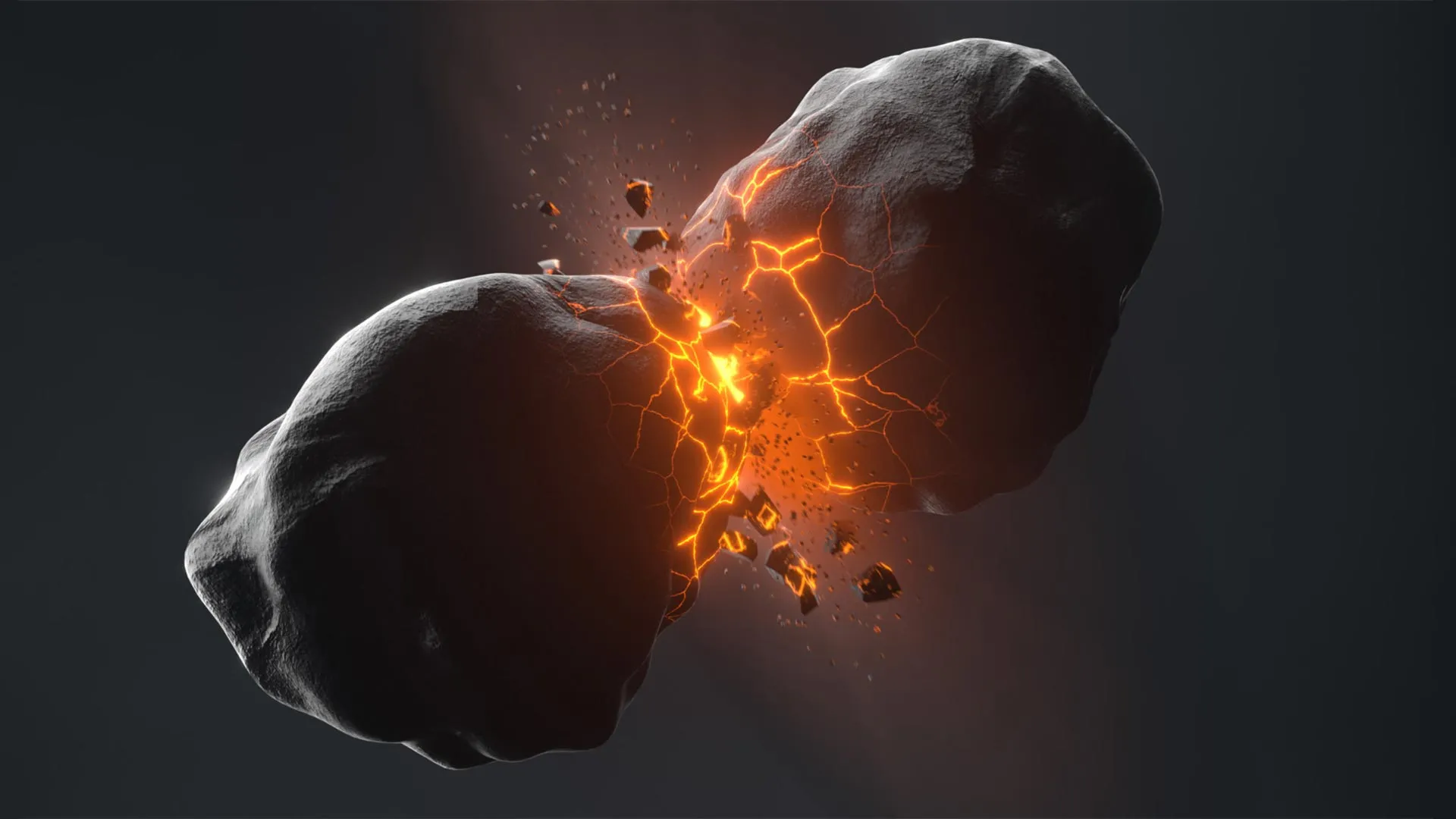
Young star systems are chaotic environments where space rocks constantly collide. Asteroids, comets, and larger bodies crash into one another, sometimes sticking together and slowly transforming clouds of dust and ice into planets and moons. Although small impacts are common, the largest collisions are thought to be extremely rare during the hundreds of millions of years it takes for a planetary system to fully form — possibly occurring only once every 100,000 years.
Yet astronomers have now identified evidence of two enormous collisions around a nearby star named Fomalhaut, all within just 20 years. The finding suggests either an extraordinary stroke of luck or that massive impacts may happen more often during planet formation than scientists previously believed.
The two events — first seen in 2004 and again in 2023 — represent the first time astronomers have directly imaged collisions between large objects in a planetary system beyond our own.
Catching the Aftermath of a Cosmic Impact
“We just witnessed the collision of two planetesimals and the dust cloud that gets spewed out of that violent event, which begins reflecting light from the host star,” said Paul Kalas, an adjunct professor of astronomy at the University of California, Berkeley, and lead author of the study. “We do not directly see the two objects that crashed into each other, but we can spot the aftermath of this enormous impact.”
Over tens of thousands of years, Kalas explained, the region around Fomalhaut would appear to be filled with glowing debris, “sparkling with these collisions” — similar to twinkling holiday lights.
A Young Star That Mirrors the Early Solar System
Kalas began studying Fomalhaut in 1993 while searching for dusty disks that remain after planet formation. Located just 25 light years from Earth, Fomalhaut is relatively young — about 440 million years old — making it a useful stand-in for what the solar system looked like early in its history.
Using NASA’s Hubble Space Telescope (HST), Kalas eventually detected a broad disk of debris around the star. In 2008, he also reported spotting a bright object near the disk that appeared to be a planet. This marked the first time an exoplanet had been directly imaged at optical wavelengths, and it was named Fomalhaut b following standard naming rules.
That apparent planet has since vanished. Researchers now believe the object was not a planet at all, but a cloud of dust created when two large bodies collided.
When Dust Clouds Look Like Planets
“This is a new phenomenon, a point source that appears in a planetary system and then over 10 years or more slowly disappears,” Kalas said. “It’s masquerading as a planet because planets also look like tiny dots orbiting nearby stars.”
Based on how bright the 2004 and 2023 events appeared, scientists estimate that the colliding bodies were at least 60 kilometers (37 miles) wide. That is more than four times the size of the asteroid that struck Earth 66 million years ago and led to the extinction of the dinosaurs. Objects of this scale are known as planetesimals, similar in size to many asteroids and comets in our solar system, but far smaller than dwarf planets such as Pluto.
“Fomalhaut is much younger than the solar system, but when our solar system was 440 million years old, it was littered with planetesimals crashing into each other,” Kalas said. “That’s the time period that we are seeing, when small worlds are being cratered with these violent collisions or even being destroyed and reassembled into different objects. It’s like looking back in time in a sense, to that violent period of our solar system when it was less than a billion years old.”
The new findings were described in a paper scheduled to be published online Dec. 18 in the journal Science.
A Natural Laboratory for Studying Planet Formation
“The Fomalhaut system is a natural laboratory to probe how planetesimals behave when undergoing collisions, which in turn tells us about what they are made of and how they formed,” said Mark Wyatt, a co-author of the study and a professor of astronomy at the University of Cambridge in the United Kingdom. “The exciting aspect of this observation is that it allows us to estimate both the size of the colliding bodies and how many of them there are in the disk, information which it is almost impossible to get by any other means.”
Wyatt estimates that roughly 300 million planetesimals of similar size orbit Fomalhaut. Earlier observations also detected carbon monoxide gas around the star, indicating that these objects are rich in volatile materials and closely resemble the icy comets found in our own solar system.
Dust Clouds Masquerading as Exoplanets
Fomalhaut lies in the southern constellation Piscis Austrinus and shines with 16 times the luminosity of our sun, making it one of the brightest stars visible from Earth. When Kalas began observing the star with HST in 2004, he discovered a wide ring of debris located 133 astronomical units (AU) from the star. This is more than three times the distance of the Kuiper Belt from the sun in our solar system. An AU is the average distance between the Earth and the sun, or 93 million miles.
The sharply defined inner edge of the debris belt suggested that unseen planets might be shaping it. After another HST observation in 2006, Kalas concluded that a bright object visible in images from both 2004 and 2006 was a planet. He acknowledged at the time that it could be a dust cloud created by a collision, but considered that explanation unlikely.
Follow-up HST observations in 2010, 2012, 2013, and 2014 changed that view. In the final image, the object known as Fomalhaut b had completely disappeared.
A Second Collision Confirms the Explanation
Nine years later, after several unsuccessful attempts to re-image the system, Kalas obtained a new HST image showing another bright point near the earlier location. This source became known as Fomalhaut cs1, short for circumstellar source 1. A second new object, called Fomalhaut cs2, appeared nearby, but its position ruled out the possibility that it was the same object reappearing. Because there was a nine-year gap between the 2014 and 2023 images, astronomers cannot say exactly when cs2 first formed.
In their new analysis, Kalas and his international team examined the 2023 image along with a lower-quality follow-up image taken in 2024. They concluded that the light could only be explained as sunlight reflecting off a cloud of dust created by a collision between two planetesimals.
Kalas noted that while cs1 initially moved in a way consistent with an orbiting planet, its trajectory later curved outward. That behavior matches what would be expected from tiny dust particles being pushed away by the pressure of starlight. The appearance of cs2 strengthens the conclusion that both objects were dust clouds, not planets.
Lessons for Future Exoplanet Missions
Kalas compared the Fomalhaut debris cloud to the plume of material produced in 2022 when NASA’s DART (Double Asteroid Redirection Test) mission intentionally crashed into the moonlet Dimorphos, which orbits the asteroid Didemos. The cloud around Fomalhaut, however, is estimated to be about a billion times larger.
Over the next three years, Kalas has been granted observing time with both the James Webb Space Telescope’s Near-Infrared Camera (NIRCam) and the HST. The goal is to monitor how the dust cloud changes over time, including whether it expands and how it moves through the system. The cloud is already about 30% brighter than Fomalhaut cs1, and observations in August 2025 confirmed that cs2 remains visible.
Looking ahead, Kalas urged caution as astronomers prepare for future missions aimed at directly imaging exoplanets.
“These collisions that produce dust clouds happen in every planetary system,” he said. “Once we start probing stars with sensitive future telescopes such as the Habitable Worlds Observatory, which aims to directly image an Earth-like exoplanet, we have to be cautious because these faint points of light orbiting a star may not be planets.”
Other co-authors include UC Berkeley research astronomer Thomas Esposito; former UC Berkeley graduate students Jason Wang, now at Northwestern University in Illinois, and Michael Fitzgerald, now at UCLA; former UC Berkeley postdoctoral fellow Robert De Rosa, now at the European Southern Observatory in Chile; Maxwell Millar-Blanchaer of UC Santa Barbara; Bin Ren of Xiamen University in China; Maximilian Sommer of the University of Cambridge; and Grant Kennedy of the University of Warwick in the UK. The research was supported by NASA (NAS5-26555, GO-HST-17139).
[ad_2]
Source link