County Wicklow: Settlement find may challenge Vikings first towns theory
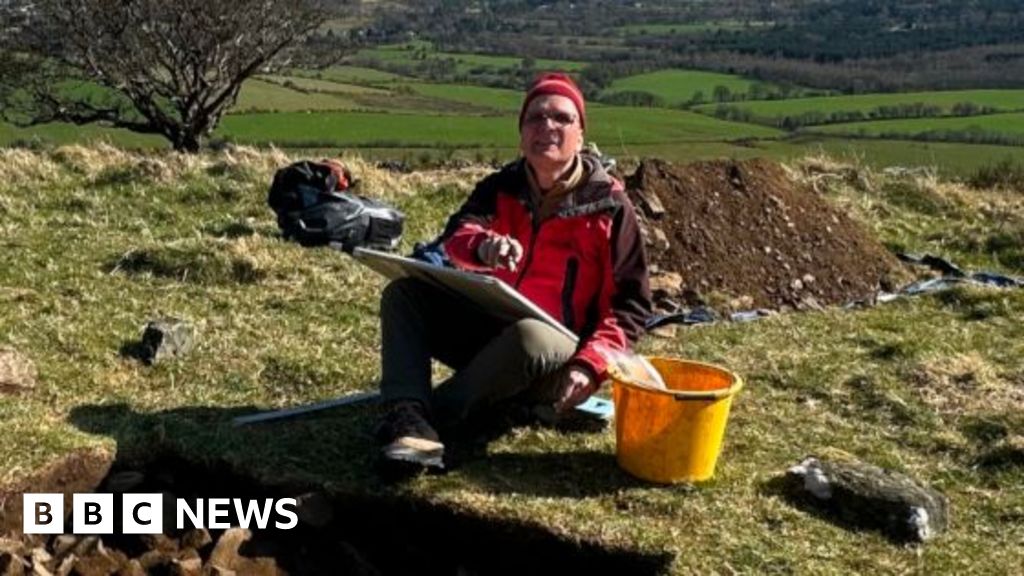
[ad_1] Antiquity Dr Dirk Brandherm was part of the research team that undertook the excavation A recently discovered large
[ad_1]

 Antiquity
A recently discovered large hilltop settlement could challenge the theory that the Vikings built the first towns in Ireland, a researcher has said.
Dr Dirk Brandherm and his colleagues have identified more than 600 suspected houses in the Brusselstown Ring making it, to date, the largest nucleated settlement ever discovered in the entirety of prehistoric Britain and Ireland.
The settlement, which is thought to have emerged at about 1200 BC (the Late Bronze Age), is located within a region called the Baltinglass Hillfort Cluster in the south-western edge of the Wicklow Mountains.
It is among the 13 large hilltop enclosures spread across the mountain range where there are structures dating back to the Neolithic period and Early Bronze Age.
 Antiquity
The findings were recently published within Antiquity, a peer-reviewed journal of world archaeology.
The study states: “Given its exceptional size, density of occupation and architectural complexity, Brusselstown Ring represents a unique case within both the Baltinglass hillfort cluster and more widely within the Atlantic Archipelago.”
Survey work has been conducted over the last two decades but researchers believed critical questions about “the date, development and function of both the enclosing elements and the internal settlement remain unanswered”.
Therefore, researchers initiated test excavations in 2024.
“The available evidence indicates their occupation mainly during the Late Bronze Age, with continued use or reuse of some house platforms in the Early Iron Age.
“This makes Brusselstown Ring the largest nucleated settlement agglomeration by far in prehistoric Ireland and Britain,” the study highlighted.
What makes it significant?
Dr Brandherm, a reader in prehistoric archaeology at Queen’s University Belfast, said the Brusselstown Ring is significant due to “the large number and the concentration of roundhouses” in one spot.
The image archaeologists had is that during the Bronze Age the settlement structure was based on small hamlets (one to five dwellings) and there were no villages or towns.
In 2002, about 74 roundhouses dating back to the Bronze Age were discovered during the Corrstown excavation in Northern Ireland.
The researcher said Corrstown was the first village from that era, but the Brusselstown Ring is “a different ball game altogether”.
The Brusselstown Ring discovery questions the idea that the first towns on the island of Ireland were founded by the Vikings, according to the researcher.
“Because if you’ve got more than 600 roundhouses, and potentially a large stone built cistern, that’s no longer a village,” Dr Brandherm told BBC News NI.
“We’re talking a proto-town of sorts, and that’s 2000 years before the Vikings.”
 Antiquity Publications Ltd
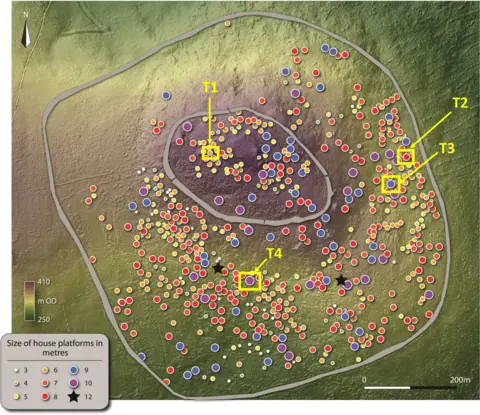
There are two widely spaced ramparts (defensive walls) encompassing the enclosure.
These ramparts do not only enclose its own summit but also that of the nearby Spinas Hill One – meaning it is one of the very few hillforts in Europe to span more than a single hill
Through the use of aerial surveys and photogrammetry mapping, it is suspected that 98 of the house platforms were inside the inner enclosure and more than 500 were located between the two ramparts.
Dr Brandherm said: “Based on the data that we presently have all the house platforms would appear to date to the same period.”
Cistern ‘a first in Ireland’
A stone-lined, flat-floored chamber was also discovered near one of the trenches at the site.
Dr Brandherm described it as being “boat-shaped” and “slightly larger than a round house”.
It appeared to have been fed by a stream from a outcrop uphill, and archaeologists believe it may have been a water cistern to store fresh water.
Further samples in the coming months will determine if the cistern dates back to the same period as the roundhouses.
He said, if confirmed, the discovery is a “first in Ireland”, as there are similar structures from the Bronze Age and the Iron Age in France and Spain.
Excavation process
 Antiquity Publications Ltd
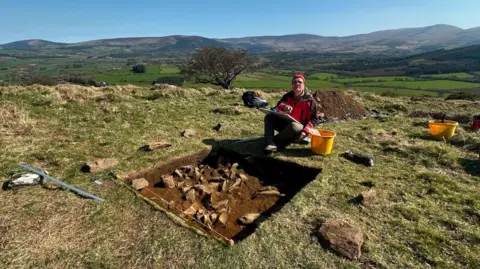
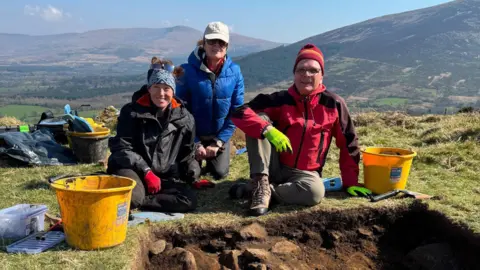
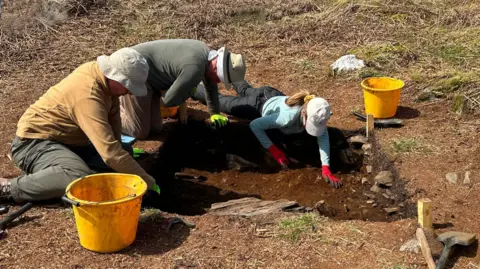
Four test excavations were completed by archaeologists to understand the site’s occupation.
The tests ranged from six-to-12m in diameter to represent house platforms of different sizes.
The idea was to investigate whether architectural differences in the platforms would signify if there were social or economic stratification within the community.
Dr Brandherm said the smaller houses were about four to five metres in diameter, with the larger ones being 11-12m in diameter.
“But the fact that we do have different sizes it you know it begs the question if there is some social differentiation sitting behind that,” he said.
However, based on the current data, Dr Brandherm said it cannot be confirmed whether there was a social hierarchy in the settlement.
Before this, the largest cluster of ancient settlements was in Mullaghfarna in County Sligo which is thought to have contained more than 150 houses during the middle Stone Age period of 3300-2900 BC and in the later Bronze Age between 1200-900 BC.
The research stated that future work at Brusselstown will “focus on confirming the nature and the date of the potential cistern, identifying structural features of the prehistoric roundhouses and establishing the nature and chronology of the enclosing elements”.
[ad_2]
Source link