Is India’s landmark rural jobs guarantee scheme under threat from G RAM G?
[ad_1] Soutik BiswasIndia correspondent Hindustan Times via Getty Images Providing unskilled public work, the jobs scheme has become a
[ad_1]
Soutik BiswasIndia correspondent

 Hindustan Times via Getty Images
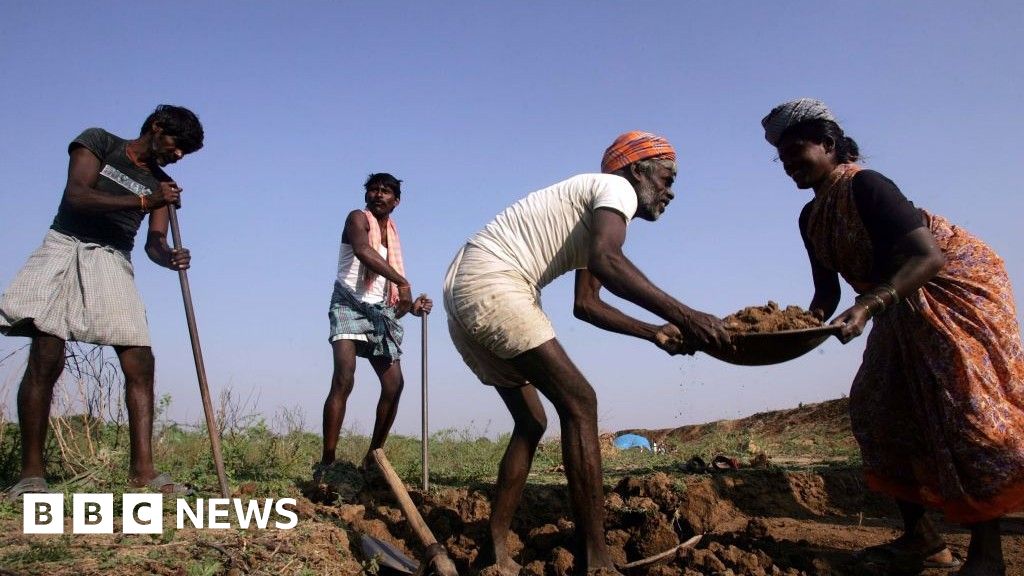
India is home to one of the world’s most ambitious social programmes – a jobs guarantee that gives every rural household the legal right to paid work.
Launched in 2005 by a Congress party government, the National Rural Employment Guarantee Scheme (NREGS) entitled every rural household to demand up to 100 days of paid manual work each year at a statutory minimum wage.
This mattered in a country where 65% of 1.4 billion people live in rural areas and nearly half rely on farming, which generates insufficient income, accounting for just 16% of India’s GDP.
Providing unskilled public work across all but fully urban districts, the scheme has become a backbone of rural livelihoods, cushioning demand during economic shocks. It is also among the world’s most studied anti-poverty programmes, with strong equity: over half of the estimated 126 million scheme workers are women, and around 40% come from “scheduled castes” or tribes, among the most deprived Indians
The ruling Narendra Modi government, initially critical and later inclined to pare it back, turned to the scheme in crises – most notably during the Covid pandemic, when mass return migration from cities to villages sharply drove up demand for work. Economists say the scheme lifted rural consumption, reduced poverty, improved school attendance, and in some regions pushed up private-sector wages.
Last week, the government introduced a new law that repeals and rebrands the scheme. The programme – renamed MGNREGA in 2009 to honour Mahatma Gandhi – has now dropped his name altogether.
While the renaming drew the political heat, the more consequential changes lie in what the new law – known as G RAM G for short – actually does.
It raises the annual employment guarantee from 100 to 125 days per rural household. It retains the provision that workers not given jobs within 15 days are entitled to an unemployment allowance.
Under the original scheme, the federal government paid all labour wages and most material costs – roughly a 90:10 split with the states.
Funding will now follow a 60:40 split between the federal government and most states. That could push states’ contribution to 40% or more of total project cost. The federal government keeps control, including the power to notify the scheme and decide state-wise allocations.
 Mint via Getty Images
States remain legally responsible for providing employment – or paying unemployment allowances, even as the central government allocates $9.5bn for the scheme in the current financial year, ending next March.
The government frames the reforms as a modernised, more effective, and corruption-free programme aimed at empowering the poor.
“This law stands firmly in favour of the poor, in support of progress, and in complete guarantee of employment for the workers,” says federal agriculture minister Shivraj Singh Chouhan.
Critics – including opposition parties, academics, and some state governments – warn that capping funds and shifting costs to states could dilute a rare legal right in India’s welfare system.
“It is the culmination of the long-standing drive for centralisation of the scheme under the Modi government. But it is more than centralisation. It is the reduction of employment guarantee to a discretionary scheme. A clause allows the federal government to decide where and when the scheme applies,” Jean Dreze, a development economist, told me.
Prof Dreze says the increase to 125 guaranteed workdays per household may sound like a major revamp, but is a “red herring”. A recent report by LibTech India, an advocacy group, found that only 7% of rural households received the 100 days of work guaranteed under the scheme in 2023-24.
“When the ceiling is not binding, how does it help to raise it? Raising wage rates, again, is a much better way of expanding benefits. Second, raising the ceiling is a cosmetic measure when financial restrictions pull the other way, ” Prof Dreze notes.
These and other concerns appear to have prompted a group of international scholars to petition the Modi government in defence of the original scheme, warning that the new funding model could undermine its purpose.
“The [scheme] has captured the world’s attention with its demonstrated achievements and innovative design. To dismantle it now would be a historic error,” an open letter, led by Olivier De Schutter, UN special rapporteur on extreme poverty and human rights, warned.
 LightRocket via Getty Images
To be sure, the scheme has faced persistent challenges, including underfunding and delays in wage payments. West Bengal’s programme, for example, has faced deep cuts and funding freezes since 2022, with the federal government halting funds over alleged non-compliance.
Yet despite these challenges, the scheme appears to have delivered measurable impact.
An influential study by economists Karthik Muralidharan, Paul Niehaus, and Sandip Sukhtankar found that the broader, economy-wide impacts of the scheme boosted beneficiary households’ earnings by 14% and cut poverty by 26%. Workers demanded higher wages, land returns fell, and job gains were larger in villages, the study found.
But many say the scheme’s durability also underscores a deeper structural problem: India’s chronic inability to generate enough non-farm jobs to absorb surplus rural labour.
Agriculture has consistently lagged behind the broader economy, growing just 3% annually since 2001–02, compared with 7% for the rest of the economy.
Critics such as Nitin Pai of the Takshashila Institution, a think-tank, argue that the scheme cushions distress but does little to raise long-term rural productivity, and may even blunt incentives for agricultural reform.
“With [the scheme] we’re merely treating a serious underlying malaise with steroids,” said Mr Pai in a post on X.
The government’s Economic Survey 2023–24 questions whether demand under the scheme truly mirrors rural hardship.
If that was the case, data should show higher fund use and employment in poorer states with higher unemployment, the survey says.
Yet, it notes, Tamil Nadu, with under 1% of the country’s poor, received nearly 15% of the scheme’s funds, while Kerala, with just 0.1% of the poor, accounted for almost 4% of federal allocations.
The survey adds that the actual work generated depends largely on a state’s administrative capacity: states with trained staff can process requests on time, directly influencing how much employment is provided.
 Hindustan Times via Getty Images
Despite these anomalies, the case for the scheme remains strong in a country where many depend on low-income rural work and where the deeper challenge is the lack of quality employment.
Even headline figures on rising labour participation in India can be misleading: more people “working” does not always mean better or more productive jobs.
A recent paper by economists Maitreesh Ghatak, Mrinalini Jha and Jitendra Singh finds that the country’s recent rise in labour force participation, especially among women, reflects economic distress rather than growth-driven job creation.
The authors say the increase is concentrated in the most vulnerable forms of work: unpaid family helpers and self-employed workers, who have very low productivity and falling real earnings.
“The recent expansion in employment reflects economic distress leading to subsistence work, rather than growth-driven better quality job creation,” they say.
The evidence suggests people are driven into subsistence work by necessity, not drawn into better-quality jobs by a stronger economy.
This ensures that the world’s largest jobs guarantee scheme will remain central to the livelihoods of hundreds of millions of Indians – whether the revamped version will strengthen it or undermine its impact remains to be seen.
Follow BBC News India on Instagram, YouTube, X and Facebook.
[ad_2]
Source link