Ukraine’s European allies press for more security guarantees
[ad_1] European leaders have said there is more work to be done to obtain security guarantees for Ukraine as
[ad_1]
European leaders have said there is more work to be done to obtain security guarantees for Ukraine as pressure mounts from Washington on Kyiv to reach a peace deal with Russia.
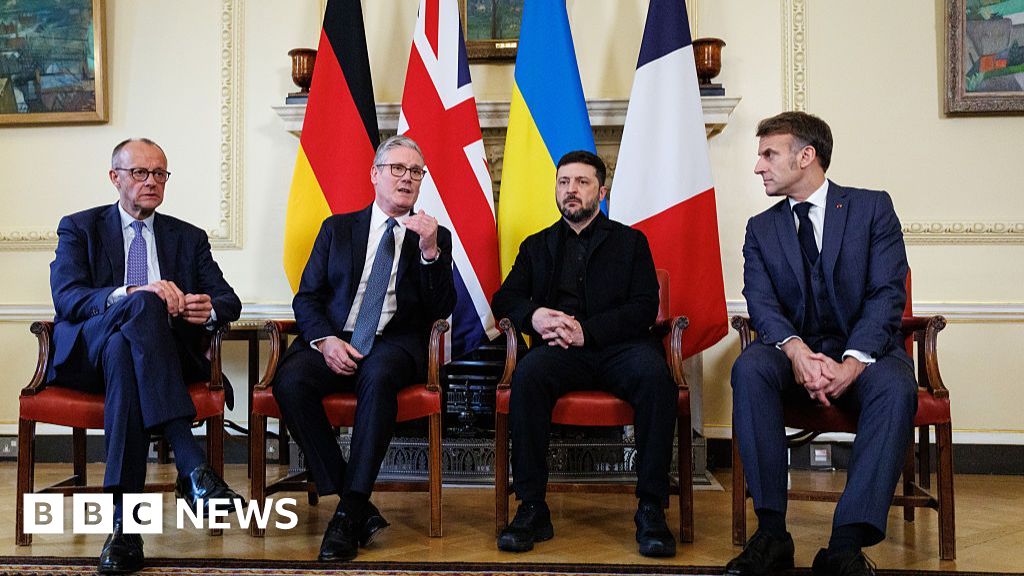
Ukrainian President Volodymyr Zelensky met UK Prime Minister Keir Starmer, France’s Emmanuel Macron and Germany’s Friedrich Merz in London on Monday to discuss the latest version of a peace plan, drafted during talks between Ukrainian and US officials last week.
Following the meeting, France said work would be “intensified” to provide security guarantees for Kyiv.
On Monday evening Zelensky was due to travel to Brussels to meet Nato officials and European Commission President Ursula von der Leyen.
Ahead of the talks he hosted at Downing Street, Starmer said there needed to be “hard-edged security guarantees” in a peace deal for Ukraine.
Merz stated he was “sceptical” about some of the details of the potential peace plan coming from the US side. “But we have to talk about it. That’s why we are here,” he added.
There is nervousness in Kyiv and across Europe that the US could end its support of Ukraine over frustration with the slow progress of negotiations. “We can’t manage without Americans, we can’t manage without Europe and that is why we need to make some important decisions,” Zelensky said in London.
Last week, Ukrainian officials spent three days with the US negotiating team in Florida pushing for changes to a US-backed peace proposal which has been widely considered favourable to Russia.
Ukraine is looking for security guarantees to ensure that in the event of a peace deal, Russia would be deterred from carrying out another invasion or attack.
The issue of territorial concessions also remains a sticking point between Moscow and Kyiv. The US has proposed Ukraine pulls its forces entirely out of eastern regions which Russia has attempted to take by force but has been unable to capture in full, in return for Russian withdrawals elsewhere and a cessation of fighting.
But this is an unpalatable option for Zelensky, who refuses to reward Moscow for its aggression and who has repeatedly warned Russia would use any foothold in the eastern regions to launch future assaults on Ukraine.
Although the White House has been pushing Kyiv and Moscow to swiftly agree to a multi-point plan to end the war, there has been little sign of a breakthrough.
A five-hour meeting between US envoy Steve Witkoff and Russian President Vladimir Putin in Moscow last week failed to yield tangible results.
Those talks were followed by three days of discussions between Zelensky’s chief negotiator Rustem Umerov and his US counterparts in Miami, which resulted in vague but positive statements of “progress” from both sides.
However, on Sunday Trump accused Zelensky of not having reading the draft of the revised peace deal.
“I’m a little disappointed that President Zelensky hasn’t yet read the proposal,” he said, while insisting Russia’s Vladimir Putin was “fine with it”.
Almost simultaneously Zelensky stated he expected to be briefed on the negotiations by Umerov either in London or Brussels on Monday. “Some issues can only be discussed in person,” he said.
The talks in London were the latest attempt by Ukraine’s European allies to carve out a role in the US-led efforts to end the war, which they fear will undercut the long-term interests of the continent in favour of a quick resolution.
Despite significant economic pressure and sustained battlefield losses, the Kremlin has shown little sign it is willing to compromise on its key demands, including ruling out any future path to Ukraine joining the Nato military alliance.
Last week, Putin also restated his willingness to continue fighting until his forces take full control of the Donetsk and Luhansk regions, 85% of which is currently occupied by the Russian army.
As talks in the US and Europe continue, so does the war.
Between Sunday and Monday a total of 10 people were killed and 47 were injured as Russian forces attacked nine regions using drones, glide bombs and missiles.
Russia’s full-scale invasion of Ukraine began in February 2022. Since then, thousands of civilians and soldiers have been killed or injured, with Ukraine’s cities continuing to come under fire on an near-nightly basis.
[ad_2]
Source link