25 Years of Space Station Technology Driving Exploration
NASA and its partners have supported humans continuously living and working in space since November 2000. After 25 years
NASA and its partners have supported humans continuously living and working in space since November 2000. After 25 years of habitation, the International Space Station continues to be a proving ground for technology that powers NASA’s Artemis campaign, future lunar missions, and human exploration of Mars.
Take a look at key technology advancements made possible by research aboard the orbiting laboratory.
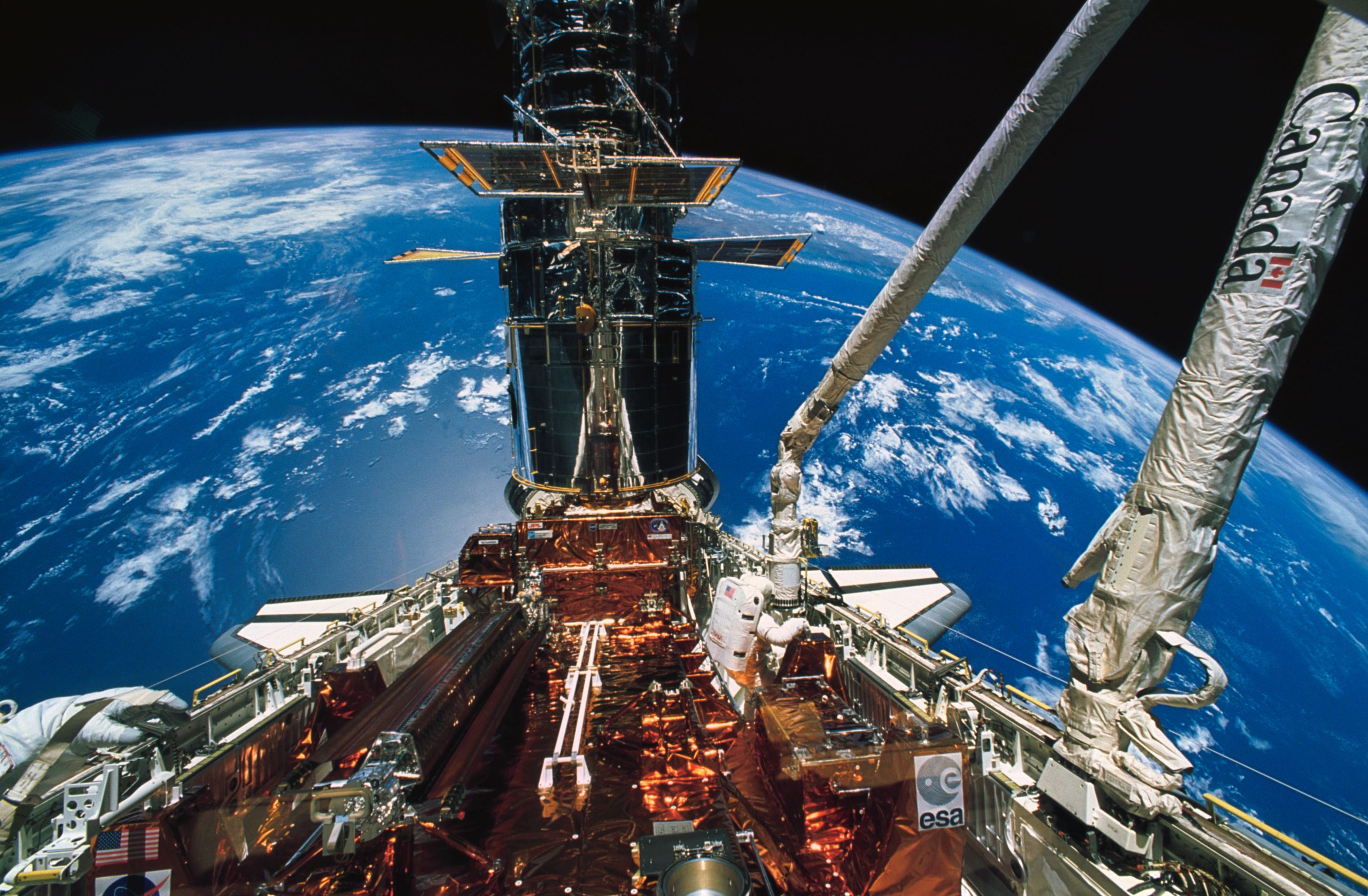
Robots have been critical to the space station’s success. From the Canadian-built Canadarm2, which assembled large portions of the orbiting laboratory and continues to support ongoing operations, especially during spacewalks, robotic technology on station has evolved to include free-flying assistants and humanoid robots that have extended crew capabilities and opened new paths for exploration.
The station’s first robotic helpers arrived in 2003. The SPHERES robots – short for Synchronized Position Hold, Engage, Reorient, Experimental Satellite – served on station for over a decade, supporting environmental monitoring, data collection and transfer, and materials testing in microgravity.
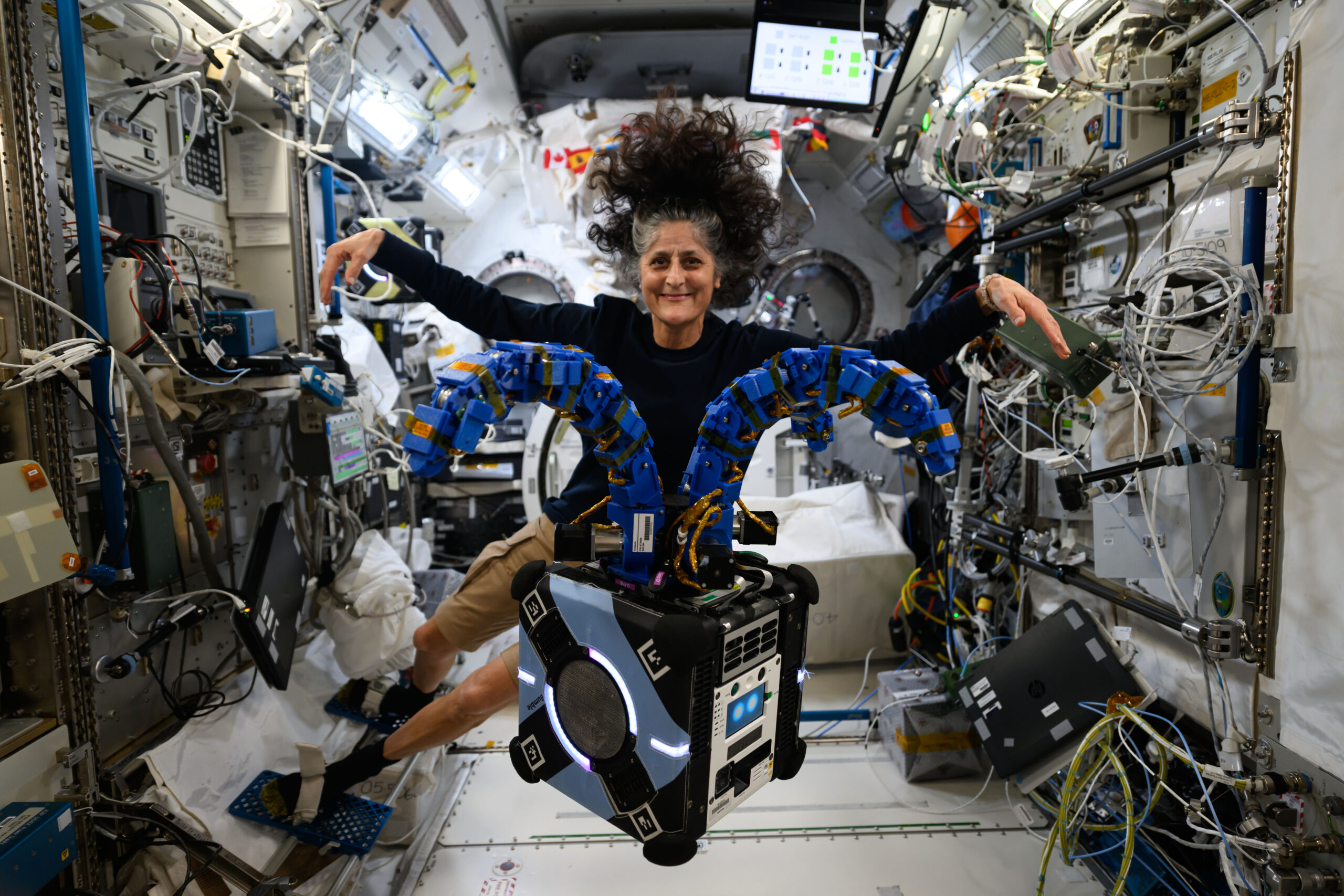
NASA’s subsequent free-flying robotic system, Astrobee, built on the lessons learned from SPHERES. Known affectionately as Honey, Queen, and Bumble, the three Astrobees work autonomously or via remote control by astronauts, flight controllers, or researchers on the ground. They are designed to complete tasks such as inventory, documenting experiments conducted by astronauts, or moving cargo throughout the station, and they can be outfitted and programmed to carry out experiments.
NASA and partners have also tested dexterous humanoid robots aboard the space station. Robonaut 1 and its more advanced successor, Robonaut 2, were designed to use the same tools as humans, so they could work safely with crew with the potential to take over routine tasks and high-risk activities.
Advanced robotic technologies will play a significant role in NASA’s mission to return to the Moon and continue on to Mars and beyond. Robots like Astrobee and Robonaut 2 have the capacity to become caretakers for future spacecraft, complete precursor missions to new destinations, and support crew safety by tackling hazardous tasks.
Living and working in space for more than two decades requires technology that makes the most of limited resources. The space station’s life support systems recycle air and water to keep astronauts healthy and reduce the need for resupply from Earth.
The station’s Environmental Control and Life Support System (ECLSS) removes carbon dioxide from the air, supplies oxygen for breathing, and recycles wastewater—turning yesterday’s coffee into tomorrow’s coffee. It is built around three key components: the Water Recovery System, Air Revitalization System, and Oxygen Generation System. The water processor reclaims wastewater from crew members’ urine, cabin humidity, and the hydration systems inside spacesuits for spacewalks, converting it into clean, drinkable water.
The air revitalization system filters carbon dioxide and trace contaminants from the cabin atmosphere, ensuring the air stays safe to breathe. The oxygen generation system uses electrolysis to split water into hydrogen and oxygen, providing a steady supply of breathable air. Today, these systems can recover around 98% of the water brought to the station, a vital step toward achieving long-duration missions where resupply will not be possible.
The lessons learned aboard the space station will help keep Artemis crews healthy on the Moon and shape the closed-loop systems needed for future expeditions to Mars.
Additive manufacturing, also known as 3D printing, is regularly used on Earth to quickly produce a variety of devices. Adapting this process for space could let crew members create tools and parts for maintenance and repair as needed and save valuable cargo space.
Research aboard the International Space Station is helping to develop this capability.
The space station’s first 3D printer was installed in November 2014. That device produced more than a dozen plastic tools and parts, demonstrating that the process could work in low Earth orbit. Subsequent devices tested different printer designs and functionality, including the production of parts from recycled materials and simulated lunar regolith. In August 2024, a device supplied by ESA produced the first metal 3D-printed product.
The space station also has hosted studies of a form of 3D printing called biological printing or bioprinting. This process uses living cells, proteins, and nutrients as raw materials to potentially produce human tissues for treating injury and disease. So far, a knee meniscus and live human heart tissue have been printed onboard.
The ability to manufacture things in space is especially important in planning for future missions to the Moon and Mars because additional supplies cannot quickly be sent from Earth and cargo capacity is limited.
As the space station orbits Earth, its four pairs of solar arrays soak up the sun’s energy to provide electrical power for the numerous research and science investigations conducted every day, as well as the continued operations of the orbiting laboratory.
In addition to harnessing the Sun’s energy for its operations, the space station has provided a platform for innovative solar power research. At least two dozen investigations have tested advanced solar cell technology – evaluating the cells’ on-orbit performance and monitoring degradation caused by exposure to the extreme environment of space. These investigations have demonstrated technologies that could enable lighter, less expensive, and more efficient solar power that could improve the design of future spacecraft and support sustainable energy generation on Earth.
One investigation – the Roll-Out Solar Array – has already led to improvements aboard the space station. The successful test of a new type of solar panel that rolls open like a party favor and is more compact than current rigid panel designs informed development of the ISS Roll-Out Solar Arrays (iROSAs). The six iROSAs were installed during a series of spacewalks between 2021 and 2023 and provided a 20% to 30% increase in space station power.
For 25 years, the orbital outpost has served as a global learning platform, advancing STEM education and connecting people on Earth to life in space. Every experiment, in-flight downlink, and student-designed payload helps students see science in action and share humanity’s pursuit of discovery.
The first and longest-running education program on the space station is ISS Ham Radio, known as Amateur Radio on the International Space Station (ARISS), where students can ask questions directly to crew members aboard the space station. Since 2000, ARISS has connected more than 100 astronauts with over 1 million students across 49 U.S. states, 63 countries, and every continent.
Through Learn with NASA, students and teachers can explore hands-on activities and astronaut-led experiments that demonstrate how physics, biology, and chemistry unfold in microgravity.
Students worldwide also take part in research inspired by the space station. Programs like Genes in Space and Cubes in Space let learners design experiments for orbit, while coding and robotics competitions such as the Kibo Robot Programming Challenge allows students to program Astrobee free-flying robots aboard the orbiting laboratory.
As NASA prepares for Artemis missions to the Moon, the space station continues to spark curiosity and inspire the next generation of explorers.