


2026 Mars mission will set out to solve the mystery of its moons
The MMX probe will visit Mars’s moons JAXA The mystery of how Mars acquired its moons, Phobos and Deimos,
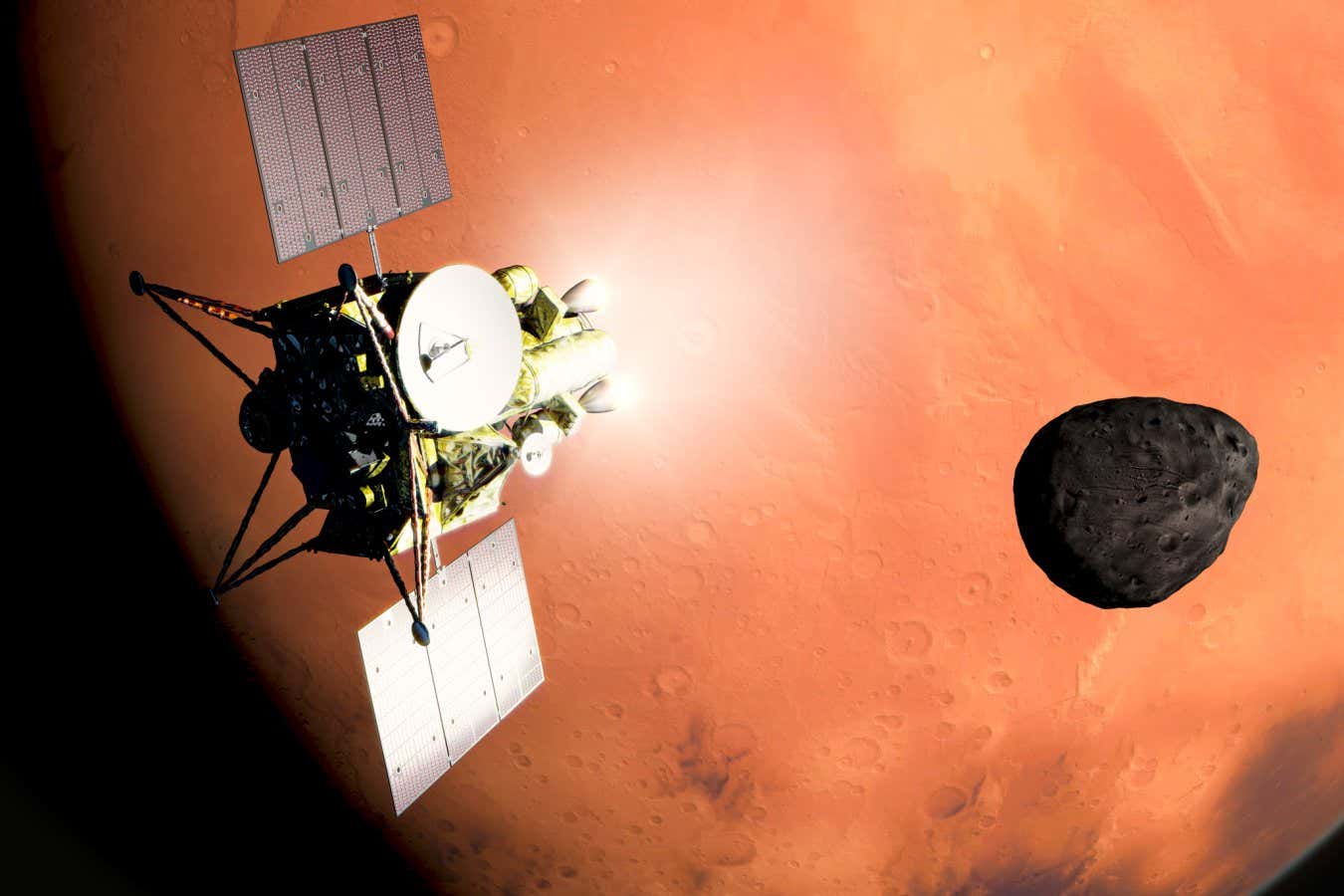
The MMX probe will visit Mars’s moons
JAXA
The mystery of how Mars acquired its moons, Phobos and Deimos, may start to be unravelled in 2026 with the launch of a spacecraft that will eventually bring a chunk of Phobos back to Earth.
“We are sure about the origin of the Earth’s moon, but we don’t know how Phobos and Deimos got there,” says Emelia Branagan-Harris at the Natural History Museum in London. “Understanding the origins of Phobos and Deimos, and how they came to be orbiting Mars, can hopefully tell us a bit about the evolution of Mars in general and its history.”
There are two competing hypotheses for how these moons came to orbit Mars: the Red Planet could have captured them as a pair of asteroids, which were either conjoined and later separated or closely orbited each other, or they could have been produced from an asteroid smashing into Mars itself, like how Earth’s moon formed.
So far, we have limited evidence for either scenario, but the Japan Aerospace Exploration Agency’s Martian Moons eXploration (MMX) spacecraft, which will launch sometime after April 2026, should be able to definitively rule out one scenario or the other, says Branagan-Harris. The spacecraft is equipped with a raft of cameras and spectrometers it can use while orbiting the moons, which it is scheduled to reach in 2027, as well as a rover that it will deploy to the surface of Phobos to collect samples.
If the observations find abundant carbon-rich molecules and water, this could suggest that the asteroid capture theory is correct. But if they are absent, then we might need to wait the samples return to Earth for analysis, which is currently scheduled for 2031.
These samples will consist of rock both from Phobos’s surface and from several centimetres into the ground. Once we can test the material itself, we can see whether it shows signs of melting in the past and infer whether it came from a collision with the Martian surface.
Regardless of Phobos’s origin, it orbits close enough to Mars that it might contain well-preserved samples from the planet at an earlier time in its history. “There’s a potential there that Phobos could have pieces of ancient Mars from back when it had liquid water, so we’d be learning a lot about the history of Mars as well,” says Branagan-Harris.
Topics: